Safe Portable CNC Machine Ideas for Field Work Compliance
Explore safe portable CNC machine ideas for field work. Learn OSHA compliance, grounding rules, and guarding for on-site mobile machining operations.
Deploying CNC equipment outside the controlled factory floor introduces a complex matrix of safety, environmental, and regulatory challenges. When sourcing portable cnc machine ideas for on-site pipeline repairs, shipyard retrofits, or remote mining maintenance, shop-floor safety protocols are no longer sufficient. Field environments lack fixed power grids, climate control, and standardized machine guarding, turning routine machining operations into high-risk activities. This guide evaluates field-ready portable CNC setups through the strict lens of OSHA compliance, ANSI safety standards, and real-world operational hazards.
The Regulatory Reality for Mobile CNC Operations
The foundational rule for any machining operation in the United States is the OSHA 1910.212 Machine Guarding standard, which mandates that one or more methods of machine guarding shall be provided to protect the operator and other employees in the machine area from hazards such as those created by point of operation, ingoing nip points, rotating parts, flying chips, and sparks.
In a fixed facility, this is solved with heavy cast-iron enclosures and interlocked polycarbonate doors. In the field, however, operators frequently strip guards to accommodate irregular workpieces—like a massive valve flange or an in-situ pipeline joint. This practice is a direct OSHA violation. To remain compliant, field safety managers must select portable CNC architectures that integrate guarding directly into the toolpath logic or the mounting mechanism, rather than relying on external enclosures.
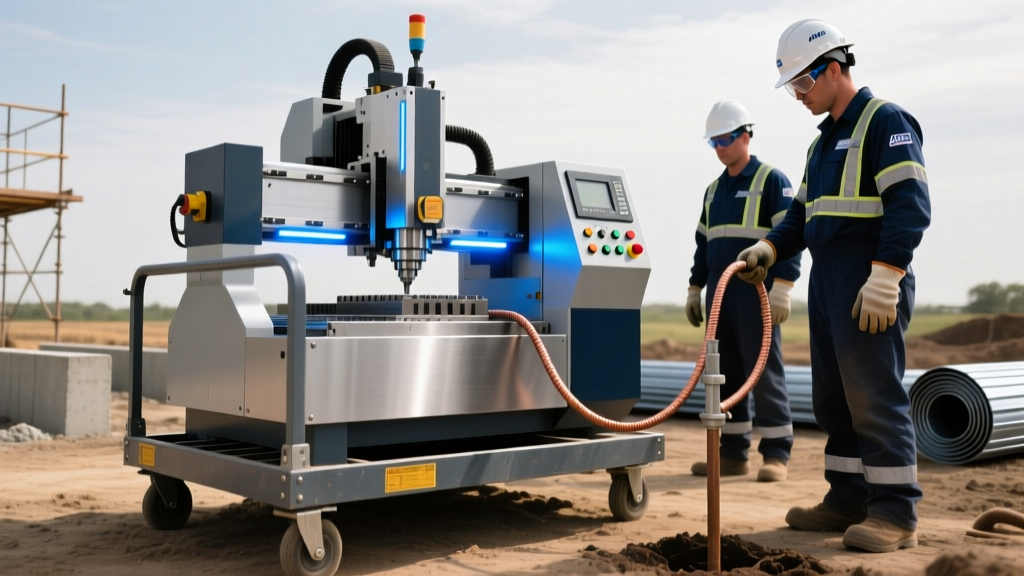
Compliance Warning: The 'Tethered Grounding' Myth. Many field operators assume that simply driving a copper rod into the earth and attaching it to a portable CNC's chassis satisfies OSHA grounding requirements. Under NEC Article 250 and OSHA electrical standards, an equipment grounding conductor (EGC) must be run with the circuit conductors back to the power source (generator or transformer) to ensure a low-impedance fault path. Earth grounding alone will not trip a breaker during a short circuit, leaving the machine chassis lethally energized.Top Portable CNC Machine Ideas Meeting Field Safety Standards
Evaluating portable CNC platforms requires balancing machining rigidity with active safety features. Below are three field-deployable concepts that maintain strict compliance without sacrificing capability.
1. Handheld Active-Braking CNC Routers (e.g., Shaper Origin)
For on-site template routing, aerospace composite trimming, and custom inlays, handheld CNC routers have revolutionized field work. The Shaper Origin (priced around $2,500) utilizes a vision system tracking specialized domain tape. From a safety compliance perspective, its critical feature is the auto-retracting spindle. If the operator's hand slips and the tool exceeds the predefined tolerance zone, the Z-axis retracts the cutting bit into the shroud in under 50 milliseconds. This active safety mechanism aligns with ISO 13849-1 Performance Level (PL) d requirements for automated intervention, drastically reducing the risk of laceration or amputation in unguarded field settings.
2. Magnetic-Base Portable CNC Mills and Flange Facers
When repairing heavy industrial flanges or machining pump casings in-situ, bolt-on or magnetic-base portable CNC mills (such as the Mirage Machines BM3000 series, ranging from $35,000 to $65,000) are the industry standard. Safety compliance here hinges on Emergency Stop (E-Stop) categorization. Field-compliant units must utilize Category 0 or Category 1 E-Stops (per NFPA 79). Category 0 stops remove power immediately via hardware contactors, which is vital in field environments where software crashes caused by generator power sags could leave a spindle spinning uncontrollably. Furthermore, these units must be fitted with 5mm minimum-thickness polycarbonate swarf shields to contain high-velocity metal chips, satisfying the OSHA 1910.212 flying chip mandate.
3. Air-Ride Enclosed Trailer CNC Workstations
For remote mining or military deployment, mounting a compact vertical machining center (like a Haas Mini Mill, approx. $55,000) inside a custom climate-controlled, air-ride trailer (total system cost $95,000+) provides a fully compliant mobile factory. Safety integration includes ANSI/NFPA 2001 compliant clean-agent fire suppression systems (like FM-200 or Novec 1230) wired directly to the machine's spindle load sensors. If a tool breaks and causes a localized fire in the enclosure, the system suppresses it in seconds without damaging the CNC electronics, a critical requirement when the nearest fire department is hours away.
Field Safety Compliance Matrix
The following matrix compares these portable CNC machine ideas across critical safety and operational metrics for field deployment.
| Platform Type | Primary Safety Mechanism | Power Requirement | OSHA Guarding Compliance | Approx. Cost (2026) |
|---|---|---|---|---|
| Handheld CNC Router | Auto-retract spindle (<50ms latency) | 120V / 15A (Standard GFCI) | High (Active intervention replaces physical guard) | $2,500 - $4,000 |
| Magnetic/Base Portable Mill | Cat 0 E-Stop + 5mm Polycarbonate Shields | 240V / 30A (3-Phase Generator) | Medium (Requires strict perimeter zoning) | $35,000 - $65,000 |
| Trailer-Mounted VMC | Full Enclosure + Fire Suppression Interlocks | 480V / 50A (Industrial Towable Gen) | Maximum (Identical to fixed shop-floor) | $95,000 - $140,000 |
Power, Grounding, and the Hidden Compliance Trap
The most frequently cited OSHA violation in field machining involves temporary power distribution. Portable CNC machines draw heavy inductive loads, particularly during spindle acceleration. When powered by portable diesel generators, the neutral-to-ground bonding must be meticulously managed.
Under OSHA electrical standards, if you are using a standard portable generator to power a CNC mill, the generator's neutral must be bonded to the frame, and the equipment grounding conductor must be continuous back to that frame. Furthermore, all 120V receptacles used for auxiliary field equipment (coolant pumps, work lights, laptops) must be protected by Ground Fault Circuit Interrupters (GFCIs) with a maximum 5mA trip threshold for personnel protection. Using a 30mA equipment-protection GFCI on a circuit where an operator is manually adjusting a portable workpiece clamp is a severe compliance failure that risks fatal electrocution in wet field conditions.
Pro-Tip for Site Managers: Invest in a portable power distribution box (spider box) with integrated 5mA GFCI breakers and an Assured Equipment Grounding Conductor Program (AEGCP) testing log. OSHA requires that all temporary field cords and grounding paths be tested and logged every 90 days, or immediately after any event that could cause damage (e.g., a cord being run over by a forklift).Airborne Hazards: Dust and Swarf Containment
Field environments rarely possess the massive HVAC and dust collection infrastructure of a fixed machine shop. When portable CNC machines mill materials like cast iron, composites, or concrete-embedded anchors, they generate airborne particulates that violate OSHA Permissible Exposure Limits (PELs).
For example, milling into silica-containing materials or concrete structures requires strict adherence to CDC NIOSH guidelines on crystalline silica exposure. A portable CNC router cutting composite or masonry must be fitted with a localized HEPA shroud extraction system capturing dust at the point of generation. Relying on standard shop-vacs is non-compliant; the exhaust from a standard vacuum will simply recirculate sub-micron hazardous particulates back into the operator's breathing zone. Specify vacuums with certified HEPA filtration (99.97% efficiency at 0.3 microns) and conduct daily air-monitoring badge tests for field operators.
Step-by-Step Field LOTO (Lockout/Tagout) for Mobile Units
Portable machines introduce a unique Lockout/Tagout challenge: the power source (a generator) is often located 50 feet away from the machine, and multiple contractors may be sharing the same power bus. To comply with OSHA 1910.147 Lockout/Tagout guidelines, field teams must implement the following protocol:
- Local Disconnect: Every portable CNC must have a lockable local main disconnect switch on its own control panel, not just rely on the generator's breaker.
- Stored Energy Dissipation: Portable hydraulic clamping systems (common on flange facers) must feature manual bleed valves to release stored hydraulic pressure before tool changes.
- Multi-Lock Hasps: When sharing a generator, a group lockout box must be utilized. The generator breaker is locked out, and the key is placed in the box. Every machinist then applies their personal padlock to the box's multi-lock hasp.
- Try-Out Verification: Attempt to start the spindle via the CNC control panel to verify zero energy state before entering the cutting envelope.
Summary Checklist for Field Deployment
Before mobilizing any portable CNC equipment to a job site, safety directors must verify the following compliance parameters:
- Machine Guarding: Are polycarbonate shields rated for the specific mass and velocity of the generated swarf?
- E-Stop Logic: Do emergency stops utilize hardware contactors (Cat 0) rather than software-dependent braking?
- Electrical Safety: Is the generator neutral bonded correctly, and are 5mA GFCIs installed on all 120V auxiliary circuits?
- Air Quality: Are localized HEPA extractors deployed for non-ferrous or silica-generating operations?
- LOTO Hardware: Are lockable local disconnects installed on the portable machine chassis?
By treating field environments with the same rigorous engineering controls applied to fixed manufacturing floors, companies can leverage portable CNC technology safely, legally, and highly effectively.