Brother CNC Machine Case Study: Scaling Small Workshop Production
Discover how small workshops use a Brother CNC machine to boost production. Read our case study on footprint, cycle times, and ROI for compact spaces.
Small job shops and prototype facilities face a persistent operational paradox: they require high-volume production speeds to maintain profit margins, yet they lack the physical floor space and electrical infrastructure to house traditional 50-taper vertical machining centers (VMCs). The Brother CNC machine lineup, specifically the Speedio series, bridges this gap by combining the compact footprint of a drill-tap center with the milling rigidity required for light-to-medium production runs.
Case Study Snapshot: Apex Precision ComponentsFacility Profile: 4,500 sq. ft. contract manufacturing job shop
Primary Machine: Brother Speedio S500X2 (3-Axis)
Target Application: 6061-T6 and 7075-T6 aluminum aerospace brackets
Operational Result: 42% reduction in aggregate cycle time, 28% floor space savings, and a 14-month ROI compared to legacy 40-taper VMCs.
The Space-to-Envelope Ratio: Reclaiming Shop Floor Real Estate
In a small workshop environment, every square foot of floor space translates directly to overhead costs and material flow efficiency. A standard 40-taper VMC typically requires a 10x12 foot operational footprint when accounting for the machine casting, operator clearance, chip conveyor, and coolant tank.
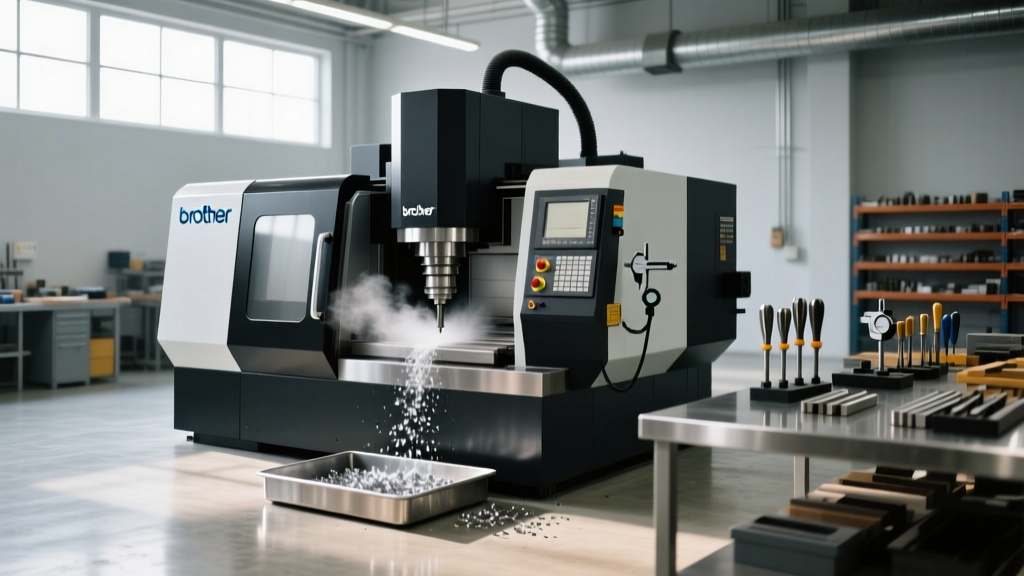
By contrast, the Brother Speedio S500X2 operates within a highly condensed 59-inch by 86-inch envelope. This spatial efficiency allows small workshops to deploy two Speedio units in the exact footprint required by a single traditional VMC. For job shops running high-mix, low-to-medium volume parts, this density enables dedicated machine cells for specific material families—one machine dedicated strictly to aluminum, and another to engineering plastics—eliminating the downtime associated with swapping out coolant concentrations and cleaning out incompatible chips.
Anatomy of Cycle Time Reductions
The primary advantage of a Brother CNC machine in a production environment is non-cutting time reduction. In high-volume aluminum machining, the spindle is often idle for up to 40% of the total cycle time due to tool changes, table positioning, and spindle acceleration. The Speedio architecture attacks these idle periods with aggressive servo tuning and lightweight component design.
| Performance Metric | Standard 40-Taper VMC | Brother Speedio S500X2 | Efficiency Delta |
|---|---|---|---|
| Tool Change (Chip-to-Chip) | 4.5 seconds | 0.7 seconds | -84% |
| Table Index (90 degrees) | 2.8 seconds | 1.0 seconds | -64% |
| Spindle Accel (0-10,000 RPM) | 1.2 seconds | 0.3 seconds | -75% |
| Rapid Traverse Rate (X/Y) | 1,400 IPM | 1,968 IPM | +40% |
Real-World Impact on Aerospace Brackets
Consider a typical aerospace bracket requiring 14 different tools, including multiple spot drills, end mills, and rigid taps. On a legacy VMC, the cumulative non-cutting time for tool changes alone exceeds 60 seconds per part. On the Speedio S500X2, that same tool-changing sequence consumes less than 10 seconds. When multiplied across a production run of 5,000 parts, the Brother CNC machine reclaims over 69 hours of spindle-on time, effectively generating an extra week of production capacity without adding overtime labor.
Multi-Tasking in Tight Spaces: The M140X2 Advantage
For small workshops producing complex, multi-face components like medical implants or hydraulic manifolds, the 3-axis Speedio models eventually require secondary operations on a lathe or a 5-axis trunnion. This is where the Brother Speedio M140X2 alters the workflow. Combining a turning spindle with a 5-axis milling capability, the M140X2 allows a shop to load a raw billet or forging and unload a finished part in a single setup.
Priced typically between $115,000 and $135,000 depending on tooling and automation packages, the M140X2 is a significant capital expenditure. However, it eliminates the need for a separate CNC lathe, saving roughly 80 square feet of floor space and eradicating the setup time and tolerance stacking associated with moving a part from a mill to a lathe. According to efficiency frameworks promoted by the NIST Manufacturing Extension Partnership, reducing part handling and secondary setups is one of the most effective methods for improving first-pass yield in small-batch manufacturing.
Tooling Economics and the BT30 Interface
A frequent hesitation among shop owners transitioning to a Brother CNC machine is the requirement for BT30 toolholders, as many shops are heavily invested in CAT40 or BT40 tooling. However, the economics of BT30 favor the small workshop model:
- Lower Initial Investment: High-quality BT30 toolholders (such as dual-contact variants for high-speed reliability) cost approximately 20% to 30% less than their 40-taper equivalents. Outfitting a 21-tool magazine with balanced BT30 holders and ER collet chucks can save a shop $2,500 to $4,000 compared to 40-taper tooling.
- Reduced Spindle Bearing Wear: The lighter mass of the BT30 toolholder assembly places less radial and axial stress on the spindle bearings during rapid acceleration and deceleration, extending the operational lifespan of the spindle cartridge.
- Clearance Advantages: The smaller nose diameter of the BT30 spindle allows for tighter toolpath clearance when machining deep pockets or complex 3D contours, reducing the need for specialized extended-reach tooling.
Hidden ROI: Power Consumption and Regenerative Braking
Small workshops often operate in older industrial parks with limited 3-phase electrical service. Upgrading electrical panels to support multiple 20-horsepower VMCs can cost upwards of $15,000. The Brother Speedio series utilizes a highly efficient spindle motor and a regenerative braking system. When the spindle decelerates from 10,000 RPM to a stop, the kinetic energy is converted back into electrical energy and fed back into the machine's power supply, rather than being dissipated as heat through braking resistors.
'We mapped our energy usage before and after replacing two older VMCs with Speedios. The regenerative braking and smaller servo motors cut our machining cell power draw by nearly 45%. We didn't have to pay the utility company to upgrade our shop's transformer, which saved us a massive headache.' — Operations Manager, Mid-West Precision Job Shop
Operational Limitations: Where the Brother CNC Machine Struggles
To maintain E-E-A-T integrity, it is critical to address the physical limitations of the Speedio platform. The Brother CNC machine is not a universal replacement for all milling operations. Small workshop owners must avoid deploying these machines for the following applications:
Warning: Material and Process Limitations- Heavy Steel Roughing: The BT30 taper and lightweight machine casting lack the mass and damping required for deep depth-of-cut (DOC) roughing in hardened steels (e.g., 4140 or 4340 at >40 HRC). Attempting heavy roughing will result in severe chatter, poor surface finishes, and premature spindle bearing failure.
- Large Part Envelopes: The S500X2 maxes out at a 500mm X-axis travel. Parts exceeding 18 inches in length require step-over machining or re-fixturing, which introduces tolerance risks.
- High-Torque Threading: While excellent for standard rigid tapping up to 1/2-13 in aluminum, the machine struggles with large-diameter thread milling or tapping in tough stainless alloys (like 316L) where high low-end torque is required.
Actionable Takeaways for Small Shop Integration
If your workshop primarily machines aluminum, brass, engineering plastics, or performs light finishing passes on pre-hardened steels, integrating a Brother CNC machine is a mathematically sound decision. To maximize the return on investment, small shops should pair the Speedio with automated part loading systems, such as a simple pneumatic push-bar feeder or a collaborative robot (cobot). Because the Speedio's door open/close and table indexing times are so aggressively fast, manual loading often becomes the new bottleneck in the cycle. Automating the load/unload process ensures the machine's 0.7-second tool change advantage is fully realized across the entire production shift.