Vibration Damping Alternatives: What CNC Machine Buyers Must Evaluate
A technical comparison of vibration damping and noise reduction alternatives for CNC machine buyers evaluating bases, mounts, and acoustic enclosures.
The Hidden Cost of Resonance: Why Damping Dictates Tool Life
When evaluating heavy manufacturing equipment, CNC machine buyers often prioritize static stiffness, spindle RPM, and rapid traverse rates. However, dynamic stiffness—specifically the machine's damping capacity—frequently dictates real-world productivity, surface finish quality, and tool longevity. A machine with high static stiffness but poor damping will suffer from regenerative chatter during aggressive material removal, particularly when machining aerospace-grade alloys like 7075-T6 aluminum or Inconel 718.
Regenerative chatter occurs when the cutting tool leaves a wavy surface on the workpiece, and the subsequent pass vibrates against those undulations, amplifying the harmonic frequency. This self-excited vibration can shatter carbide end mills in seconds and leave unacceptable chatter marks on precision components. To combat this, modern machine tool builders and retrofit specialists offer a spectrum of vibration damping and noise reduction alternatives. Understanding the trade-offs between these technologies is critical for buyers looking to maximize uptime and comply with strict occupational health standards.
Base Material Alternatives: Cast Iron vs. Polymer Concrete vs. Steel Weldments
The foundation of any CNC machine is its base. The material chosen for the bed and column determines the baseline structural damping, measured by the loss factor (tan delta). A higher loss factor indicates a faster dissipation of vibrational energy.
| Base Material | Loss Factor (tan delta) | Thermal Stability | Cost Premium vs. Cast Iron |
|---|---|---|---|
| Steel Weldments | ~0.0005 | Poor (High expansion) | -10% (Cheaper) |
| Gray Cast Iron | ~0.002 | Moderate | Baseline (0%) |
| Polymer Concrete (Mineralguss) | ~0.015 to 0.020 | Excellent (Low expansion) | +15% to +25% |
The Case for Polymer Concrete
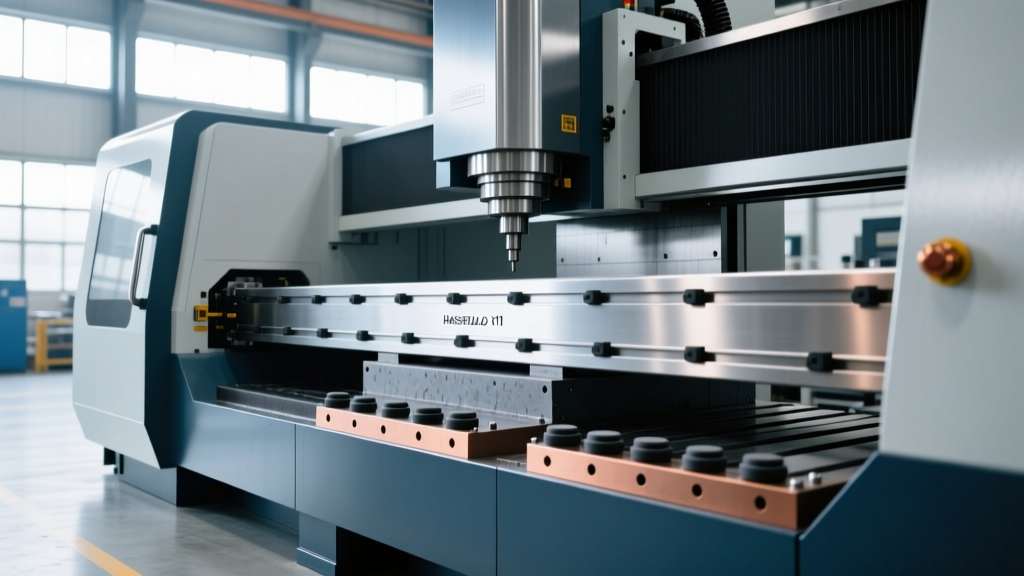
Polymer concrete (often referred to by trade names like Mineralguss or Epocast) is a composite of quartz sand, basalt aggregate, and an epoxy resin binder. It offers a damping capacity up to 10 times greater than traditional gray cast iron. For CNC machine buyers focused on high-speed machining (HSM) or ultra-precision boring, the 15% to 25% cost premium—typically translating to an additional $4,000 to $8,000 on a mid-sized vertical machining center (VMC)—is easily justified by the elimination of chatter and extended tool life.
Conversely, steel weldments are notoriously poor at absorbing vibration. If a buyer must choose a steel-framed machine for cost or weight reasons, they should verify that the manufacturer has filled the hollow welded sections with sand or injected them with expanding epoxy foam to artificially increase the mass and damping properties.
Isolation Mounts: Passive Elastomeric vs. Active Piezoelectric Systems
Even with a highly damped base, external vibrations from nearby stamping presses, forklift traffic, or the machine's own rapid axis accelerations can compromise tolerances. Isolation mounts decouple the machine from the factory floor.
Passive Elastomeric and Pneumatic Mounts
Standard passive isolation relies on elastomeric pads (such as Mason ND series neoprene mounts) or pneumatic air springs. These are highly effective at filtering out high-frequency, low-amplitude floor vibrations. However, passive mounts have a critical limitation: they struggle with low-frequency, high-amplitude shocks. Furthermore, overly soft mounts can introduce 'rocking' during heavy rapid traverses, forcing the CNC controller to work harder to maintain positional accuracy.
⚠️ Warning on Resonance Frequencies: Never install passive isolation mounts without calculating the machine's center of gravity and the mount's natural frequency. If the mount's natural frequency aligns with the spindle's rotational frequency (e.g., a 3,000 RPM spindle operating at 50 Hz), the mounts will amplify rather than isolate the vibration.Active Piezoelectric Damping Systems
For ultra-precision environments like optical mold making or medical device manufacturing, active damping systems utilize piezoelectric actuators (such as the PI P-887 series). These sensors detect incoming vibrational waves in milliseconds and generate an equal and opposite counter-force to cancel the harmonic. While active systems add upwards of $15,000 to the machine's footprint cost and require dedicated control hardware, they allow machines to hold sub-micron tolerances even in high-vibration factory environments.
Acoustic Enclosures: Comparing Retrofit vs. OEM Integrated Solutions
Noise reduction is not merely a comfort issue; it is a strict regulatory requirement. According to OSHA noise standards, prolonged exposure to environments exceeding 85 dBA requires mandatory hearing conservation programs. High-speed spindles and coolant pumps can easily push a VMC's ambient noise output past 95 dBA. The NIOSH occupational noise exposure criteria further recommends engineering controls over personal protective equipment (PPE) as the primary defense.
OEM Integrated Enclosures
Modern OEM enclosures are designed with acoustic modeling in mind. They typically feature double-walled sheet metal with an internal air gap and constrained layer damping (CLD) treatments on the inner panels. A high-quality OEM enclosure will achieve a Sound Transmission Class (STC) rating of 25 to 30, reducing a 95 dBA internal cutting noise to a manageable 65-70 dBA on the shop floor.
Retrofit Acoustic Treatments
For buyers purchasing older machines or budget-friendly models with thin, single-wall sheet metal enclosures (STC 10-15), retrofitting is a highly cost-effective alternative. The most effective retrofit strategy involves a three-layer approach:
- Mass-Loaded Vinyl (MLV): Applying 1 lb/sq ft MLV (approx. $2.50 per sq ft) to the interior panels adds the necessary mass to block airborne sound waves.
- Decoupling Standoffs: MLV must not be glued directly to the vibrating sheet metal. It should be mounted on 1/2-inch foam standoffs to prevent structure-borne noise transfer.
- Acoustic Absorption: A 1-inch to 2-inch layer of polyurethane acoustic foam (wedged or pyramidal) is applied over the MLV to absorb internal reverberations, preventing the enclosure from acting like an echo chamber.
When executed correctly, this retrofit can push a cheap sheet-metal enclosure to an STC 32 rating, rivaling premium OEM solutions for a fraction of the cost.
Decision Framework for CNC Machine Buyers
Selecting the right combination of damping and noise reduction technologies requires aligning the machine's physical properties with your specific manufacturing profile. Use the following framework to guide your purchasing decisions:
Scenario A: Heavy Roughing and High Material Removal Rates (MRR)
Priority: Maximize structural damping to prevent regenerative chatter.
Recommendation: Mandate a polymer concrete base. Avoid steel weldments entirely. Specify heavy-duty elastomeric isolation mounts tuned to a low natural frequency (below 3 Hz) to handle the massive dynamic shifts during roughing passes. OEM enclosures with CLD treatments are sufficient for noise control.
Scenario B: High-Speed Finishing and Micro-Machining
Priority: Eliminate external floor vibrations and spindle harmonics.
Recommendation: A cast iron base is acceptable if paired with active piezoelectric damping mounts. The active system will filter out high-frequency floor noise that ruins mirror-finish surface tolerances. Ensure the spindle housing includes internal Tuned Mass Dampers (TMDs) to suppress high-RPM harmonics.
Scenario C: Budget-Constrained Job Shops
Priority: Regulatory compliance and operator safety on a tight budget.
Recommendation: Purchase a standard cast-iron or sand-filled steel machine. Forego expensive active damping or polymer bases. Instead, allocate $1,500 to $3,000 for a comprehensive MLV and acoustic foam retrofit on the existing sheet metal enclosure to ensure OSHA compliance, and use standard neoprene anti-vibration pads for basic floor isolation.
By looking beyond the basic axis travel and spindle speed specifications, CNC machine buyers can strategically invest in damping and acoustic technologies that yield compounding returns through reduced tooling costs, fewer scrapped parts, and a safer, more compliant manufacturing environment.