CNC Machine 4 Axis: Industrial vs Consumer Specs
Compare industrial and consumer CNC machine 4 axis specifications. Explore rigidity, interpolation, rotary drives, and real-world tolerances.
The addition of a rotary 4th axis transforms a standard 3-axis mill into a complex contouring powerhouse, enabling helical interpolation, continuous cam machining, and multi-face indexing without manual repositioning. However, the mechanical execution of this axis creates a massive performance chasm between industrial workhorses and consumer-grade hobby machines. When evaluating a CNC machine 4 axis configuration, understanding the underlying kinematics, drive mechanisms, and controller interpolation capabilities is critical for predicting real-world machining outcomes.
Kinematic Chain and 4th Axis Drive Mechanics
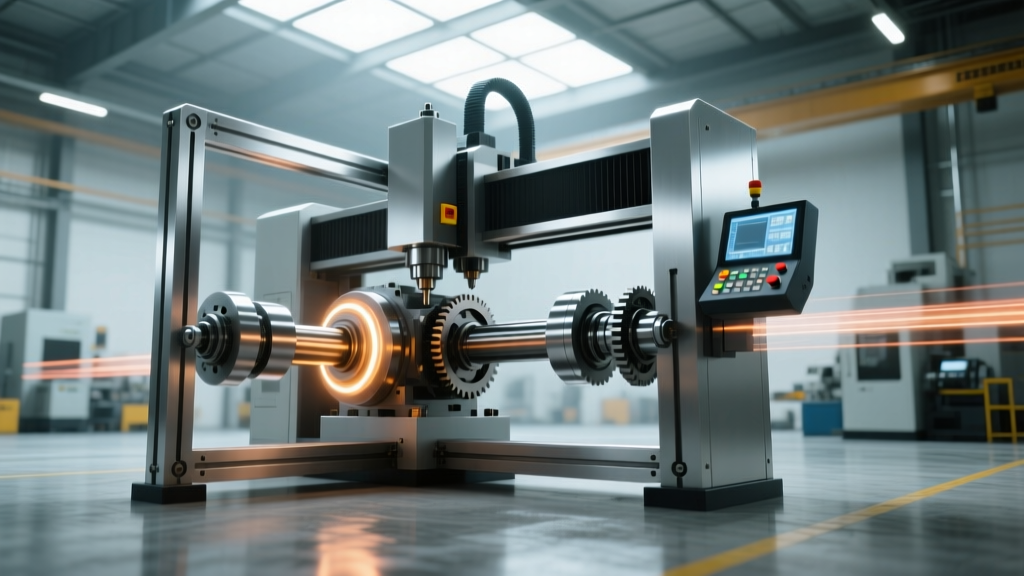
The defining characteristic of a 4-axis CNC setup is the A-axis (rotating around the X-axis) or B-axis (rotating around the Y-axis). The physical drive mechanism dictating this rotation determines the machine's ability to hold tolerance under cutting loads.
Industrial 4th axes, such as the Haas HRT210 rotary table, utilize high-precision worm gear drives or harmonic drive systems. These mechanisms provide immense holding torque (often exceeding 150 ft-lbs) and maintain backlash under 3 arc-minutes. This rigidity is non-negotiable for simultaneous 4-axis swarf machining, where the endmill's flank must maintain continuous, precise contact with a curving part profile.
Consumer and prosumer machines typically rely on NEMA 23 or NEMA 34 stepper motors paired with planetary gearboxes or belt-driven reductions. While adequate for 3+1 indexing (rotating the part, locking it, and performing a 3-axis cut), these drives suffer from 10 to 20 arc-minutes of backlash. Under the lateral cutting forces of aluminum or steel, this backlash manifests as severe chatter, tool deflection, and visible witness lines on the finished part.
Technical Callout: Continuous vs. Indexed 4-Axis
Continuous (Simultaneous): The X, Y, Z, and A axes move concurrently. Requires high-end servo drives and rigid worm gears. Used for impellers, marine propellers, and complex camshafts.
Indexed (3+1): The A-axis rotates to a specific degree, engages a mechanical brake or relies on stepper holding torque, and the machine cuts in 3 axes. Consumer machines are almost exclusively limited to this method.
Technical Specification Matrix: 2026 Market Snapshot
The following matrix contrasts a true industrial vertical machining center (VMC) equipped with a 4th axis against prosumer and consumer-grade alternatives. Pricing reflects current 2026 market averages, including the base mill, 4th axis rotary hardware, and necessary controller licenses.
| Specification | Industrial VMC (e.g., Haas VF-2SS + HRT210) | Prosumer (e.g., Tormach PCNC 440 + 4th Axis) | Consumer (e.g., Shapeoko 4 XXL + Rotary) |
|---|---|---|---|
| Approximate Cost | $85,000 - $98,000 | $16,000 - $19,500 | $2,800 - $3,500 |
| Positioning Accuracy | ±0.005 mm (±0.0002") | ±0.025 mm (±0.001") | ±0.15 mm (±0.006") |
| 4th Axis Backlash | < 3 arc-minutes | ~ 8 arc-minutes | 15 - 25 arc-minutes |
| Spindle Power & Cooling | 20 HP Vector Drive, Liquid Cooled | 1.5 HP, Belt/Poly-V driven, Air Cooled | 1.25 kW VFD or Trim Router, Air Cooled |
| Tool Retention System | CAT40 / BT40 Taper (Mechanical Pull Stud) | TTS (Tormach Tooling System) or ER Collet | ER11 / ER20 Collet Only |
| Simultaneous Interpolation | Full 4-Axis Continuous (Swarf/Helical) | Limited (Requires Mach4/PathPilot tuning) | None (Strictly 3+1 Indexing via GRBL) |
Controller Architecture and Interpolation Limits
Hardware rigidity is only half the equation; the controller's ability to calculate complex kinematic chains in real-time dictates the surface finish of a 4-axis part.
The GRBL Limitation in Consumer Machines
Most consumer CNC machines run on GRBL or similar open-source firmware. These controllers are fundamentally optimized for 3-axis linear interpolation. When a 4th axis is added via a clone board, the firmware treats the rotary axis as a linear axis mapped to degrees. This results in severe non-linear velocity errors during simultaneous moves. If the CAM software outputs a toolpath requiring the A-axis to rotate 90 degrees while the X-axis moves 10mm, the consumer controller will often stall, lose steps, or create massive dwell marks on the part surface because it cannot dynamically adjust the feed rate to account for the rotational circumference.
Industrial NGC and Fanuc Systems
Industrial controllers, such as the Haas NGC or Fanuc 0i-F Plus, utilize dedicated servo drives with absolute encoders on the rotary table. The controller natively understands the centerline offset and the exact diameter of the stock. According to Sandvik Coromant's machining fundamentals, maintaining constant chip thickness during multi-axis milling is critical for tool life. Industrial controllers automatically perform RTCP (Rotary Tool Center Point) calculations, adjusting the X, Y, and Z vectors on the fly to maintain the programmed feed rate at the cutting edge, regardless of the A-axis rotational speed.
"Attempting continuous 4-axis swarf machining on a consumer-grade stepper-driven rotary table will inevitably result in tool breakage. The micro-stutters inherent in stepper motor resonance at low RPMs translate directly into harmonic chatter at the cutting edge, destroying surface finishes on aerospace alloys like Ti-6Al-4V."
Structural Damping and Thermal Stability
A 4-axis CNC machine is only as accurate as its foundational mass. Industrial VMCs are cast from Meehanite or high-grade cast iron (Grade 30/40). Cast iron possesses a high damping coefficient, absorbing the high-frequency vibrations generated when a 4-flute endmill engages hardened steel at 8,000 RPM.
Consumer machines utilize aluminum extrusions (e.g., 80/20 profiles) or welded steel tubing. Aluminum transmits vibrations rather than absorbing them. When the 4th axis rotates a heavy, unbalanced part, the centrifugal force induces harmonic resonance through the aluminum gantry, causing the Z-axis spindle to oscillate by 0.05mm or more—completely ruining tight-tolerance aerospace or automotive components.
Furthermore, thermal growth is a critical factor. Industrial spindles and rotary tables are liquid-cooled, maintaining a thermal equilibrium. Consumer air-cooled spindles and stepper motors radiate heat directly into the aluminum frame, causing the machine's geometry to shift by up to 0.1mm over a 4-hour machining cycle.
Real-World Failure Modes Under Load
When pushing a consumer or prosumer CNC machine 4 axis setup beyond its design limits, specific failure modes emerge that are rarely seen in industrial environments:
- Rotary Table Slippage: In consumer belt-driven 4th axes, the lateral cutting forces of a 1/2" endmill in aluminum will easily overcome the belt tension, causing the A-axis to skip teeth and ruin the part's angular registration.
- Collet Pull-Out: Consumer ER11/ER20 collets lack a mechanical retention knob. During heavy 4-axis contouring where axial and radial loads fluctuate rapidly, the tool can be pulled downward out of the collet, resulting in a catastrophic crash.
- Stepper Motor Stalling (Lost Steps): Without closed-loop encoders, if the 4th axis encounters a hard spot in the material (like a scale inclusion in steel), the stepper motor will silently lose steps. The machine will continue the program, but the part will be machined at the wrong angle.
- Way Cover Binding: On prosumer linear guideways, the introduction of heavy, off-center 4th axis loads can cause the carriage blocks to bind, accelerating wear on the recirculating ball bearings.
Procurement Decision Framework
Choosing between an industrial and consumer CNC machine 4 axis configuration requires aligning your production requirements with mechanical realities.
Opt for Consumer/Prosumer (Under $20,000) if:
- Your 4th axis needs are strictly limited to 3+1 indexing (e.g., machining four sides of a wooden enclosure or engraving the circumference of a soft aluminum cylinder).
- You are prototyping in low-density materials like woods, plastics, or machining wax for casting molds.
- Tolerances can remain above ±0.05mm (±0.002").
Opt for Industrial VMC (Over $75,000) if:
- You require simultaneous 4-axis interpolation for complex geometries like impellers, turbine blades, or helical gears.
- You are machining high-tensile materials (stainless steels, titanium, Inconel) where cutting forces exceed 500 N.
- Your parts demand aerospace or medical-grade tolerances (±0.005mm) and require documented repeatability across 1,000-part production runs.
- You need automated tool changing (ATC) integrated with the 4th axis workflow to run untended overnight shifts.
For shops transitioning from prototyping to low-volume production, prosumer CNC mills offer a viable bridge, provided the operator understands the strict limits of the machine's damping capacity and utilizes conservative feeds and speeds to protect the rotary drive mechanism.