Small Workshop CNC Machine Guitar Setup: Luthier Case Studies
Discover how small workshops use a CNC machine for guitar building. Explore luthier case studies, routing specs, and ideal benchtop models.
The Intersection of Heritage and Automation
The modern luthier operates at the intersection of heritage craftsmanship and digital precision. For small workshops—often tucked into garages, basements, or 400-square-foot commercial units—finding the right CNC machine guitar setup transforms production bottlenecks. Rather than spending four hours hand-routing a neck pocket or chiseling an acoustic rosette, boutique builders are leveraging benchtop and mid-sized CNC routers to achieve sub-thousandth tolerances. This guide examines real-world case studies of small-shop luthiers utilizing CNC automation in 2026, detailing the exact tooling, workholding strategies, and machine models that make small-footprint guitar manufacturing viable.
Case Study 1: The Boutique Electric Shop (Avid CNC Benchtop)
Electric guitar bodies, particularly standard T-style and offset designs, require a cutting envelope of roughly 14 by 21 inches. The Avid CNC Benchtop offers a 24x36-inch cutting area, making it the undisputed workhorse for small-shop electric builders. Priced between $8,500 and $11,000 depending on the spindle package, this machine handles the heavy material removal required for swamp ash, alder, and mahogany bodies without frame deflection.
Profiling and Cavity Routing
In a recent production run of 15 swamp ash electric bodies, a small shop in Portland utilized a 1/2-inch carbide compression bit for the final profile cut. Compression bits are critical in luthiery; the upcut geometry clears chips from deep cavities (like control cavities and neck pockets), while the downcut geometry at the tip prevents tear-out on highly figured top veneers. Running the HSD 1.7kW spindle at 18,000 RPM with a feed rate of 90 inches per minute (IPM) and a depth of cut (DOC) of 0.25 inches per pass, the builder achieved a glass-smooth edge requiring zero hand-sanding before binding.
CAM Software and Toolpath Strategies
Translating a 3D CAD model of a carved top guitar (such as a Les Paul or PRS-style archtop) into machine code requires robust CAM software. Vectric Aspire and Autodesk Fusion 360 are the industry standards. For carved tops, builders employ a 3D roughing toolpath using a 1/4-inch ballnose bit to remove the bulk of the material, leaving 0.020 inches of stock. This is followed by a 3D raster finishing pass with a 1/8-inch tapered ballnose bit at a stepover of 6%. The result is a carved maple top that requires less than 15 minutes of hand-scraping to achieve a finish-ready surface. Headstock logos are executed using V-carve toolpaths with a 60-degree V-bit, achieving crisp corners that mimic traditional hand-chiseling.
Case Study 2: Acoustic Inlay and Rosette Precision (ShopBot Desktop MAX)
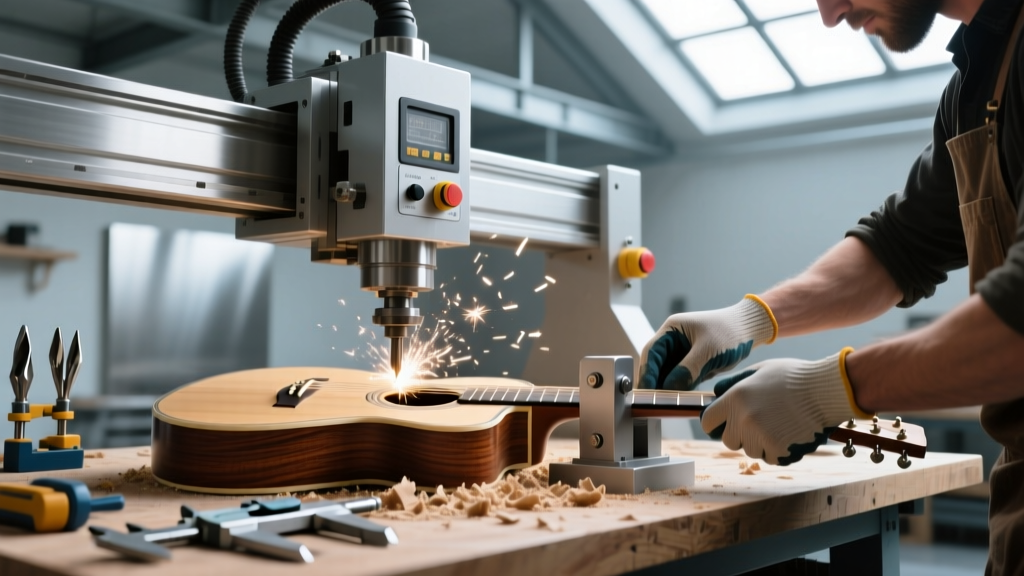
Acoustic guitar manufacturing demands a different tier of precision. While body profiling is similar, the installation of soundhole rosettes, purfling, and bridge pin holes requires micro-tooling. The ShopBot Desktop MAX, with its rigid aluminum extrusions and high-resolution stepper motors, excels in this arena.
Luthier Insight: The Micro-Tooling ChallengeRouting a 0.040-inch purfling channel around a dreadnought soundboard requires a specialized carbide end mill. Standard router bits deflect at this scale. Builders source specialized micro-end mills from suppliers like Stewart-MacDonald or specialized industrial carbide vendors. Running a 0.031-inch bit at 24,000 RPM requires a slow feed rate (15-20 IPM) and a strict 0.020-inch DOC to prevent bit shear and protect the delicate soundboard.
Workholding Strategies: Why Vacuum Pods Fail in Luthiery
A common mistake for newcomers bringing CNC automation into guitar building is attempting to use vacuum chucks. Raw, unsealed tonewoods like Sitka spruce and cedar are highly porous. Unless the entire perimeter is perfectly sealed with gasket tape, vacuum pressure bleeds out, resulting in catastrophic part ejection mid-cut. Small workshops rely on two primary mechanical workholding methods:
- The Sacrificial MDF Tab Method: For full body profiling, the tonewood blank is screwed directly into a 3/4-inch MDF sacrificial board. The CAM software generates 0.25-inch holding tabs. After routing, the builder uses a flush-trim saw and a chisel to remove the tabs, followed by light hand-sanding.
- The Tape and CA Glue Trick: For smaller, delicate components like fretboards, bridges, and headstock veneers, luthiers apply wide blue painter's tape to both the sacrificial board and the workpiece. A thin layer of cyanoacrylate (CA) glue is applied to the tape, and an activator spray bonds the two taped surfaces instantly. This provides immense holding power for high-RPM micro-routing without damaging the wood surface or requiring mechanical tabs.
Tooling and Feeds/Speeds Matrix for Tonewoods
Dialing in feeds and speeds is highly dependent on wood density and moisture content. The following matrix serves as a baseline for small-shop CNC guitar operations using standard 1/4-inch and 1/2-inch shank carbide tooling.
| Operation | Wood Species | Bit Type & Size | Spindle RPM | Feed Rate (IPM) | Depth of Cut (DOC) |
|---|---|---|---|---|---|
| Body Profiling | Alder / Swamp Ash | 1/2" Compression | 18,000 | 90 - 110 | 0.250" |
| Neck Pocket Routing | Mahogany | 3/8" Upcut Spiral | 16,000 | 70 - 85 | 0.125" |
| Control Cavities | Basswood | 1/4" Upcut Spiral | 18,000 | 100 - 120 | 0.250" |
| Fretboard Slotting | Ebony / Richlite | 0.090" Downcut | 22,000 | 30 - 40 | 0.100" |
| Acoustic Rosette | Sitka Spruce | 0.031" Carbide | 24,000 | 15 - 20 | 0.020" |
The 4th Axis Dilemma: Do You Need Rotary for Necks?
When researching a CNC machine guitar package, many builders assume a 4th-axis rotary attachment is mandatory for neck carving. In reality, most high-end boutique shops avoid 4th-axis neck carving entirely. The geometry of a guitar neck—specifically the volute behind the nut and the heel transition—requires tool reach that exceeds the capabilities of standard benchtop 4th-axis setups, leading to severe tool deflection and chatter marks.
Instead, the industry standard is 3D surfacing via dual-sided flipping. The builder machines the top profile (fretboard surface and headstock angle) using a precision fixture board. The blank is then flipped, and the back contour is machined using 3D roughing and finishing toolpaths. Alignment is guaranteed by machining two 1/4-inch dowel holes into the fixture and the waste ends of the neck blank. This method, documented extensively by the Guild of American Luthiers, yields a smoother surface finish and allows the use of shorter, more rigid end mills.
Small Shop Infrastructure: Dust and Noise Mitigation
Routing dense tonewoods like Indian Rosewood or Maple generates fine, hazardous particulate and high-decibel noise. A small workshop cannot rely on open-air routing.
Dust Collection
A standard shop vac is insufficient for the volume of chips generated during body profiling. Small shops must invest in a 1.5 HP to 2 HP cyclone dust collector with a minimum 600 CFM rating. The cyclone separator is crucial; it drops 95% of the heavy wood chips into a drum before they reach the filter, preserving suction and extending filter life in a cramped environment.
Acoustic Enclosures and Spindle Selection
An air-cooled spindle cutting maple at 18,000 RPM routinely exceeds 90 dB, compounded by the internal cooling fan noise. Builders operating in shared commercial spaces or residential garages increasingly opt for water-cooled spindles (like the HSD ES951 series) which eliminate fan noise entirely. Combined with partial MDF enclosures lined with 2-inch acoustic foam, this reduces high-frequency router whine by up to 15 dB, keeping operations compliant with local noise ordinances while maintaining optimal spindle temperatures during long 3D surfacing toolpaths.
ROI and Production Metrics
Integrating a CNC router into a small luthier shop is a capital-intensive decision, but the time-yield is undeniable. Hand-routing a single electric guitar body, including template creation, pickup cavities, and neck pockets, takes an experienced builder 6 to 8 hours. A CNC machine executes the same operations in 45 minutes of spindle time, plus 15 minutes of setup and tab removal. For a shop producing 10 instruments a month, the CNC reclaims over 50 hours of labor—time redirected toward high-value tasks like fretwork, finishing, and setup. When sourcing equipment, prioritize rigidity, spindle quality, and CAM software compatibility over raw cutting speed; in luthiery, a flawless surface finish is the ultimate metric of success.