CNC Gun Drilling Machine Electrical Setup & Power Trends
Master the electrical setup for your CNC gun drilling machine. Explore 2026 power trends, VFD harmonic mitigation, and high-pressure coolant wiring.
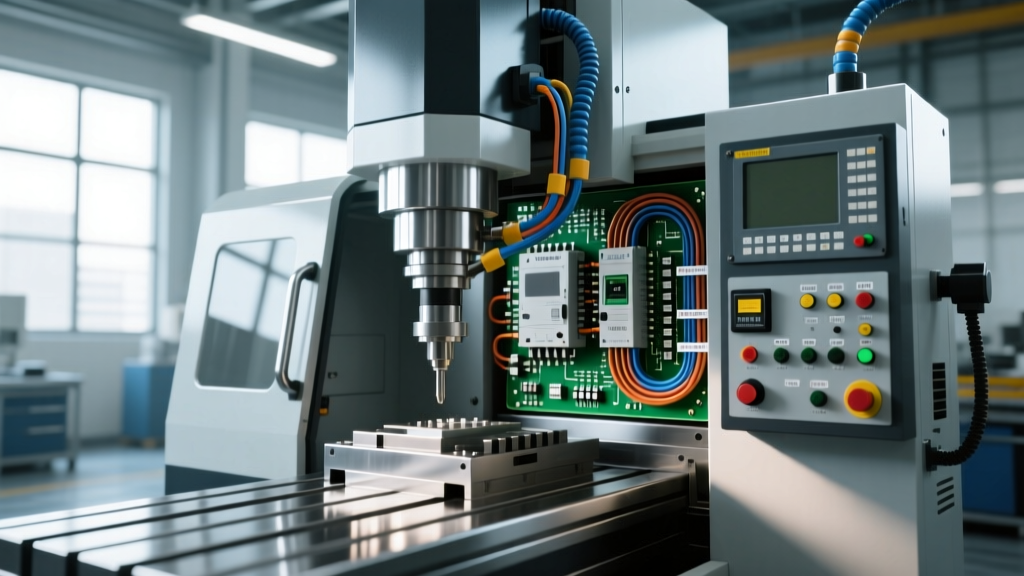
The electrical architecture of a CNC gun drilling machine differs fundamentally from standard 3-axis machining centers. While a standard vertical machining center (VMC) balances power between a 15-30 kW spindle and low-pressure coolant, a deep hole drilling system is dominated by high-pressure coolant pump arrays and asymmetric torque requirements. Setting up the electrical service for these specialized machines in 2026 requires navigating strict harmonic distortion limits, high-inertia motor starting currents, and advanced IoT power monitoring protocols.
Typical 5-Axis BTA/Gun Drilling Cell Power Profile (2026 Baseline):• Voltage: 480V 3-Phase 60Hz (US) / 400V 50Hz (EU)
• Main Service Disconnect: 250A - 400A
• Spindle Motor: 22 kW - 37 kW (High-torque, low-RPM vector drive)
• Coolant Pump Array: 90 kW - 130 kW (Variable Frequency Driven)
• Control/IO Isolation: 5 kVA UPS-backed
The Asymmetric Load Profile of Deep Hole Drilling
Deep hole machining—encompassing both gundrilling (1-40mm diameters) and BTA/STS systems (20-300mm+ diameters)—demands a unique power distribution strategy. The spindle motor must deliver peak torque at relatively low rotational speeds to maintain the precise surface finish and chip evacuation required in tough materials like Inconel 718 or 4140 pre-hardened steel. According to Sandvik Coromant's deep hole machining guidelines, maintaining the correct cutting speed and feed rate is critical to prevent drill tube deviation and premature insert wear. This translates to a spindle drive that operates continuously in a high-current, low-frequency state, generating significant thermal load on the spindle VFD (Variable Frequency Drive).
Conversely, the coolant system is the true power hog. To achieve the 100 to 250 bar (1,450 to 3,600 psi) pressure required to force cutting oil through the drill tube and evacuate chips from deep bores, facilities deploy multi-stage centrifugal pump arrays. A standard 150 bar system for a mid-sized BTA machine requires a 90 kW (120 HP) motor. Starting this motor across-the-line (DOL) would cause severe voltage sag, tripping facility PLCs and corrupting CNC memory. Modern setups mandate soft-starters or, increasingly, VFDs to ramp the pump pressure linearly with drill depth, requiring precise electrical sizing.
2026 Innovations: Active Front Ends and Harmonic Mitigation
The widespread adoption of VFDs on both the spindle and the massive coolant pumps introduces a critical power quality issue: Total Harmonic Distortion (THD). Standard 6-pulse rectifiers in VFDs draw non-sinusoidal current, injecting 5th, 7th, 11th, and 13th harmonics back into the facility grid. As detailed in Fluke's power quality analysis resources, excessive harmonics cause transformer overheating, neutral conductor overloading, and nuisance tripping of sensitive CNC encoder circuits.
In 2026, the industry standard for high-end CNC gun drilling machines (such as those from TBT Tiefbohrtechnik or IMSA) has shifted from passive harmonic filters to Active Front End (AFE) drives. An AFE uses an IGBT-based rectifier bridge that draws near-unity power factor current, reducing THDi (current harmonic distortion) to below 4%, well within the IEEE 519-2022 limits for industrial facilities. This eliminates the need for oversized, heavily derated isolation transformers.
| Power Architecture Feature | Legacy Passive Filter Setup | 2026 Active Front End (AFE) Setup |
|---|---|---|
| THDi at Full Load | 8% - 12% | < 4% |
| Power Factor (PF) | 0.92 - 0.95 (Lagging) | 0.99 (Adjustable Unity) |
| Transformer Derating Required | 15% - 20% (K-factor rating) | None (Standard sizing) |
| Regenerative Braking Capability | No (Requires dynamic braking resistors) | Yes (Feeds power back to grid) |
| Footprint in Electrical Cabinet | Large (Passive reactors + resistors) | Compact (Integrated IGBT modules) |
High-Pressure Coolant Pump Electrical Demands & Edge Cases
Wiring the high-pressure coolant system involves more than just sizing the conductors for the full load amperage (FLA). The cutting fluid used in gun drilling is typically a highly refined, low-viscosity straight oil or a specialized dielectric fluid. When pumped at 200 bar through narrow drill tube clearances, the fluid friction generates massive static electrical charges.
⚠ WARNING: Static Arcing in Coolant LinesIf the high-pressure coolant hoses and pump manifolds are not bonded to the machine's isolated ground ring, static buildup can arc across the machine enclosure or CNC control panel, destroying 24V DC I/O modules. Always specify conductive PTFE hoses and install a dedicated 4 AWG copper ground strap directly from the pump manifold to the main ground busbar. Never rely on the machine's structural steel for high-frequency static dissipation.
Step-by-Step Facility Power Drop & Grounding Protocol
Proper installation of a CNC gun drilling machine requires strict adherence to NFPA 79 (Electrical Standard for Industrial Machinery) and IEC 60204-1. Follow this protocol to ensure clean power and operational safety:
- Service Drop and Main Disconnect: Size the main feeder conductors using XHHW-2 wire in rigid metal conduit. Because the high-pressure coolant pump operates continuously (often exceeding 3 hours per cycle), NEC Article 430 requires sizing the conductors and overcurrent protection at 125% of the motor's FLA. For a 90 kW pump (approx. 115A at 480V), size conductors for 144A minimum.
- Isolation Transformer Configuration: If your facility lacks a dedicated clean power bus, install a Delta-Wye isolation transformer upstream of the machine. The Wye secondary provides a stable, low-impedance ground reference that prevents common-mode noise from the plant's heavy welding or stamping equipment from corrupting the CNC's linear scale feedback signals.
- Shielded VFD Cable Routing: The cables connecting the coolant pump VFD to the motor must be symmetrical, shielded power cables (e.g., 3 symmetric ground wires plus a continuous copper braid shield). This prevents common-mode voltage from capacitively coupling into the motor bearings, which causes electrical discharge machining (EDM) fluting and premature bearing failure—a critical risk for high-speed pump motors.
- Equipotential Grounding Ring: Install a copper grounding ring around the machine perimeter. Bond the CNC enclosure, the coolant tank, the chip conveyor, and the high-pressure manifold to this ring using minimum 6 AWG green/yellow conductors. Connect the ring to the facility grounding electrode system at a single point to prevent ground loops.
Managing Voltage Sag During Spindle Reversal
During the BTA drilling cycle, the spindle must rapidly decelerate and reverse to retract the drill tube. Without an AFE drive or a properly sized dynamic braking resistor bank, this rapid deceleration dumps kinetic energy back into the DC bus of the VFD. This causes a DC bus overvoltage fault, halting the machine mid-cycle and potentially leaving the drill tube stuck in the workpiece. Ensure the VFD's braking chopper is rated for 100% continuous duty during the retraction phase.
IoT Power Monitoring for Predictive Maintenance
The latest innovation in CNC gun drilling machine electrical setups is the integration of smart power meters directly into the coolant pump and spindle VFDs. By monitoring the high-frequency current signature of the 90 kW pump motor, the CNC control can detect micro-changes in amperage. An unexplained 3-5% increase in pump motor current at a constant RPM often indicates filter clogging, cutting oil viscosity breakdown, or early-stage chip packing inside the drill tube.
Modern 2026 machine controls utilize edge-computing gateways (such as Siemens MindSphere or MT-Connect protocols) to log these power signatures. This allows facility managers to transition from reactive tool-changing to predictive maintenance, replacing coolant filters and drill tube support pads exactly when electrical data indicates degradation, thereby eliminating catastrophic tool breakage and saving thousands of dollars in scrapped aerospace or oil-and-gas components.