Budgeting CNC Tolerances: Software Document Machine CNC Impacts
Analyze the true cost of CNC accuracy specs. Learn how tolerance tiers, ISO 230 standards, and software document machine CNC workflows impact your budget.
The Exponential Cost Curve of Positional Accuracy
Procuring a CNC machine based solely on its work envelope and spindle speed is a primary driver of budget overruns in precision manufacturing. The true financial friction lies in positional accuracy and geometric tolerance specifications. Moving from a standard commercial tolerance band of ±0.001" (0.025mm) to a high-precision band of ±0.0002" (0.005mm) does not yield a linear price increase; it triggers an exponential CapEx multiplier. For example, a standard Haas VF-2SS vertical machining center retails for approximately $85,000. To achieve sustained ±0.0002" tolerances across a similar work envelope, a shop must step up to a DMG MORI HSC 75 linear with direct-drive linear scales and thermal shielding, pushing the capital requirement past $220,000.
When engineering teams attempt to hold ±0.00005" (0.0012mm) for aerospace or optical tooling, the equipment shifts from standard machining centers to hydrostatic guideway jig borers or ultra-precision mills like the Kern Pyramid Nano, which commands a price tag exceeding $450,000. Understanding this cost curve is mandatory before finalizing a machine budget.
Budget Alert: The Rule of HalvesEvery time you halve your required positional tolerance band, expect the base machine cost to increase by a factor of 2.5x to 4x. This multiplier accounts for the transition from ballscrews to linear motors, standard castings to polymer concrete bases, and the integration of high-resolution glass scales.
Decoding ISO 230-2 for Procurement Teams
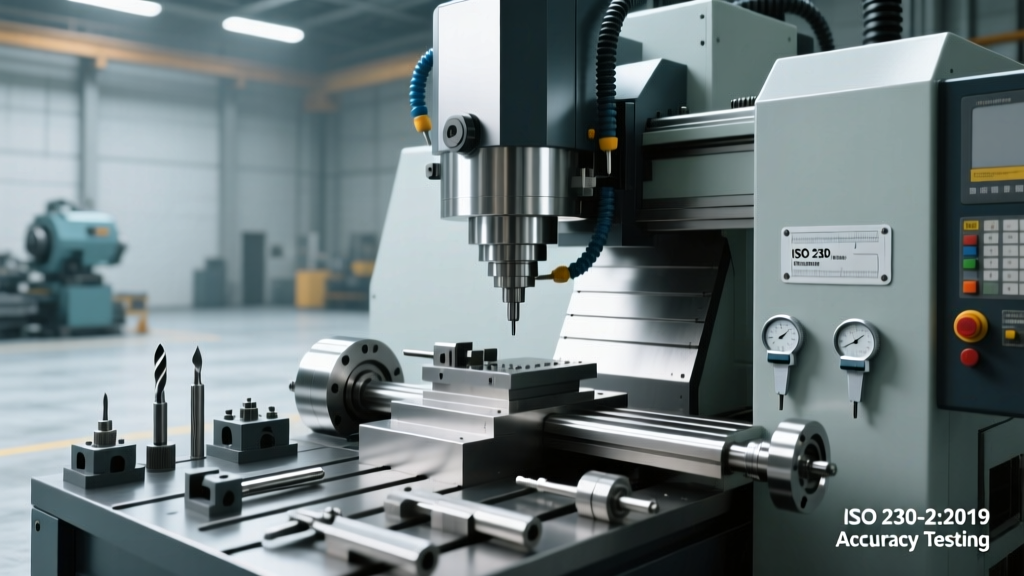
Machine tool builders market accuracy using varying metrics, making apples-to-apples budget comparisons difficult. The global benchmark for evaluating CNC accuracy is ISO 230-2:2014, which defines the determination of accuracy and repeatability of axis positioning on numerically controlled machine tools. Procurement teams must look past marketing brochures and demand the ISO 230-2 test certificates to verify three specific financial drivers:
| ISO 230-2 Parameter | Definition | Budget Impact |
|---|---|---|
| Accuracy (A) | The maximum range of positional deviation including systematic and random errors. | Dictates the need for laser calibration and linear scales (+$15,000 to $30,000). |
| Repeatability (R) | The ability of the machine to return to the exact same position under identical conditions. | Driven by axis drive mechanics (ballscrew vs. linear motor) and bearing preload. |
| Systematic Deviation (E) | Predictable errors like pitch error and backlash that can be compensated via CNC parameters. | Low cost to fix if the controller supports bi-directional pitch error compensation mapping. |
If a vendor quotes a machine based on "JIS B 6336" or proprietary in-house metrics rather than ISO 230-2 or ASME B5.54, apply a 20% contingency to your budget. Non-standardized testing often masks thermal drift and bidirectional reversal errors that will manifest as scrap during continuous production runs.
Metrology and the Software Document Machine CNC Overhead
Achieving tight tolerances on the shop floor requires more than a rigid casting; it demands rigorous, continuous verification. This is where the integration of a comprehensive software document machine CNC infrastructure becomes a critical line item in your budget. When shops deploy a dedicated software document machine CNC workflow, they transition from reactive scrap reduction to proactive thermal and volumetric compensation.
Documenting machine performance over time requires specialized metrology software that interfaces directly with the CNC controller and external laser interferometers or ballbar systems. Budgeting for this ecosystem involves several hidden costs:
- In-Machine Probing Hardware: A standard Renishaw OMP600 spindle probe system costs between $14,000 and $18,000, including the optical transmission interface and macro programming licenses.
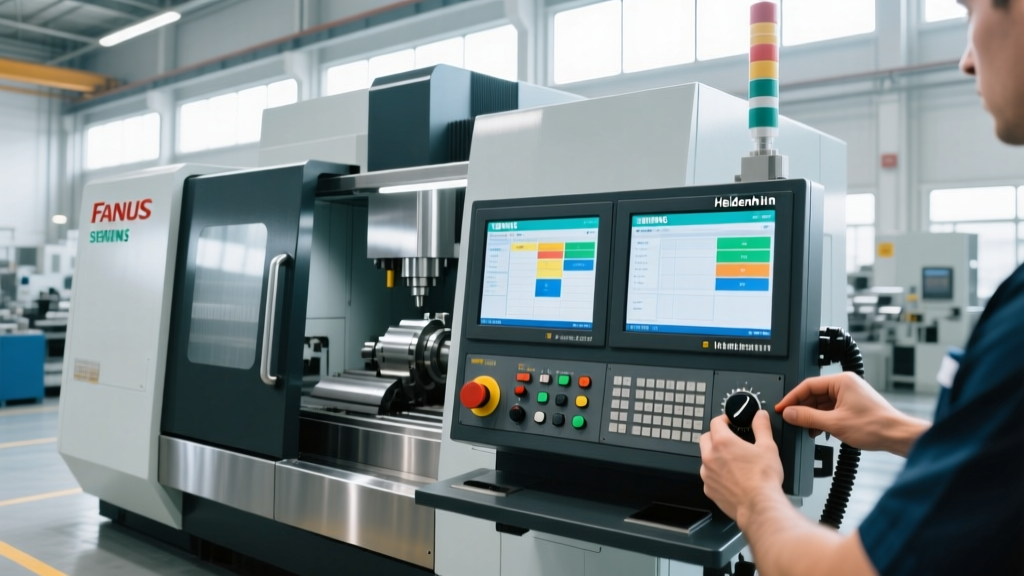
- Volumetric Compensation Software: Advanced controllers (like the Heidenhain TNC7 or Siemens Sinumerik One) offer optional kinematic compensation licenses. Budget an additional $4,500 to $8,000 per machine for these software modules.
- Data Logging and SPC Integration: Connecting your machine's probing cycles to a centralized Statistical Process Control (SPC) database requires middleware and API licensing, typically costing $10,000+ annually for a multi-machine cell.
"Shops often budget $250,000 for a 5-axis mill and zero dollars for the software required to document and verify its volumetric accuracy. Without a software document machine CNC protocol, a $250,000 machine performs like a $70,000 machine after six months of thermal cycling and guideway wear." — Advanced Manufacturing Metrology Guidelines, NIST Advanced Manufacturing.
Hidden Costs: Thermal Management and Fixturing
Tolerance specifications are measured in climate-controlled metrology labs at 20°C (68°F). The shop floor environment introduces variables that can instantly void a machine's accuracy guarantee. To maintain a ±0.0003" tolerance on aluminum or steel, you must budget for environmental control hardware that machine builders classify as "optional accessories."
Thermal Stabilization Hardware
Ballscrews generate friction heat, causing axial expansion. A standard VMC without cooling will experience Z-axis growth of up to 0.004" during a heavy roughing cycle. To counteract this, you must specify a spindle and ballscrew chiller unit. A high-capacity dual-circuit chiller (such as those from Hyfra or Single) adds $12,000 to $18,000 to the initial purchase price and requires dedicated 3-phase electrical drops and plumbing.
Precision Workholding
Accuracy is lost if the part moves during cutting. Standard manual Kurt vises introduce deflection and inconsistent clamping forces. Budgeting for high-precision machining requires upgrading to hydraulic or pneumatic self-centering vises (e.g., Schunk Tandem plus series at $4,500 each) and zero-point clamping systems (like System 3R or Erowa), which can add $25,000 to a palletized cell setup.
A 4-Step Framework for Right-Sizing Your Tolerance Budget
To prevent over-capitalizing on accuracy you do not need, or under-capitalizing on specs that will generate scrap, follow this procurement framework:
Step 1: Map the Functional Tolerance vs. Print Tolerance
Engineering drawings often apply blanket tolerances of ±0.0005" to all dimensions. Audit the CAD model to identify which features actually require this precision for assembly fitment. Isolate the critical datums. If only 10% of the part requires ultra-precision, budget for a standard machine for roughing and a specialized jig borer or CNC grinder for the final critical passes, rather than buying an ultra-precision mill for the entire operation.
Step 2: Audit the Environmental Variables
Measure the ambient temperature swing in your facility. If the shop floor fluctuates by more than ±5°C between morning and afternoon, the thermal expansion coefficient of steel (approx. 11.5 µm/m·°C) will cause a 20-inch part to grow or shrink by 0.0004". If you cannot afford facility-wide HVAC stabilization, you must allocate budget for machine-integrated thermal compensation sensors and localized enclosures.
Step 3: Factor in the Documentation Ecosystem
Allocate 8% to 12% of the machine's base CapEx specifically for metrology and documentation tools. This covers the spindle probing systems, tool setting lasers, and the software document machine CNC licenses required to log accuracy degradation over the asset's lifecycle.
Step 4: Calculate the Scrap vs. CapEx Breakeven
Run a financial model comparing the cost of upgrading to a higher-tier accuracy machine against the cost of anticipated scrap and manual CMM inspection bottlenecks. If a standard machine yields a 4% scrap rate on a $500 aerospace structural component, the annualized scrap cost is $20,000 per 1,000 parts. If the linear-scale upgrade on the CNC costs $18,000 and reduces scrap to 0.5%, the CapEx pays for itself in under 11 months.