Choosing the Right Guitar CNC Machine for Small Workshops
Discover how boutique luthiers integrate guitar CNC machines into small workshops. Explore case studies, workholding tactics, and ROI for custom builds.
The Intersection of Traditional Luthiery and Desktop Automation
The integration of a guitar CNC machine into a small boutique workshop is no longer a luxury reserved for large-scale factories; it is a critical survival tool for independent luthiers. In 2026, the cost of high-precision desktop and benchtop routers has stabilized, allowing custom builders to achieve sub-thousandth-inch tolerances on neck pockets, inlay cavities, and 3D body contours without sacrificing the handcrafted ethos of their brand. However, the spatial, acoustic, and dust-management constraints of a typical 400 to 800-square-foot garage or basement shop dictate strict machine selection criteria.
Luthier Insight: The primary value of CNC in a small shop is not necessarily batch production, but repeatability and risk reduction. Routing a $400 piece of master-grade flamed maple for a neck joint leaves zero margin for router-base tilt errors. A CNC eliminates this variable entirely.Case Study 1: Acoustic Rosettes and Bridge Routing in a 400 Sq. Ft. Shop
For acoustic builders, the primary CNC applications involve intricate 2.5D and 3D carving: rosette inlay pockets, bridge pin routing, and scalloped X-bracing profiles. These tasks require high spindle RPMs for fine detail work rather than massive material removal rates.
Machine Profile: ShopBot Desktop MAX
With a 24" x 36" cutting envelope, the ShopBot Desktop MAX (priced around $10,500 in 2026) fits perfectly in constrained environments while accommodating standard dreadnought and OM-sized acoustic top plates.
- Spindle Requirements: A 1.5 HP HSD spindle running up to 24,000 RPM is essential for cleanly cutting delicate abalone and holly purfling without tear-out.
- Toolpath Strategy: Luthiers use a 60-degree V-bit (0.005" tip) for rosette pockets, followed by a 1/16" downcut spiral for clearing the cavity floor to exactly 0.045" depth.
- Acoustic Bracing: Instead of hand-scalloping spruce braces, builders use a 1/8" tapered ball nose end mill to execute 3D finishing toolpaths in VCarve Pro, reducing brace-carving time from 45 minutes to 8 minutes per top.
Case Study 2: Solid-Body Electric Production and 3D Contouring
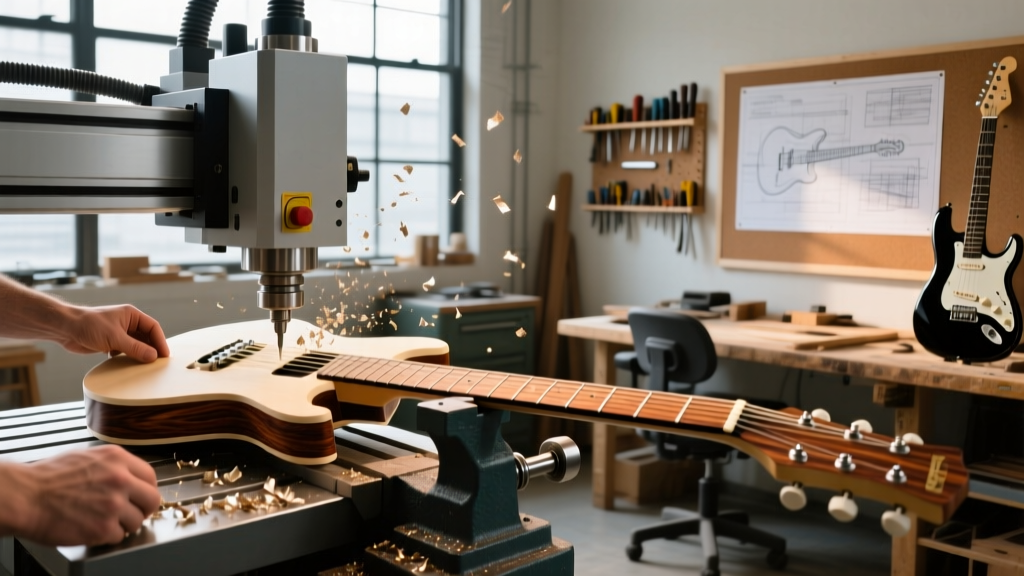
Electric guitar builders face different challenges: deep cavity routing for humbuckers, precise neck pocket dimensions, and complex 3D ergonomic contours (arm and tummy cuts). This requires a machine with a longer Y-axis travel and superior Z-axis rigidity to handle the lateral forces of deep pocketing in dense hardwoods like swamp ash or mahogany.
Machine Profile: Axiom Precision AR8 Pro
The Axiom AR8 Pro offers a 24" x 48" work area and a heavy-duty steel frame, pricing out at approximately $12,500. Its 2.2 kW water-cooled spindle provides the torque needed for deep roughing passes.
Critical Tolerance Warning: A standard Fender-style bolt-on neck pocket must measure exactly 3.000" wide, 2.1875" long, and 0.625" deep. A deviation of just 0.010" in the width will result in either a loose neck (causing tuning instability) or a split body horn. Always calibrate the CNC's X and Y micro-stepping drivers before cutting master templates.The "Flip" Jig Strategy for 3D Bodies
Because small-shop CNCs rarely have 4th-axis rotary tables large enough for guitar bodies, luthiers rely on "flip milling." The body is secured to an MDF sacrificial board via double-sided template tape and wooden toggle cauls. The top contours (pickups, neck pocket, control cavities) are routed first. The body is then flipped 180 degrees on the Y-axis, registered against precision aluminum dowel pins embedded in the spoilboard, and the back contours and rear control cavities are machined. This requires absolute homing repeatability from the machine's limit switches.
Overcoming Small-Shop Constraints: Toxic Dust and Noise
Luthiers frequently work with exotic, highly sensitizing tonewoods such as Cocobolo, East Indian Rosewood, and Ebony. The fine particulate generated by a CNC router spinning at 18,000 RPM poses severe respiratory and dermatological risks. According to OSHA's guidelines on wood dust, prolonged exposure to these specific hardwood dusts can lead to chronic asthma, nasal cancers, and severe allergic contact dermatitis.
Engineering a Compact Extraction System
Standard 110V shop vacuums are entirely inadequate for CNC dust collection; they lack the CFM (Cubic Feet per Minute) required to capture fine particulate at the source. Small workshops must invest in a wall-mounted cyclone collector with a HEPA canister filter.
- Source Capture: Route a 4" flex hose directly to a custom 3D-printed or machined acrylic dust shoe that surrounds the spindle collet, maintaining a 0.125" gap from the workpiece.
- Airflow Metrics: Ensure the dust collector delivers a minimum of 600 CFM at the tool head. The ShopBot educational resources frequently emphasize that static pressure loss in flexible hose runs can reduce effective CFM by up to 30% in poorly designed small-shop layouts.
- Ambient Filtration: Supplement the primary collector with a ceiling-hung ambient air filter (e.g., Jet AFS-1000B) to capture the sub-micron particles that escape the dust shoe.
Workholding Strategies for Odd Geometries
Guitar blanks are rarely perfectly rectangular, and clamping them without obstructing the router's Z-axis clearance is a persistent challenge. Small shops have largely abandoned mechanical toe-clamps for body routing in favor of advanced adhesive and vacuum methods.
| Workholding Method | Best Application | Pros & Cons |
|---|---|---|
| Carbide 3D / Luthier Double-Sided Tape | Flat-top routing, inlay pockets, headstock veneering | Pros: Zero Z-clearance issues. Cheap. Cons: Fails on oily woods (Rosewood) unless wiped with naphtha first. |
| MDF Spoilboard with Toggle Cauls | Deep neck pocket routing, body perimeter cutting | Pros: Extremely rigid, reusable. Cons: Requires manual clamping around the perimeter; limits toolpath boundaries. |
| Custom Vacuum Pods (Venturi Pump) | Batch production of identical body shapes | Pros: Instant hold, 5-sided access. Cons: High initial setup cost ($800+ for pump and gasketing); requires perfectly flat blanks. |
Capital Allocation and ROI Matrix for the Boutique Builder
Justifying a $10,000+ machine in a shop producing fewer than 20 guitars a year requires a shift in perspective from "time saved" to "scrap reduction and capability expansion." A single ruined $600 set of master-grade Adirondack spruce and Brazilian rosewood due to a hand-router slip instantly destroys the profit margin of a custom acoustic build.
Feeds and Speeds: The Hidden Time Saver
Experienced luthiers utilizing a guitar CNC machine optimize their CAM software (typically Fusion 360 or VCarve Pro) with adaptive clearing toolpaths. For example, routing a standard humbucker cavity (2.68" x 1.57" x 0.75" deep) in dense mahogany using a 1/4" solid carbide compression bit at 18,000 RPM, 60 IPM (Inches Per Minute), and a 0.25" depth of cut (DOC) takes exactly 4 minutes. Hand-routing the same cavity with a template and a plunge router takes 12 minutes, plus an additional 5 minutes of sanding to clean up the slight tear-out left by the hand-held base. Over a 50-piece production run, the CNC reclaims over 10 hours of labor while guaranteeing identical pickup fitment across every instrument.
Final Integration Checklist
Before taking delivery of a CNC router, small-shop owners must verify three infrastructure requirements:
- Power: Ensure a dedicated 20-amp 220V circuit is available for water-cooled spindles and dust collectors to prevent tripping breakers mid-toolpath.
- Flooring: CNC machines weighing over 300 lbs require a level, reinforced concrete slab. Uneven flooring will twist the machine frame, destroying the squareness of the X and Y gantries and resulting in skewed neck pockets.
- Software Pipeline: Establish a parametric CAD library (using Fusion 360) where changing a single variable (e.g., scale length from 25.5" to 24.75") automatically updates the neck pocket location, bridge placement, and fretboard slotting toolpaths.