Carvera Air Desktop CNC Machine Tolerance & Cost Breakdown
Analyze the true cost of achieving tight tolerances with the Carvera Air desktop CNC machine, including tooling, metrology, and scrap rate budgets.
Baseline Accuracy vs. Real-World Tolerances
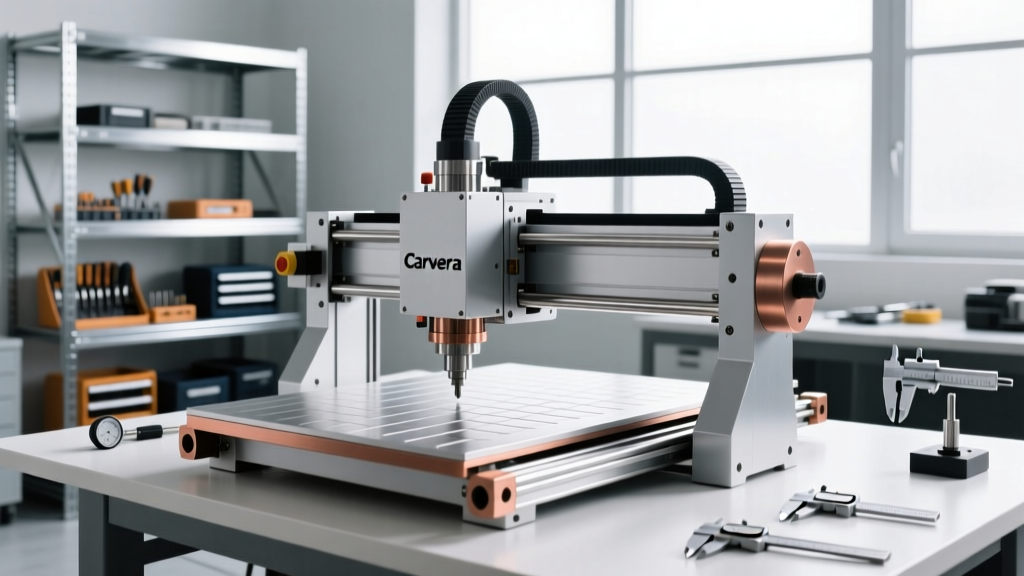
When evaluating the carvera air desktop cnc machine for precision prototyping, manufacturers must separate marketing specifications from physics. According to the official Makera Carvera Air specifications, the machine features high-precision linear rails and a closed-loop stepper system yielding a repeatability of 0.05mm (0.002 inches). However, repeatability is not accuracy.
Repeatability dictates the machine's ability to return to the exact same coordinate. Accuracy dictates how close that coordinate is to the true dimensional design. Out of the box, the Carvera Air's volumetric accuracy hovers around 0.1mm over a 100mm travel distance. To tighten this to the +/- 0.025mm range required for aerospace or medical prototyping, you must account for thermal expansion, spindle runout, and tool deflection.
Thermal Drift Warning: The Carvera Air's fully enclosed acoustic shell is excellent for dust containment and noise reduction, but it traps spindle heat. During a 45-minute continuous roughing cycle in 6061-T6 aluminum, the internal ambient temperature can rise by 8°C to 12°C. This thermal shift can induce up to 0.015mm of Z-axis drift. Budget for intermittent pausing or install an external exhaust fan to stabilize the thermal envelope if holding tight Z-depth tolerances.The Hidden Costs of Chasing Sub-0.05mm Tolerances
Budgeting for a desktop CNC rarely stops at the machine's MSRP. Achieving tight tolerances requires a compounding investment in the cutting ecosystem. Below is the cost matrix for upgrading the Carvera Air from standard hobbyist prototyping to precision micro-machining.
| Upgrade Category | Standard Setup Cost | Precision Setup Cost | Tolerance Impact |
|---|---|---|---|
| ER11 Collet System | $0 (Included) | $180 - $250 (Techniks/Schutte) | Reduces TIR from 0.015mm to 0.003mm |
| Micro Endmills (1/32" & under) | $15 (HSS/Coated) | $45 - $65 (Harvey Tool Carbide) | Eliminates tool deflection in hard metals |
| Workholding (Vises/Fixtures) | $40 (Standard Machinist Vise) | $250 (Mitee-Bite / Kurt DX4) | Prevents part lift and micro-vibrations |
| Tool Presetter / Z-Touch | $0 (Manual Paper Method) | $120 (Precision Macro Probe) | Reduces Z-zero error to 0.005mm |
Spindle Runout and Tooling Budget
The most critical bottleneck in desktop CNC accuracy is Total Indicated Runout (TIR) at the tool tip. The stock ER11 collet nut and standard collets provided with most desktop machines exhibit a TIR of 0.010mm to 0.020mm. When using a 0.5mm micro-endmill, 0.020mm of runout means the tool is effectively cutting 4% larger than its diameter, destroying tolerance stacks and accelerating tool breakage.
According to micro-machining guidelines from Harvey Tool's technical expertise database, TIR should not exceed 3% of the tool diameter. For a 1/32" (0.79mm) endmill, your maximum allowable runout is 0.023mm. Investing $180 in a precision ER11A collet set with a balanced, high-torque nut is not optional if your blueprints demand +/- 0.025mm profile tolerances.
Material Scrap Rates and Budgeting for Failure
When planning your cost-per-part, you must model the scrap rate associated with your target tolerance grade. Desktop machines lack the mass and dampening of industrial VMCs (Vertical Machining Centers), making them susceptible to chatter during aggressive material removal.
- Standard Prototyping (+/- 0.1mm): Expect a 2% to 5% scrap rate. Failures are usually due to programming errors or workholding slip.
- Precision Machining (+/- 0.05mm): Expect a 10% to 15% scrap rate. Failures stem from tool wear, thermal drift, and minor chatter marks.
- Micro-Tolerance (+/- 0.02mm): Expect a 25% to 40% scrap rate on initial runs. Achieving this on the Carvera Air requires multiple spring passes, ultra-slow feed rates, and strict temperature control.
Budget Formula: If your raw material blank costs $20 and your target is +/- 0.02mm, apply a 1.35 multiplier to your material budget to account for scrap. A part that nominally costs $45 in machine time and materials must be budgeted at $60.75 to remain profitable.
Metrology: The Unseen Budget Drain
You cannot machine what you cannot measure. A common budgeting failure in desktop CNC operations is allocating funds for the machine while ignoring the metrology required to verify the output. The NIST Engineering Physics Division emphasizes that measurement uncertainty must be at least one-tenth of the part tolerance (the 10:1 rule).
If your part tolerance is +/- 0.025mm (total band of 0.05mm), your measurement tool must have an uncertainty of no more than 0.005mm.
- Digital Calipers ($25 - $50): Resolution of 0.01mm. Accuracy of +/- 0.02mm. Verdict: Useless for verifying +/- 0.025mm tolerances.
- Standard Outside Micrometer ($150 - $250): Resolution of 0.001mm. Accuracy of +/- 0.002mm. Verdict: Mandatory for external dimensions.
- Bore Gauges / Pin Gauges ($100 - $300 per set): Required for verifying internal holes and slots, as micrometers cannot measure internal features.
- Optical Comparator or Vision System ($2,500+): Required for complex 2D profile tolerances and true position callouts on micro-features.
Decision Framework: In-House vs. Outsourcing
Not every part should be machined on the Carvera Air. Use this decision matrix to determine when to utilize your desktop setup versus outsourcing to a local machine shop with industrial 5-axis capabilities.
Machine In-House on the Carvera Air When:
- The material is non-ferrous (aluminum, brass, Delrin, PEEK) or soft plastics.
- Part envelope is under 100mm x 100mm x 50mm.
- Tolerances are +/- 0.05mm or larger.
- You require rapid iteration (3 to 5 design changes per week).
- Batch sizes are under 20 units.
Outsource to an Industrial VMC When:
- The material is titanium, hardened steel, or Inconel (the 500W spindle lacks the torque and rigidity for these alloys).
- Tolerances demand +/- 0.010mm or tighter (requires climate-controlled rooms and CMM verification).
- Surface finish requirements dictate Ra 0.8 or better across large planar surfaces.
- Batch sizes exceed 50 units, where the Carvera Air's slower rapid traverse rates and tool change times destroy your hourly margin.
Final Cost-Benefit Synthesis
The carvera air desktop cnc machine represents an exceptional ROI for engineering teams, university labs, and hardware startups, provided the budget reflects the reality of precision machining. By allocating an additional $1,200 beyond the base MSRP for precision collets, carbide micro-tooling, rigid workholding, and proper metrology, you transform the platform from a capable prototyping toy into a legitimate low-volume production asset. Factor in a 15% scrap rate allowance for tight-tolerance metal parts, and your per-unit costing models will remain accurate and profitable throughout the production run.