How Portable CNC Machines Operate Safely in Field Environments
Master field safety compliance for portable CNC machines. Learn OSHA protocols, grounding specs, and operational hazards for on-site plasma and milling.
The Core Mechanics: How Portable CNC Machines Operate Off-Grid
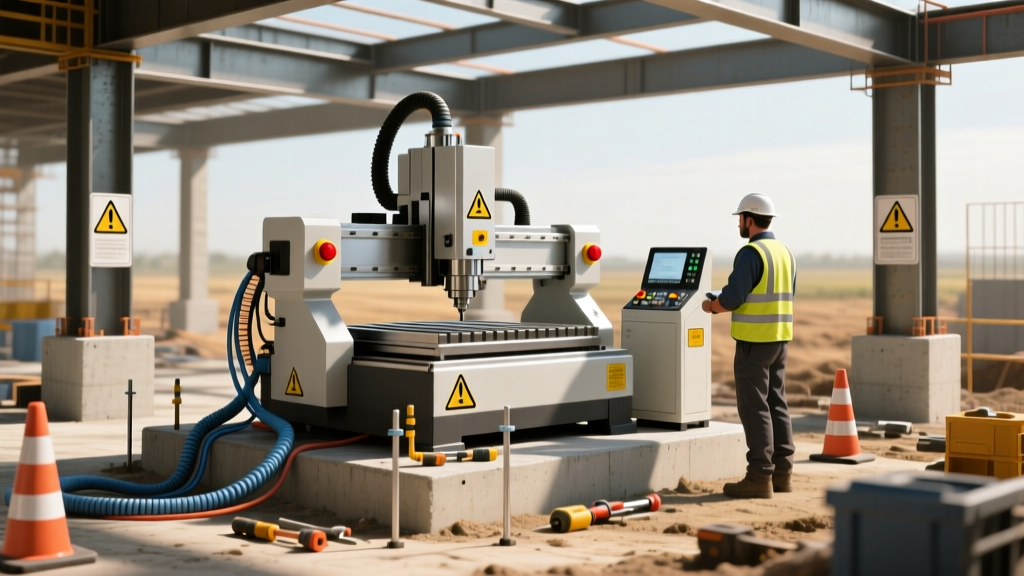
Deploying portable CNC machinery—such as track-mounted plasma cutters or portable boring mills—transfers sub-millimeter precision from controlled factory floors to unpredictable construction sites, shipyards, and pipeline trenches. Understanding how CNC machines operate in these uncontrolled environments requires a fundamental shift in safety and compliance planning. Unlike stationary 5-axis mills tethered to 480V three-phase shop power and anchored to vibration-dampening concrete, portable CNC units must adapt to uneven terrain, variable weather, and unstable power grids.
Modern portable CNC controllers, such as the DSP (Digital Signal Processing) units found on 2026 field-ready models, rely on pure sine wave power to maintain micro-stepping accuracy on servo motors. When powered by field generators, harmonic distortion from dirty power can cause stepper motors to lose synchronization, leading to catastrophic tool crashes or uncontrolled plasma arc deflections. Therefore, field compliance begins at the power source: OSHA and site-specific safety plans mandate the use of inverter generators with Total Harmonic Distortion (THD) below 5% to ensure stable CNC operation and prevent electrical fires.
OSHA and ANSI Compliance Matrix for Field CNC Work
Field operators frequently misapply shop-floor safety standards to outdoor or confined-space environments. The following matrix outlines the critical divergence in compliance requirements under OSHA Welding, Cutting, and Brazing Standards (1910.252) and general machinery guidelines.
| Compliance Parameter | Standard Shop Floor (Indoor) | Portable Field Work (Outdoor/Confined) |
|---|---|---|
| Electrical Grounding | Bonded to building steel; < 1 ohm resistance | Dedicated 8-ft copper ground rod; < 5 ohms required |
| Controller Enclosure | NEMA 12 (Dust/Drip resistant) | NEMA 3R or 4X (Weather/Waterproof) |
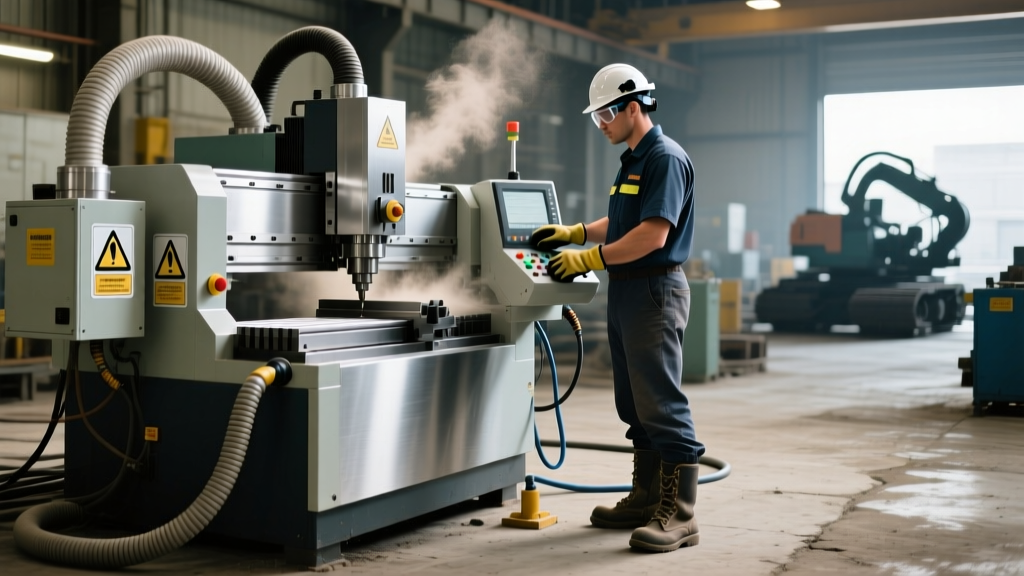
| Fume Extraction | Ambient HVAC + overhead source capture | Local exhaust ventilation (LEV) at 150-200 CFM per arc |
| Machine Guarding | Fixed polycarbonate shields, light curtains | Magnetic perimeter barriers, physical tethered kill-switches |
| Vibration Tolerance | ISO 10816 Zone A (Rigid foundation) | Dynamic compensation via magnetic track clamping |
Critical Failure Modes in Portable CNC Field Operations
Field environments introduce edge cases that factory-trained operators rarely encounter. Ignoring these specific failure modes violates ANSI Z49.1 safety protocols and risks severe injury.
⚠️ Warning: Ground Potential Rise (GPR) in Wet Trenches
When operating portable CNC plasma cutters in damp pipeline trenches, the workpiece grounding clamp can create a Ground Potential Rise if the soil conductivity is poor. If an operator touches the workpiece and the CNC controller simultaneously, they can complete a circuit carrying up to 200A of return current. Mandate: Always use a dedicated ground clamp attached directly to the workpiece within 2 feet of the cut zone, never relying on the earth or structural steel as a return path.
🛑 Danger: Confined Space Fume Accumulation
Portable CNC plasma cutting generates hexavalent chromium and manganese fumes. Inside a tank or ship hull, natural ventilation is zero. According to NIOSH Welding Safety Guidelines, operators must use supplied-air respirators or local exhaust ventilation (LEV) systems capable of capturing fumes at the source. Relying on standard P100 masks in confined spaces without forced air exchange is a fatal OSHA violation.
Step-by-Step Pre-Operation Safety Audit
Before initiating the G-code cycle on any portable CNC unit, the site supervisor must complete this field-specific audit:
- Power Quality Verification: Connect a power quality analyzer to the generator output. Verify voltage stability (±5%) and THD (<5%) under a simulated load before plugging in the CNC controller.
- Track Adhesion Test: For magnetic track-mounted systems (e.g., Bug-O), test the magnetic holding force. Attempt to slide the track manually with the magnets engaged. If it shifts on a 15-degree incline, clean the workpiece surface of rust and scale to restore full magnetic flux.
- Emergency Stop (E-Stop) Tethering: Field machines cannot rely on fixed E-Stop buttons. Verify that the operator wears a physical breakaway tether connected to the controller's safety relay, ensuring the machine halts if the operator trips or falls away from the zone.
- Ground Resistance Check: Use a digital earth ground tester to verify the temporary ground rod resistance is below 5 ohms. Drive a secondary rod if soil resistivity is too high.
Equipment Spotlight: Field-Ready CNC Models and Pricing
Selecting the right equipment is a compliance decision as much as a financial one. Below are two industry-standard portable CNC machines and their integrated safety architectures.
Bug-O Systems Auto-Cut (Portable CNC Plasma/Oxy-Fuel)
- Estimated Price: $12,500 - $15,000 (Base carriage and DSP controller)
- Application: Pipeline beveling, shipyard plate cutting.
- Safety Features: The 2026 Auto-Cut models feature an integrated arc-shield carriage that physically blocks UV radiation and spatter from the operator's line of sight. The controller is housed in a NEMA 4X polycarbonate shell, rated for high-pressure washdowns and salt-spray environments, preventing the short-circuits common in lesser marine-grade units.
Mirage Machines BM4000 Portable Boring Mill
- Estimated Price: $38,000 - $45,000 (Depending on tooling and stroke length)
- Application: On-site flange facing, valve body repair in power plants.
- Safety Features: Unlike plasma cutters, portable mills generate massive torque. The BM4000 utilizes a mechanical locking pin system alongside magnetic mounting to prevent the machine from tearing off the workpiece during interrupted cuts. It also features a zero-volt release (ZVR) contactor; if field power drops, the spindle brakes instantly rather than freewheeling when power is restored.
Confined Space Fume Extraction Standards
When pairing a portable CNC plasma cutter with a fume extraction unit in the field, calculate the required CFM based on the cutting amperage. A 100A plasma arc requires a minimum of 150 CFM of source-capture airflow to maintain the operator's breathing zone below the Permissible Exposure Limit (PEL) for manganese. Always position the extraction hood within 6 inches of the arc, utilizing flexible articulating arms that move synchronously with the CNC carriage.