Carbon Fiber CNC Machine Troubleshooting: Spindle Wear
Diagnose and repair abrasive wear, spindle failure, and VFD shorts on your carbon fiber CNC machine with expert troubleshooting protocols.
Machining carbon fiber reinforced polymer (CFRP) generates highly abrasive, electrically conductive micro-dust that destroys standard CNC components within months if not properly managed. A standard carbon fiber CNC machine operates in a uniquely hostile environment: the 7-micron carbon fibers act like microscopic glass shards, infiltrating labyrinth seals, degrading linear motion systems, and short-circuiting variable frequency drives (VFDs). Troubleshooting these machines requires moving beyond standard metal-cutting maintenance paradigms and addressing the specific failure modes induced by composite materials.
Diagnostic Matrix: Symptom to Root Cause
When a composite routing system begins producing out-of-tolerance parts or exhibiting mechanical noise, use this diagnostic matrix to isolate the failure before catastrophic component destruction occurs.
| Symptom | Root Cause | Immediate Diagnostic Action | Repair Protocol |
|---|---|---|---|
| High-frequency spindle whine >18,000 RPM | Ceramic bearing seal breach by carbon dust | Check air purge flow meter; verify positive pressure | Rebuild spindle with upgraded labyrinth seals; recalibrate air purge to 15 PSI |
| Z-axis backlash exceeding 0.002" | Ball screw wiper seal degradation and fiber packing | Measure lead error with dial indicator; inspect wiper lips | Replace standard wipers with double-lip polyurethane scrapers; flush with ISO VG 68 |
| Delamination at cut exit (blowout) | Tool wear masking as spindle runout | Check TIR (Total Indicator Runout) at tool tip | Replace ER collets with HSK-F63 toolholders; switch to CVD diamond end mills |
| Random VFD fault codes (Overcurrent/Short) | Conductive carbon dust bridging electrical terminals | Inspect electrical enclosure seals and cooling fans | Upgrade to IP65 sealed enclosures; install static-dissipative vacuum hoses |
Spindle Bearing Failure & Air Purge Calibration
The spindle is the most vulnerable and expensive component on any carbon fiber CNC machine. Standard steel bearings will pit and fail within 400 hours of CFRP cutting due to the extreme abrasiveness of the matrix. Modern composite routers utilize spindles like the HSD ES929 or Colombo RC90, which feature hybrid ceramic bearings (silicon nitride balls with steel races). However, even ceramic bearings will fail if carbon dust breaches the seals.
The 15 PSI Threshold
To prevent dust ingress, high-speed composite spindles rely on a positive-pressure air purge system that forces clean, dry air outward through the labyrinth seal. The most common maintenance oversight is failing to monitor the pressure drop across the purge lines.
- Required Pressure: The air purge must maintain a minimum of 15 PSI (1.03 bar) at the spindle inlet, delivering 4-6 CFM of clean, desiccated air.
- Moisture Contamination: If shop air contains moisture, it mixes with carbon dust to form a highly corrosive, conductive slurry that rapidly destroys the bearing races. An inline coalescing filter with a 0.01-micron rating is mandatory.
- Troubleshooting Step: Disconnect the purge line at the spindle collar and attach a digital flow meter. If flow drops below 4 CFM, the internal labyrinth is already packed with carbon fiber. The spindle must be removed and disassembled in a cleanroom environment.
Carbon fiber dust is not merely a mechanical hazard; it is a severe respiratory and dermal irritant. The microscopic fibers can become lodged in lung tissue, leading to macrophage accumulation and chronic respiratory issues. Always ensure your dust extraction system utilizes HEPA filtration and that operators wear NIOSH-approved P100 respirators during manual machine cleaning. Consult OSHA's Respiratory Protection guidelines for compliance standards regarding synthetic particulates.
Linear Guideway Degradation: Beyond Standard Wipers
Standard linear motion blocks (such as baseline THK SHS or Rexroth BS series) utilize rubber end-wipers designed to keep liquid coolant and large metal chips out of the ball recirculation zone. In a composite cutting environment, these standard wipers are entirely inadequate. The 7-micron carbon fibers slip past standard rubber lips, packing into the ball retainer and causing the block to seize or lose preload.
The Solution: Specialized Scraper Seals
When rebuilding the X and Y axes of a carbon fiber CNC machine, you must upgrade to blocks equipped with specialized scraper seals (often designated with a "W" or "X" suffix by manufacturers, such as the THK QZ self-lubricating scraper series). These feature a hardened urethane scraper that physically wipes the rail profile clean before the dust can reach the internal ball bearings. While a standard linear block might cost $150, a scraper-equipped, sealed block costs approximately $320. Given that a single seized block can cause a $4,000 ball screw to bind and snap, the ROI on upgraded seals is immediate.
Electrical Faults: VFD Shorting from Conductive Dust
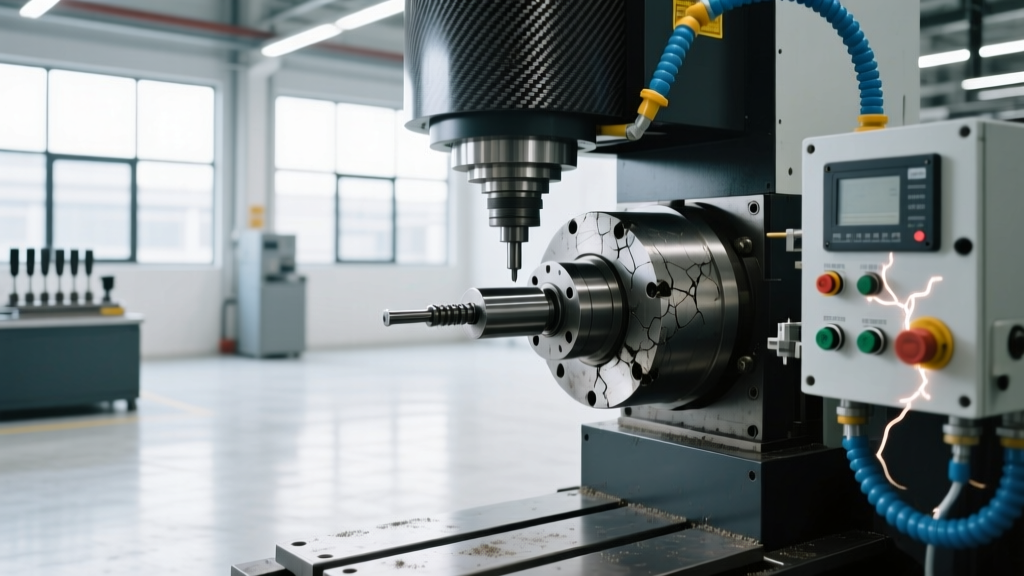
Unlike aluminum or steel swarf, carbon fiber dust is electrically conductive. When fine carbon dust infiltrates the electrical cabinet, it settles on the printed circuit boards (PCBs) and terminal blocks of the VFDs and servo drives. Over time, the dust creates microscopic conductive bridges between high-voltage terminals, leading to random overcurrent faults, phase-shorting, and catastrophic drive failure.
Troubleshooting the Electrical Enclosure
- Inspect the Cooling Fans: Standard CNC cabinets use filtered intake fans. If the filter media is not rated for sub-micron particulates, carbon dust will bypass the filter. Upgrade to electrostatically charged synthetic media filters.
- Check for Positive Pressure: The cabinet must maintain positive air pressure relative to the shop floor. If the exhaust fans out-flow the intake fans, the cabinet will draw unfiltered, dust-laden air through microscopic gaps in the door seals.
- Vacuum, Do Not Blow: Never use compressed air to clean the inside of a CNC electrical cabinet that has been cutting composites. Blowing air will force conductive carbon dust deeper into the relay sockets and VFD heat sinks. Use an ESD-safe (electrostatic discharge) vacuum with a conductive nozzle.
Step-by-Step Z-Axis Ball Screw Rebuild
The Z-axis on a composite router is highly susceptible to wear because gravity constantly pulls carbon dust down into the exposed screw threads. If you detect Z-axis backlash or uneven depth-of-cut during nesting operations, follow this rebuild protocol:
- Lock and Support: Engage the Z-axis brake and physically block the router head with a hardened steel stand. Never rely solely on the servo motor holding torque during disassembly.
- Remove the Wiper Assemblies: Unbolt the top and bottom wiper housings. Inspect the felt wipers; if they are black and hardened, the carbon dust has polymerized with the way oil.
- Solvent Flush: Flush the exposed ball screw threads with a high-flashpoint, non-chlorinated parts cleaner. Do not use WD-40 or standard degreasers, as they will strip the internal grease from the ball nut recirculation tubes.
- Measure Lead Error: Mount a 0.0001" resolution dial indicator on the router head. Command the Z-axis to move in 1.000" increments. If the actual movement deviates by more than 0.0008" over a 12-inch travel, the ball screw has suffered abrasive wear and must be replaced, not just cleaned.
- Re-grease with Composite-Specific Lubricant: Standard lithium-complex grease attracts carbon dust. Purge the ball nut and repack with a synthetic ISO VG 68 way oil or a specialized low-tack linear rail grease that resists particulate adhesion.
Tool Holder Runout and Collet Contamination
Delamination and frayed edges on CFRP parts are frequently misdiagnosed as dull tooling or incorrect feed rates. In reality, the root cause is often tool holder runout exacerbated by carbon dust contamination. According to tooling specialists at Harvey Tool, machining composites requires exceptionally tight tolerances to prevent the tool from "wobbling" and tearing the composite plies rather than shearing them cleanly.
Why ER Collets Fail in Composite Routing
Standard ER32 or ER40 collets feature slits that easily pack with carbon fiber dust. When a collet is tightened, the packed dust prevents uniform clamping pressure, introducing up to 0.004" of TIR (Total Indicator Runout) at the tool tip. At 24,000 RPM, this runout causes severe vibration, destroying the cutting edge of solid carbide tools in less than 15 linear feet of cutting.
The Upgrade Path:
Transitioning to an HSK-F63 tooling system provides a dual-cone clamping mechanism that is inherently more resistant to dust contamination and provides superior radial rigidity. If you must use ER collets, implement a strict protocol: collets must be ultrasonically cleaned in an isopropyl alcohol bath every 40 hours of spindle runtime to dissolve and dislodge impacted carbon matrix residue.
Maintaining a carbon fiber CNC machine requires a fundamental shift from reactive repairs to aggressive, predictive contamination control. By upgrading sealing technologies, enforcing strict air-purge pressures, and managing the electrical conductivity of the dust, shops can extend the operational lifespan of their composite routing equipment by 300% or more. For further insights on composite-specific cutting geometries and toolpath strategies, refer to the CompositesWorld machining archives.