Beyond the 3 Axis CNC Machine: Selecting a Mill-Turn Center
Compare a standard 3 axis CNC machine to a multi-function mill-turn center. Explore ROI, specific models, and decision frameworks for complex parts.
The Bottleneck of Multi-Setup Machining
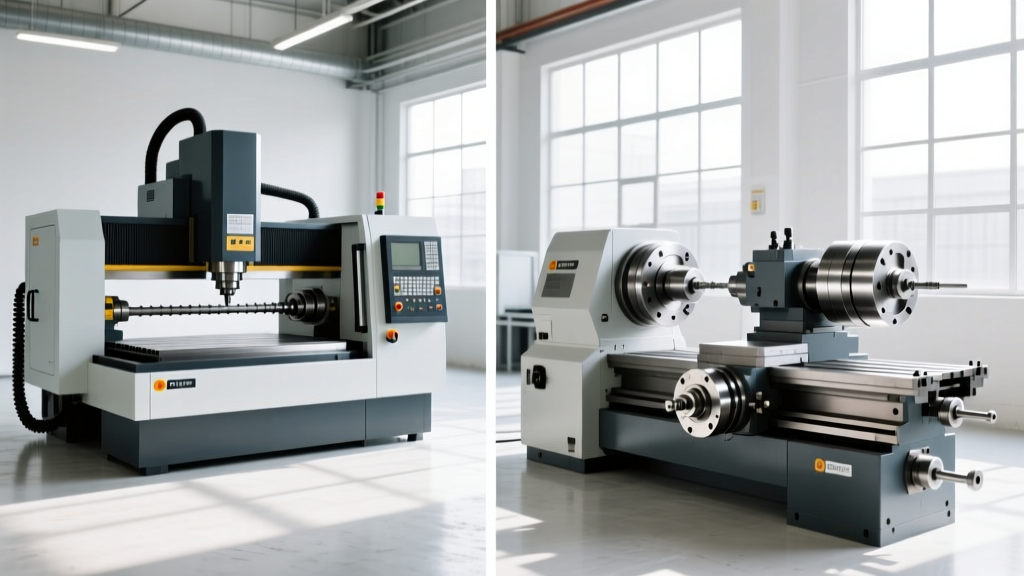
While a standard 3 axis CNC machine remains the undisputed workhorse for prismatic components like brackets and enclosures, it falls short when manufacturing complex cylindrical parts with off-center features. Aerospace valve bodies, medical bone screws, and hydraulic manifolds often require turning, facing, eccentric milling, and deep-hole drilling. Traditionally, shops tackle this by roughing on a lathe, then moving the workpiece to a 3 axis CNC machine equipped with a rotary table or custom tombstone.
This multi-setup workflow introduces severe inefficiencies. Every time a part is unchucked and re-fixtured, you risk tolerance stack-up, specifically losing concentricity and true position. Furthermore, the Work-In-Progress (WIP) queue between the lathe and the milling center ties up capital and extends lead times. The solution adopted by high-mix, high-precision job shops is the multi-function mill-turn center—a machine that completes the part in a single chucking.
Anatomy of a Multi-Function Mill-Turn Center
Unlike a basic 3 axis CNC machine restricted to X, Y, and Z linear movements, a true mill-turn center integrates advanced kinematics to manipulate both the tool and the workpiece simultaneously.
Key Kinematic Features
- C-Axis Spindle Positioning: Both the main and sub-spindles can lock into precise angular positions or interpolate slowly, allowing the machine to mill flats and drill off-center holes on the part's circumference.
- B-Axis Contouring Head: The upper turret or milling head rotates on the B-axis (typically -30 to +210 degrees), enabling 5-axis simultaneous contouring and complex angled milling without manual tool changes.
- Y-Axis Interpolation: Allows the cutting tool to move off the centerline of the spindle, critical for machining keyways, hexagonal profiles, and eccentric features.
- Lower Turret with Live Tooling: Operates independently of the upper head, often working on the sub-spindle to perform back-machining and secondary operations while the main spindle is being roughed.
Financial Analysis: 3 Axis CNC Machine + Lathe vs. Mill-Turn
Upgrading from a standalone 3 axis CNC machine and 2-axis lathe configuration to a mill-turn center requires a significant capital jump. However, the ROI is realized through scrap reduction, floor space optimization, and labor savings. Below is a comparative analysis based on 2026 market pricing and a production run of 500 complex titanium aerospace fittings.
| Metric | 3 Axis VMC + 2-Axis Lathe | 5-Axis Mill-Turn Center |
|---|---|---|
| Capital Equipment Cost | $185,000 (e.g., Haas VF-2 + ST-20) | $520,000 (e.g., DMG MORI NLX 2500) |
| Setup Time (Per Batch) | 6.5 Hours (Dual fixturing & zeroing) | 1.5 Hours (Single chucking) |
| Cycle Time (Per Part) | 18 Minutes (Plus transit/queue time) | 11 Minutes (Overlapping ops) |
| Scrap Rate (Tolerance Loss) | 4.2% (Concentricity errors on secondary ops) | 0.3% (Done-in-one accuracy) |
| Operator Requirement | 2 Operators (or 1 splitting focus) | 1 Operator (Lights-out capable) |
Top Mill-Turn Platforms to Evaluate
When selecting a mill-turn center, the control architecture and turret rigidity are just as critical as the casting. Here are three industry-leading platforms dominating the market in 2026.
1. Mazak INTEGREX i-200S
Mazak’s INTEGREX series is synonymous with multi-tasking. The i-200S features a 10-inch chuck, a 40-tool magazine, and a high-torque B-axis milling spindle capable of 12,000 RPM. The MAZATROL SmoothAi control significantly reduces programming time for complex contours. Expect to invest between $550,000 and $680,000 depending on automation readiness and high-pressure coolant (HPC) packages. For more on their multi-tasking architecture, refer to the Mazak Multi-Tasking lineup.
2. DMG MORI NLX 2500
The NLX 2500 is engineered for high-rigidity turning combined with precision milling. Its standout feature is the BMT (Built-in Motor Tool) turret, which eliminates the gear backlash found in traditional VDI turrets, providing up to 30% more rigidity during heavy interrupted milling cuts. Base pricing starts around $420,000, scaling up to $500,000 with a sub-spindle and Y-axis on the lower turret. Explore their turning-milling solutions via DMG MORI's official turning-milling portal.
3. Okuma MULTUS U3000
Okuma leverages its Thermo-Friendly Concept to combat thermal growth—a critical factor when holding 0.0002-inch tolerances over a 48-hour unattended cycle. The OSP-P500 control features advanced collision avoidance, which is vital when the upper B-axis head and lower turret are operating in close proximity within the main spindle zone.
Tooling and CAM: The Hidden Costs
Purchasing the machine is only the first step. Transitioning from a standard 3 axis CNC machine to a mill-turn center requires a complete overhaul of your CAM strategy and tooling inventory.
Warning: Manual G-code programming is virtually impossible for simultaneous 5-axis mill-turn operations due to the complex kinematic chain and collision risks. You must budget $15,000 to $25,000 for advanced CAM software like Mastercam Mill-Turn or ESPRIT, plus annual maintenance and machine-specific post-processor licensing.
Furthermore, tooling interfaces matter. While standard VDI tooling is cheaper upfront, upgrading to a Capto C6 or KM63 quick-change spindle interface on the B-axis head reduces tool change times from 45 seconds to under 8 seconds, drastically improving cycle times on high-mix jobs.
Decision Matrix: Is a Mill-Turn Right for Your Shop?
Not every shop needs to abandon the 3 axis CNC machine. Use this framework to determine your next capital equipment purchase:
- Part Geometry: If your parts are primarily prismatic (brackets, plates) with minimal cylindrical features, stick to a 5-axis VMC or a standard 3 axis CNC machine with a rotary table. If the part is fundamentally round (shafts, valves, fittings) with off-center milling, buy a mill-turn.
- Tolerance Requirements: If the print calls for strict concentricity (e.g., ≤0.0005" TIR) between an ID bore and an OD milled contour, secondary chucking on a lathe or milling on a VMC will likely result in scrap. Mill-turn guarantees concentricity by maintaining the original datum.
- Batch Size & Automation: For prototypes (1-5 parts), the 8-hour setup of a mill-turn may not be justifiable. However, for batch sizes exceeding 50 parts, or if you plan to integrate a gantry loader or bar feeder for weekend lights-out machining, the mill-turn center pays for itself rapidly.
For advanced toolpath generation and collision simulation specific to these complex machines, reviewing the Mastercam Mill-Turn solutions can provide clarity on the software side of the investment.
Summary Checklist for Buyers
- Verify the machine's maximum turning diameter and distance between centers against your largest part family.
- Demand a BMT turret over VDI for any application requiring heavy milling in hardened steels or titanium.
- Budget an additional 15% of the machine cost for high-pressure coolant (1,000+ PSI) to manage stringy chips in deep-cavity mill-turn operations.
- Ensure your shop's electrical infrastructure can support the 480V / 60A+ draw of dual-spindle configurations.