Budget CNC Machine Vibration Damping: DIY vs Commercial Pads
Compare DIY and commercial vibration damping pads for your budget CNC machine. Reduce chatter, lower dB levels, and improve surface finishes.
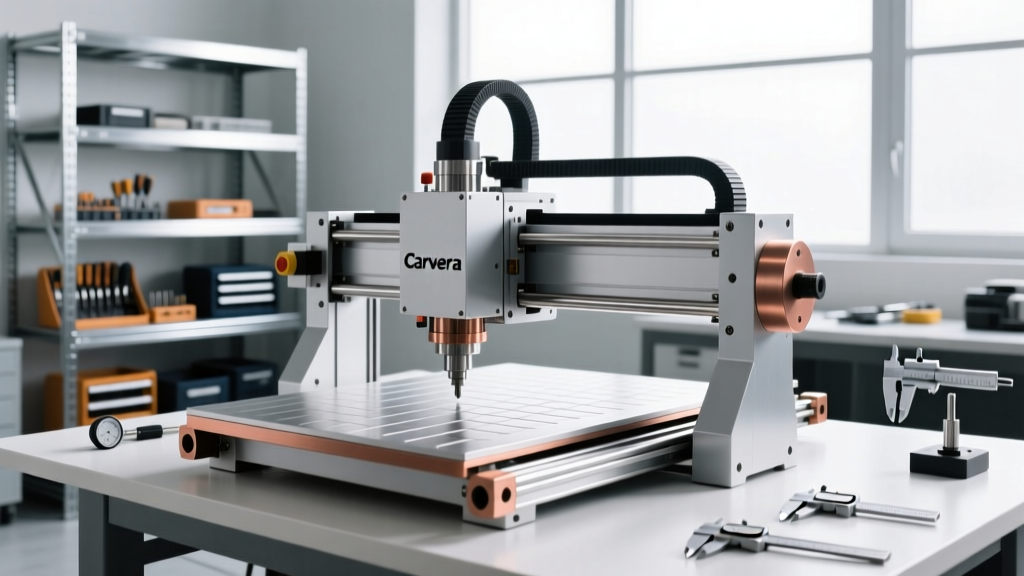
Budget CNC machines like the Genmitsu 3018-PRO, Sainsmart PROVerXL 4030 V2, and entry-level Shapeoko variants prioritize affordability over structural mass. The engineering trade-off is a lightweight aluminum extrusion or stamped-steel frame that acts as an acoustic sounding board for spindle harmonics. During aggressive cuts in aluminum or hardwoods, these frames routinely push ambient noise to 82–88 dB. According to OSHA's occupational noise exposure standards, prolonged exposure above 85 dB triggers mandatory hearing conservation protocols. Beyond regulatory compliance, unmitigated vibration translates directly into tool chatter, accelerating endmill wear and leaving visible resonance marks on machined surfaces.
The Mass Deficit Problem in Entry-Level Routers
In industrial machining, a 3,000-lb cast-iron VMC absorbs high-frequency cutting forces through sheer mass. A 60-lb desktop CNC router lacks this inertial dampening. When a 1/4-inch carbide endmill engages 6061 aluminum at 12,000 RPM, it generates dynamic cutting forces oscillating between 150 Hz and 400 Hz. Without proper vibration isolation and structural damping, these frequencies couple with the natural resonant frequency of the machine's aluminum extrusions (typically 120–250 Hz), creating destructive harmonic amplification. Treating this requires a two-pronged approach: base isolation to prevent structure-borne noise transmission, and kinematic tuning to eliminate internal frame chatter.
Material Science Matrix: Elastomers vs. Composites
Selecting the wrong damping material is the most common failure point in DIY noise reduction. Placing a rigid material under a light machine will actually amplify high-frequency vibrations, while a material that is too soft will cause the machine to rock during rapid traverse movements. The ideal material must operate within its optimal load-deflection curve.
| Material Type | Durometer (Shore A) | Avg. Cost (per sq ft) | Damping Coefficient | Best Application |
|---|---|---|---|---|
| Sorbothane (Grade 50) | 50A | $35.00 - $45.00 | 0.85 - 0.95 | High-frequency spindle isolation; heavy Z-axis loads. |
| Neoprene Rubber Sheet | 60A | $8.00 - $12.00 | 0.30 - 0.45 | General base padding; preventing tabletop scratching. |
| Cork/Rubber Composite | 70A | $10.00 - $15.00 | 0.50 - 0.60 | Mid-weight routers; excellent acoustic decoupling. |
| EVA Foam (DIY Craft Foam) | 20A - 30A | $2.00 - $4.00 | 0.15 - 0.25 | Avoid for CNC. Compresses fully under machine weight, losing all damping properties. |
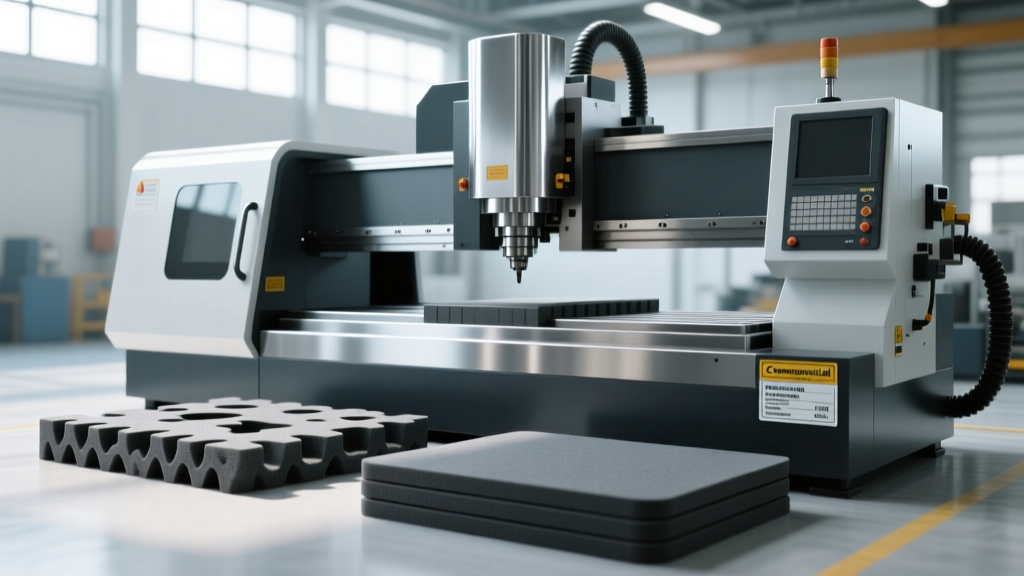
Many hobbyists use cheap yoga mats or EVA foam under their machines. Under the static weight of a 60-lb CNC router, these low-durometer foams compress to their solid limit. Once an elastomer bottoms out, its damping coefficient drops to near zero, and it effectively becomes a rigid mechanical bridge, transmitting 100% of the vibration to the workbench. Always calculate the static load per square inch and match it to the material's load-bearing chart.
Isolation Hardware: Commercial Mounts vs. DIY Pucks
If your machine sits on a shared workbench or a floor stand, base isolation is mandatory to prevent structure-borne noise from traveling through the building framing. The NIOSH guidelines on industrial noise control heavily emphasize isolating vibrating equipment at the source to mitigate low-frequency structural transmission.
Alternative A: Commercial Elastomeric Mounts (e.g., Kinetics Noise Control or Mason VHD)
Commercial mounts feature a molded rubber or neoprene element bonded to a steel housing, designed with a specific vertical deflection (usually 0.10 to 0.25 inches). Pros: Engineered load curves prevent bottoming out; integrated leveling bolts; superior shear resistance during X/Y axis rapids. Cons: High cost ($25–$40 per mount); requires 4 to 6 mounts depending on machine footprint.
Alternative B: The DIY Hockey Puck and Lag Bolt System
A pervasive forum hack involves sandwiching a rubber hockey puck between two plywood discs, with a lag bolt acting as a height adjuster. Pros: Extremely cheap (under $10 total); highly customizable height. Cons: Hockey pucks are made of vulcanized rubber (approx. 85A durometer), which is far too stiff to dampen high-frequency spindle chatter. The lag bolt creates a rigid metal-to-metal path through the center of the puck, completely bypassing the rubber's damping properties and short-circuiting the isolation.
The Verdict: For machines under 100 lbs, skip the hockey puck hack. Purchase 1/2-inch thick Sorbothane hemispheres or sheets (50A durometer) and adhere them to the machine's rubber feet using 3M VHB tape. This provides genuine viscoelastic damping without the short-circuiting effect of threaded hardware.
Kinematic Tuning: Eliminating Internal Resonance
Damping pads only treat the transmission of vibration, not the source. A poorly tuned budget CNC will chatter violently regardless of what it sits on. Follow this precise calibration sequence to stiffen the kinematic chain.
- Frame Preload and Squaring: Aluminum extrusion frames (like the 2020 or 2040 V-slot profiles used on Genmitsu models) rely on bolt tension for rigidity. Loosen all frame bolts, apply a diagonal clamping force to square the gantry, and re-torque M5 bolts to exactly 12 Nm and M4 bolts to 8 Nm. Use a precision machinist square (0.001-inch tolerance) on the X and Y axes.
- Belt Tensioning via Frequency: Loose GT2 timing belts cause low-frequency gantry whip. Do not rely on the 'thumb press' method. Download a carbon fiber belt tensioning app (like Gates Carbon Drive) and use your phone's microphone to pluck the belt. Target a fundamental frequency of 85 Hz to 95 Hz for the X-axis and 90 Hz to 100 Hz for the Y-axis. This translates to roughly 2.5 mm of deflection under 10 Newtons of lateral force.
- Z-Axis Gib Adjustment: The Z-axis is the most common source of vertical chatter. On machines utilizing linear rails or V-wheels, adjust the eccentric nuts or gib screws until there is exactly 0.002 inches of backlash when measured with a dial indicator. Zero backlash will bind the stepper motors and cause missed steps; 0.002 inches allows smooth travel while preventing harmonic bounce during plunge cuts.
- Spindle Collet Runout Check: Budget ER11 collets often have 0.003+ inches of runout, causing the endmill to act like an unbalanced flywheel at high RPMs. Replace the stock collet with a precision AA-grade ER11 collet (max 0.0002-inch runout) to eliminate high-pitch spindle whine.
Chatter Troubleshooting Decision Tree
When vibration persists after installing damping pads and tuning belts, use this diagnostic matrix to identify the specific failure mode.
- Symptom: High-pitched squeal exclusively during climb milling in aluminum.
- Root Cause: Spindle speed is harmonizing with the natural frequency of the endmill overhang.
- Engineering Fix: Alter the spindle RPM by +/- 15% to shift the excitation frequency away from the tool's resonant node. Reduce stick-out length to a maximum of 3x the cutter diameter.
- Symptom: Low-frequency 'thumping' visible as periodic waves on the X-axis surface finish.
- Root Cause: Y-axis stepper motor resonance coupling with the gantry mass at specific feed rates.
- Engineering Fix: Enable microstepping interpolation in your GRBL or Mach3 settings (switch from 1/8 to 1/16 or 1/32 stepping) and install mechanical vibration dampers directly onto the rear shafts of the NEMA 23 stepper motors.
- Symptom: Random dimensional inaccuracies and loud grinding noises during rapid directional changes.
- Root Cause: V-wheel flat spots or debris embedded in the Delrin/POM wheel surface, causing stick-slip friction.
- Engineering Fix: Remove V-wheels, clean the V-slot track with isopropyl alcohol, and replace any wheels showing visible wear rings. Re-tension eccentric nuts.
Upgrading a budget CNC machine is not just about buying a more expensive spindle or larger router bits. True performance gains come from mastering the physics of the machine's structure. By pairing high-damping viscoelastic materials like 50A Sorbothane with rigorous kinematic tuning, you can transform a deafening, chatter-prone desktop router into a quiet, precision instrument capable of holding tight tolerances in demanding materials.