CNC Safety Interlocks & ATC Compliance Guide 2026
Master CNC machine safety interlocks, ATC compliance, and ISO/OSHA standards. Includes diagrams, resistance specs, and guarding best practices—download now!
The Hidden Hazard: ATC Kinetic Energy and Compliance Mandates
Automatic Tool Changers (ATCs) represent one of the most significant mechanical hazards on the shop floor. An ATC arm moving a 15 kg toolholder at speeds exceeding 2.5 meters per second generates substantial kinetic energy. If a tool is improperly seated or a retention knob fails, the resulting ejection can penetrate standard polycarbonate guarding. Under ISO 16090-1:2017 (Machine tools safety - Machining centres and turning centres), manufacturers and end-users are strictly liable for containing these hazards within the machining envelope.
When mapping safety interlocks across various cnc machine types, the primary variable is the ATC mechanism's kinetic envelope and the corresponding Performance Level (PL) required by ISO 13849-1. Modern safety architectures in 2026 rely on integrated safety PLCs—such as those found in Siemens Sinumerik One or Fanuc 31i-B5 controllers—to monitor ATC door interlocks and arm position encoders, eliminating the latency and failure points of legacy external relay circuits.
OSHA & ISO 16090-1 Alert: Bypassing ATC enclosure interlocks for maintenance or setup without engaging a certified safe-torque-off (STO) and safe-motion-monitoring (SMM) mode is a direct violation of OSHA machine guarding standards (29 CFR 1910.212). Fatalities from ATC arm strikes occur when operators enter the magazine zone while pneumatics remain pressurized.Safety Interlock Requirements by CNC Machine Types
The physical configuration of the tool magazine dictates the guarding strategy. A disc-type magazine on a vertical mill presents entirely different pinch-point and ejection hazards compared to a chain-type magazine on a horizontal boring mill or a servo-turret on a turning center.
| CNC Machine Type | Common ATC Mechanism | Primary Kinetic/Ejection Hazard | Required ISO 13849-1 PLr | Mandatory Guarding Specification |
|---|---|---|---|---|
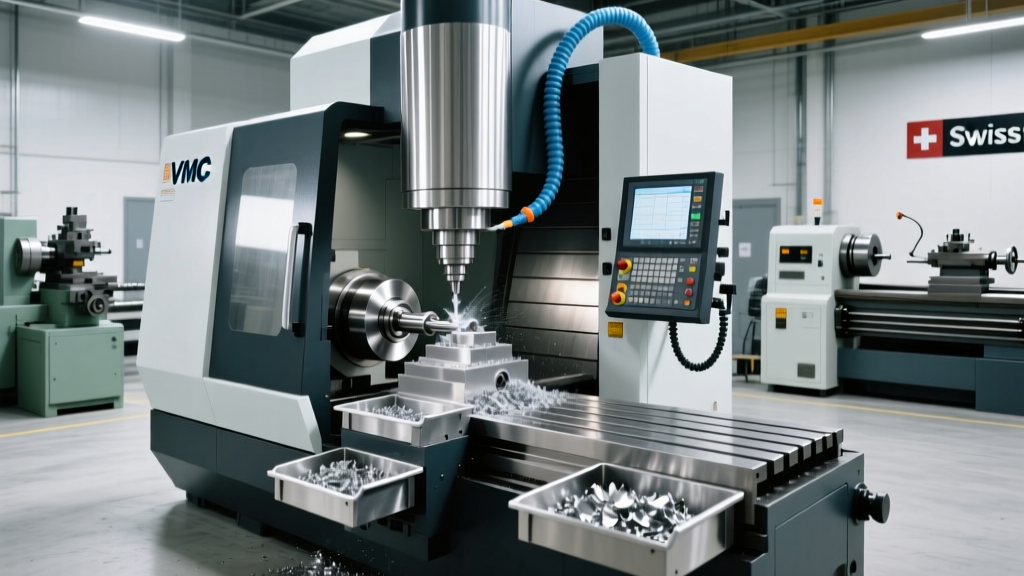
| Vertical Machining Center (VMC) | Swing-Arm / Disc Magazine | Tool ejection during arm swap; pinch points at arm pivot. | PL d (Category 3) | 10mm minimum thickness polycarbonate with RFID interlock; no open top gaps. |
| Horizontal Machining Center (HMC) | Chain-Type / Matrix Magazine | Heavy tool drop (up to 50kg); chain whip failure. | PL e (Category 4) | Steel mesh enclosure (ISO 14120) with dual-channel safety switch on access door. |
| CNC Turning Center | Servo-Driven Turret | Rotational inertia strike; hydraulic clamping failure. | PL d (Category 3) | Interlocked chuck guard; turret rotation disabled unless spindle is in STO mode. |
| 5-Axis Trunnion Mill | Side-Mount Disc / Pick-up | Collision between table tilt and extended ATC arm. | PL e (Category 4) | Software zone limits (safe-cam) integrated with hardware door interlocks. |
Tool Retention Systems: Preventing Catastrophic Pull-Stud Failures
The retention knob (pull-stud) is the sole mechanical link keeping a toolholder seated in the spindle taper against centrifugal forces that can exceed 12,000 RPM. A pull-stud failure at high RPM turns the toolholder into a ballistic projectile. Compliance requires strict adherence to material specifications and fatigue lifecycle management.
Metallurgical and Dimensional Compliance
Never substitute a certified pull-stud with a standard hardware store bolt. Compliant retention knobs for BT40 or CAT40 tapers must be machined from 4340 alloy steel, heat-treated to a core hardness of 45-50 HRC, with a minimum tensile strength of 1,200 MPa. The thread relief groove—a common stress concentration point—must feature a minimum 0.5mm radius to prevent micro-fractures.
- BT40 / CAT40 Retention Force: Standard spindle drawbars exert 10 to 15 kN of clamping force. The pull-stud must withstand a static pull test of at least 25 kN without yielding.
- HSK-63A Dual Contact: HSK systems rely on both the taper and the flange face for rigidity. The clamping force is higher (18-25 kN), and the retention knobs are subjected to cyclic bending loads. Inspect HSK knobs for flange fretting every 3 months.
- Coromant Capto C6: Utilizes a polygonal taper with a mechanical clamping wedge. Compliance requires verifying the internal wedge actuator stroke (typically 4.5mm ± 0.1mm) during annual spindle teardowns.
Pneumatic Safety and Soft-Dump Valve Requirements
ATC mechanisms are predominantly driven by 6 to 8 bar pneumatic cylinders. In older cnc machine types, a sudden loss of shop air pressure or electrical fault would cause the drawbar to open, dropping the toolholder directly onto the workpiece or fixture. Modern compliance standards mandate specific pneumatic circuit architectures to prevent uncontrolled motion.
- Pilot-Operated Check Valves: Must be installed directly at the drawbar cylinder port to lock air pressure inside the cylinder if the supply line ruptures.
- Soft-Start / Dump Valves (ISO 13849-1 compliant): When the safety interlock is triggered (e.g., opening the ATC maintenance door), the pneumatic circuit must not instantly exhaust to atmosphere. An instantaneous dump causes the heavy ATC arm to drop violently. A compliant soft-dump valve meters the exhaust air, allowing the arm to descend at a controlled rate of less than 0.1 m/s.
- Pressure Switch Interlocks: A redundant pressure switch must be wired to the safety PLC. If shop air drops below 5.5 bar, the PLC must immediately halt the ATC cycle and inhibit spindle start, preventing tool clamping on an insufficiently pressurized drawbar.
Upgrading Legacy ATCs: CE and NRTL Certification Pathways
Retrofitting older equipment with modern safety interlocks is common, but altering the ATC logic voids the original CE mark or NRTL (Nationally Recognized Testing Laboratory) listing. To regain compliance when upgrading a legacy VMC with a modern RFID door switch and safety PLC, you must execute a formal risk assessment.
According to the OSHA Machine Guarding guidelines, the integrator assumes the role of the manufacturer. This requires documenting the new Performance Level (PL) using the ISO 13849-1 SISTEMA software tool, verifying that the chosen safety relays or PLCs meet Category 3 or 4 architecture, and updating the machine's technical file. Furthermore, the Association for Manufacturing Technology (AMT) provides extensive frameworks for validating that retrofitted guarding does not introduce new hazards, such as obstructing the operator's line of sight to the cutting zone.
Frequently Asked Questions: ATC Safety Compliance
Can we use magnetic safety switches instead of RFID interlocks on ATC doors?
Standard magnetic reed switches are no longer compliant for ATC enclosures on modern machinery. They can be easily defeated with a secondary magnet, violating the anti-defeat requirements of ISO 14119. You must use RFID-coded safety switches (Type 4) that are uniquely paired to the actuator, ensuring the door cannot be bypassed without triggering a safe-stop.
How often should we measure spindle drawbar retention force?
Compliance best practices dictate using a calibrated drawbar force gauge (e.g., a specialized hydraulic pull-tester) every 6 months or every 1,000,000 ATC cycles. A drop in retention force below 80% of the manufacturer's specification (e.g., dropping from 15 kN to 12 kN on a BT40) indicates Belleville washer fatigue in the spindle cylinder, requiring immediate replacement to prevent tool ejection.
Are polycarbonate windows sufficient for HMC chain-magazine enclosures?
Generally, no. While 10mm polycarbonate is adequate for VMC disc magazines, Horizontal Machining Centers (HMCs) often store heavy, long-reach boring bars. The kinetic energy of a 40kg tool dropping inside the chain magazine exceeds the impact resistance of standard polycarbonate. Steel mesh or solid steel guarding with an inspection window is required for HMC magazine zones.