5th Axis CNC Machine Workholding: Aerospace & Medical Case Studies
Explore real-world 5th axis CNC machine workholding case studies in aerospace and medical manufacturing, featuring zero-point systems and dovetail fixtures.
The Kinematic Reality of 5-Axis Fixturing
Simultaneous 5-axis machining eliminates multiple setups and drastically reduces lead times, but it introduces severe toolholder-to-workpiece collision risks. Standard 6-inch CNC vises occupy excessive Z-space and physically block the B or C axis rotation during complex contouring. When configuring a 5th axis CNC machine for aerospace blisks or medical implants, the workholding solution must provide maximum rigidity while maintaining a minimal physical footprint.
Off-the-shelf fixturing fails in high-end 5-axis applications because it ignores the specific kinematic envelope of the machine table. A trunnion table tilting at 110 degrees requires the workpiece to be elevated, yet the cutting tool must reach deep undercuts. This paradox demands specialized, low-profile clamping technologies. Below, we examine two distinct industry applications where advanced fixturing solved critical 5-axis machining bottlenecks.
CRITICAL Z-AXIS COLLISION RISK: In CAM software like HyperMill or Mastercam, the post-processor must account for the exact Z-height of the workholding system. If a standard vise adds 120mm to the part elevation, a B-axis tilt beyond 90 degrees will almost certainly drive the spindle nose into the table casting. Always model the exact zero-point chuck and pull-stud geometry in your digital twin environment before running G-code.Aerospace Case Study: Titanium Blisk Machining on Hermle C 250
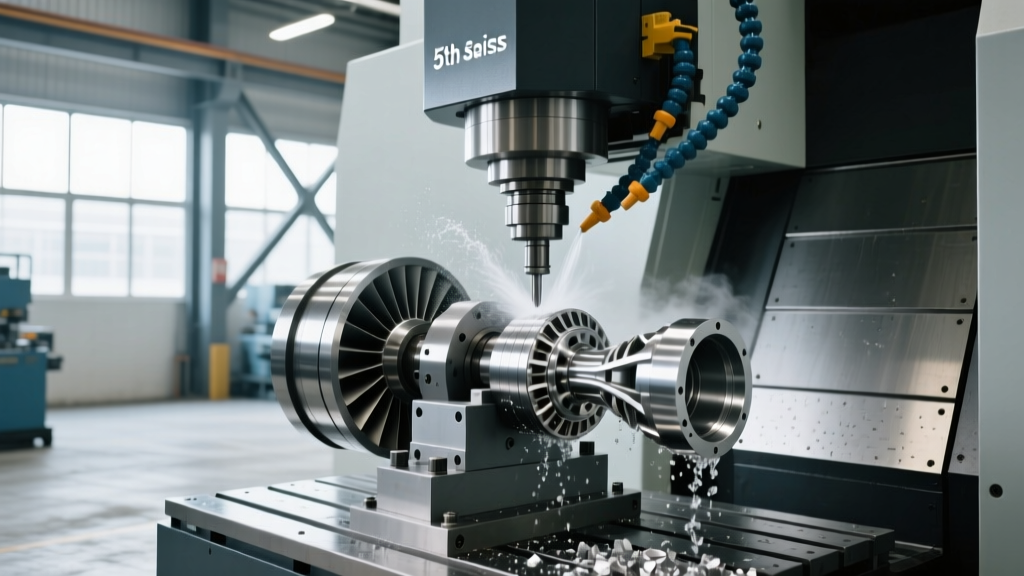
Bladed disks (blisks) for LEAP engine compressors require 5-axis simultaneous milling from solid Ti-6Al-4V forgings. The geometry features deep, narrow channels between airfoils, demanding long-reach toolholders and extreme part stability. A Tier-1 aerospace supplier utilized a Hermle C 250 5-axis machine but faced severe harmonic chatter during semi-finishing passes due to inadequate clamping rigidity on the thin outer rim of the blisk.
The Fixturing Solution: Zero-Point and Custom Dovetails
The engineering team abandoned traditional strap clamps and implemented a two-operation workflow utilizing Hainbuch zero-point clamping technology.
- Operation 1 (Roughing): The raw titanium forging is clamped in a heavy-duty hydraulic vise. The machine mills the aerodynamic profiles and cuts a precision 60-degree dovetail feature into the non-critical base of the part.
- Operation 2 (Finishing): The part is flipped and the dovetail is locked into a custom-machined low-profile zero-point chuck. This exposes the entire top and side profiles to the spindle without any physical obstructions.
The clamping force required to withstand the radial cutting forces of titanium roughing (often exceeding 4,000 N per tooth) was achieved by using four Hainbuch chucks per pallet, generating a combined retention force of 80 kN. This eliminated the micro-movements that were previously causing premature tool wear on the $450 solid carbide end mills.
Medical Case Study: Cobalt-Chrome Femoral Implants on Haas UMC-750SS
Orthopedic knee femoral components feature complex, freeform articular surfaces that require mirror finishes and strict geometric tolerances (±0.01mm). Machining Cobalt-Chrome (CoCr) alloys is notoriously difficult due to their high work-hardening rates and abrasive nature. A medical contract manufacturer running a Haas UMC-750SS struggled with part deformation when using high clamping pressures on standard vises.
The Fixturing Solution: Force-Multiplying Low-Profile Vises
To secure the irregular forging without crushing the delicate internal condyle cavities, the facility integrated the Schunk TANDEM plus 4 clamping force multiplier. This specific vise utilizes a 1:4 mechanical leverage ratio. By applying a standard hydraulic input pressure of 15 kN, the vise generates an output clamping force of 60 kN.
"In 5-axis medical machining, the vise is often the limiting factor for tool access. By using force multipliers, we can use significantly lower input pressure, which allows us to design smaller, lighter vise bodies that clear the 5-axis spindle housing during extreme C-axis rotations." — Lead Manufacturing Engineer, Orthopedic Contract Manufacturer.
The low-profile jaws were custom wire-EDM'd to match the exact contour of the raw CoCr forging. Because the Schunk zero-point clamping systems allow for rapid pallet swaps, the machine's twin-pallet pool keeps the spindle cutting 95% of the time, while the operator loads raw forgings on the secondary pallet outside the machining envelope.
Comparative Matrix: 5-Axis Workholding Methods
Selecting the correct fixturing method depends on the material hardness, part geometry, and production volume. The matrix below outlines the operational parameters for the four primary 5-axis workholding strategies.
| Workholding Method | Optimal Application | Z-Clearance Profile | Approx. Cost per Station | Rigidity / Damping |
|---|---|---|---|---|
| Zero-Point Dovetail | Aerospace structural, Blisks | Extremely Low (15-30mm) | $1,800 - $2,500 | Exceptional (Direct metal-to-metal) |
| Force-Multiplier Vise | Medical implants, Hard metals | Medium (60-90mm) | $3,200 - $4,500 | High (Mechanical leverage) |
| Vacuum Chucking | Thin-wall aluminum, Composites | Ultra-Low (5-10mm) | $4,000 - $8,000 | Low (Relies on surface area/friction) |
| Magnetic Chucks | Ferrous die/mold components | Low (20-40mm) | $2,500 - $5,000 | Medium (Susceptible to lateral shear) |
Overcoming Edge Cases: Harmonic Chatter and Thermal Growth
Even with premium fixturing, 5-axis simultaneous machining introduces unique physical edge cases that standard CAM toolpaths fail to predict.
Harmonic Chatter in Thin-Wall Features
When milling 2mm thin walls in aerospace aluminum (7075-T6) using a 5-axis tilt to maintain optimal tool engagement, the part acts as a tuning fork. Standard workholding cannot dampen this vibration. The proven solution is the application of a specialized damping polymer, such as Magna-Damp, between the raw stock and the fixture base during roughing. This viscous material absorbs high-frequency acoustic energy, reducing chatter marks by up to 85% and allowing for 30% higher feed rates.
Thermal Expansion in Zero-Point Systems
During high-volume production of titanium parts, the continuous application of 70-bar through-spindle coolant causes the machine table and the zero-point base plate to expand at different rates. If the base plate is made of standard carbon steel and the machine table is cast iron, thermal growth will misalign the pull-studs by up to 0.04mm over an 8-hour shift. To mitigate this, high-end aerospace facilities mandate that all zero-point base plates be machined from the same material grade as the machine table, or utilize Invar (an iron-nickel alloy with near-zero thermal expansion) for critical high-tolerance pallets, despite the $6,000+ material premium.
Strategic Procurement: Building a 5-Axis Fixturing Budget
Transitioning a shop floor to advanced 5-axis workholding requires a significant capital expenditure, but the ROI is realized through spindle uptime and scrapped-part reduction. A baseline procurement strategy for a single 5-axis cell should allocate funds as follows:
- Master Base Plate (Machine Specific): $3,500 - $5,500 (Includes custom T-slot or grid-hole machining to match the trunnion table).
- Zero-Point Chucks (Qty 4): $7,200 ($1,800 each for pneumatic/hydraulic actuation models).
- Calibrated Pull-Studs and Pallets (Qty 6): $4,500 (Allows for continuous offline loading while the machine runs).
- Custom Dovetail Cutters and Fixtures: $2,000 (Initial tooling for creating part-specific locking features).
Total initial cell investment hovers between $17,200 and $19,200. However, by eliminating manual part indicating and reducing setup times from 45 minutes to under 5 minutes, the system typically achieves full payback within 14 weeks on a standard two-shift production schedule. Investing in modular, high-rigidity workholding is not an optional accessory for 5-axis machining; it is the fundamental prerequisite for unlocking the machine's kinematic capabilities.