What Is Meant By CNC Machine Technology in 2026?
Discover what is meant by CNC machine technology in 2026. Explore AI toolpaths, MTConnect integration, and modern 5-axis smart manufacturing architectures.
The Core Definition: What Is Meant By CNC Machine?
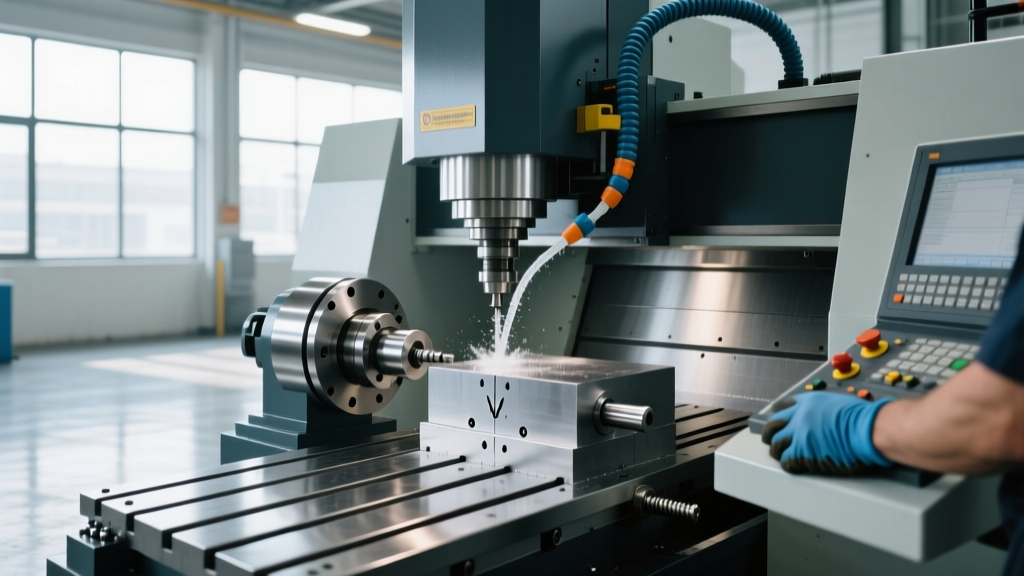
At its most fundamental level, Computer Numerical Control (CNC) refers to the automated control of machining tools by means of a computer executing a programmed sequence of machine control instructions. When industry professionals ask what is meant by CNC machine architecture in a historical context, they are typically referring to this basic electromechanical translation: digital G-code and M-code commands are converted into voltage signals that drive servo motors, moving a cutting tool along precise X, Y, and Z Cartesian coordinates.
The 2026 Paradigm Shift
Traditional Definition (Pre-2015): A blind, open-loop or semi-closed-loop system that executes static toolpaths until a tool breaks or a cycle completes.
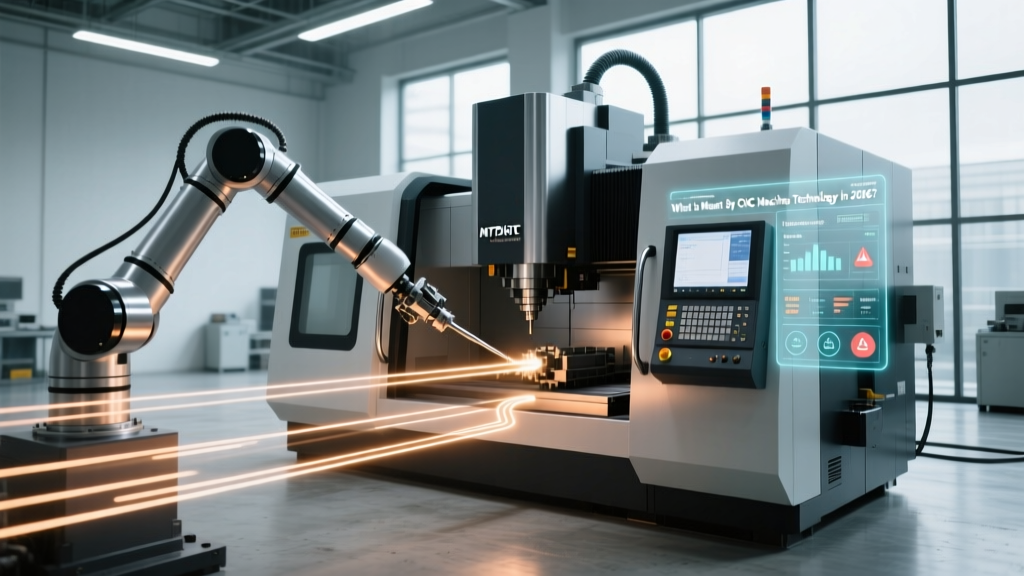
Modern Definition (2026): A cyber-physical, closed-loop manufacturing node that utilizes edge computing, real-time sensor fusion, and AI-driven kinematic compensation to autonomously adjust cutting parameters on the fly.
Today, the definition has expanded far beyond simple motion control. A modern CNC system is a data-generating node within a larger Industrial Internet of Things (IIoT) ecosystem. It does not merely remove material; it monitors spindle load at 1,000 Hz, compensates for thermal expansion in real-time, and pushes telemetry to cloud-based digital twins.
From Static G-Code to AI-Driven Kinematics
The most significant evolution in what is meant by CNC machine operation is the shift from static CAM output to dynamic, AI-augmented machining. Legacy workflows involved generating a toolpath in software like Mastercam, posting it to G-code, and running it blindly. If the material had a hard spot, the tool chipped.
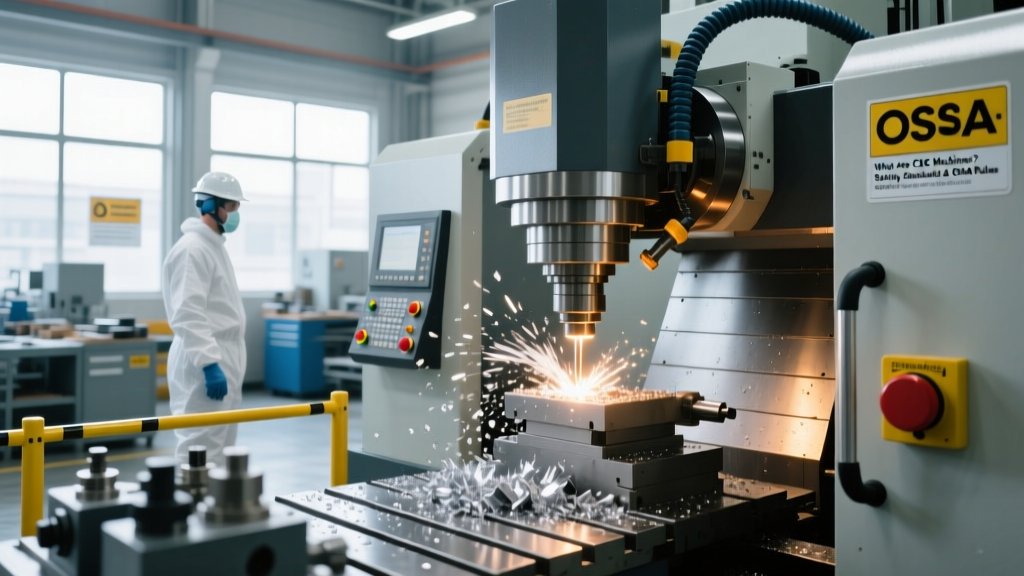
In 2026, advanced controllers like the Siemens Sinumerik 840D sl and Fanuc 31i-B5 feature integrated edge-computing capabilities. These systems utilize onboard AI to monitor acoustic emissions and spindle vibration. If the system detects chatter—a destructive self-excited vibration typically occurring between 400 Hz and 1,200 Hz—the controller autonomously adjusts the spindle speed and feed rate within milliseconds to move the process out of the resonant frequency zone.
Performance Metrics: AI Chatter Avoidance vs. Static CAM
- Cycle Time Reduction: 14% - 22% (due to optimized dynamic feed rates)
- Carbide End Mill Lifespan: Increased by up to 38%
- Surface Finish (Ra): Improved from 1.6 μm to 0.4 μm on aerospace aluminum (7075-T6)
- Scrap Rate: Reduced by 65% in thin-wall milling applications
Hardware Architecture of a Modern Smart CNC
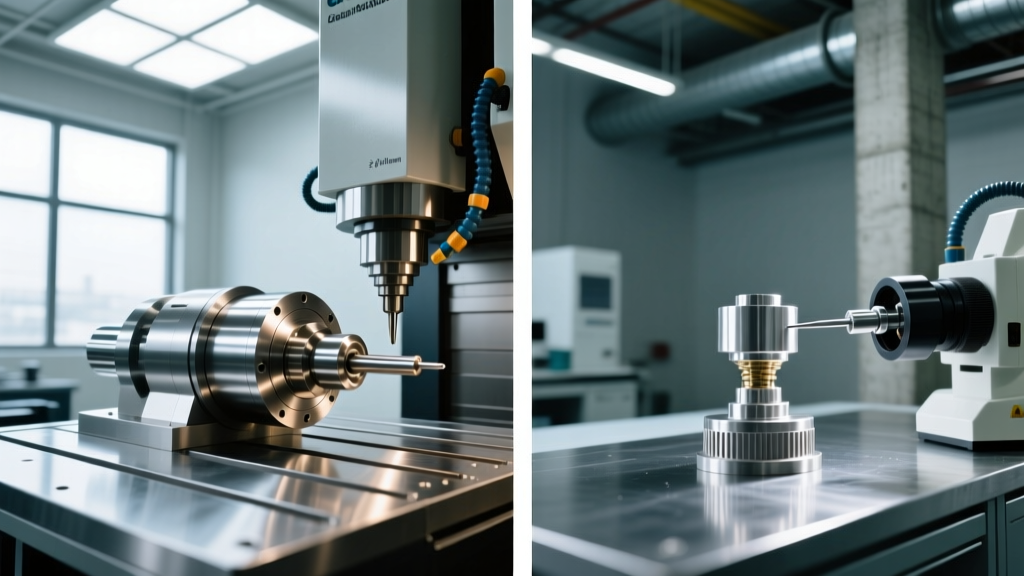
Understanding the physical hardware is critical to grasping modern CNC capabilities. The mechanical architecture of a 2026 machine tool relies heavily on direct-drive technology and absolute feedback loops.
Linear Encoders vs. Rotary Encoders
Legacy machines relied on rotary encoders attached to the servo motors to guess the position of the table based on ball screw rotations. This introduced backlash and thermal growth errors. Modern high-precision CNC mills utilize absolute linear encoders, such as the Heidenhain LC 400 series. These glass scales measure the actual position of the machine table directly, eliminating ball screw pitch errors and thermal expansion inaccuracies, holding tolerances down to ±2 μm over a 1,000 mm travel distance.
Direct Drive Torque Motors
In 5-axis CNC machines, the rotary trunnion tables (A and C axes) have largely abandoned worm-gear drives in favor of direct-drive torque motors. This eliminates mechanical backlash entirely, allowing for simultaneous 5-axis interpolation with zero reverse-error, which is mandatory for machining complex aerodynamic profiles in Inconel 718 or titanium Ti-6Al-4V.
Legacy vs. Smart CNC: A Technical Comparison
The table below illustrates the hardware and software divergence between standard legacy machines and modern smart manufacturing nodes.
| System Feature | Legacy Architecture (2010-2018) | Smart CNC Architecture (2026) |
|---|---|---|
| Position Feedback | Rotary motor encoders (semi-closed loop) | Absolute linear glass scales (fully closed loop) |
| Tool Monitoring | Contact-based tool setter (pre-cycle only) | Non-contact laser (Renishaw NC4) + spindle load AI monitoring |
| Thermal Control | Manual warm-up cycles required | Active spindle cooling + AI thermal kinematic compensation |
| Connectivity | RS-232 serial, USB, basic Ethernet (DNC drip-feed) | Native MTConnect, OPC UA, 5G edge gateway integration |
Connectivity Standards: MTConnect and OPC UA
A machine cannot be considered 'smart' if its data is trapped inside the controller. The industry standard for extracting this data is MTConnect, an open-source, royalty-free standard that uses HTTP/HTTPS to stream XML-formatted machine data. MTConnect adapters sit on the machine controller and translate proprietary variables (like Fanuc FOCAS or Siemens S7 protocols) into a standardized schema.
While MTConnect is excellent for monitoring (reading data), OPC UA (Open Platform Communications Unified Architecture) is the 2026 standard for bidirectional, secure communication. OPC UA allows factory-level MES (Manufacturing Execution Systems) to not only read spindle speeds but also securely write new offset values or pause the machine based on downstream assembly line bottlenecks. According to NIST's Smart Manufacturing guidelines, combining MTConnect for high-speed telemetry with OPC UA for secure semantic command-and-control forms the backbone of a compliant Industry 4.0 shop floor.
Real-World Economics: Upgrading vs. Retrofitting
Understanding what is meant by CNC machine investment in 2026 requires analyzing the cost of acquiring smart capabilities. Purchasing a brand-new, fully integrated 5-axis smart machine, such as a Hermle C 42 U with integrated automation and pallet handling, routinely exceeds $750,000. Lead times for these European-built systems often stretch past 14 months.
For job shops and mid-sized manufacturers, the more viable route is CNC retrofitting and IoT integration. Upgrading an existing 3-axis machine (like a 2016 Haas VF-2) with a smart IoT gateway, an MTConnect adapter, and a Renishaw Equator comparative gauging system for automated in-process inspection costs between $22,000 and $28,000. This retrofit yields an ROI in under 14 months by eliminating manual inspection bottlenecks and enabling lights-out (unattended) machining shifts.
Step-by-Step: Auditing Your CNC for Smart Readiness
If you are evaluating your current fleet to determine if they meet the modern definition of a smart CNC node, execute this technical audit:
- Verify Controller I/O and Memory: Check if your CNC controller supports minimum 2GB of RAM and has an available RJ45 Ethernet port capable of 100/1000 Base-T. Older controllers with only RS-232 ports cannot support real-time MTConnect streaming without expensive hardware middleware.
- Assess Spindle Load Monitoring: Navigate to the machine's diagnostic pages. If the controller only displays total amperage, it lacks the granular data needed for AI tool-breakage detection. You need a controller that outputs per-axis load data at a minimum sampling rate of 100 Hz.
- Evaluate Thermal Stability: Run a 4-hour continuous cycle with a dial indicator on the spindle nose. If Z-axis thermal growth exceeds 15 μm and the machine lacks a software-based thermal compensation table, you will need to install external chillers or rely on manual offset adjustments, disqualifying it from unattended lights-out operations.
- Test Network Latency: Ping the machine's IP address from your shop's central server. For reliable OPC UA command-and-control, latency must remain below 5ms. If the machine is on a crowded Wi-Fi network, hardwire it via Cat6a cabling to a dedicated manufacturing VLAN.
The Future of Subtractive Manufacturing
Ultimately, what is meant by CNC machine technology today is the convergence of subtractive hardware with predictive software. The machines of 2026 do not just cut metal; they predict their own maintenance needs, order their own replacement carbide inserts via API integrations with suppliers, and dynamically rewrite their own toolpaths to account for material inconsistencies. For manufacturing engineers, mastering this cyber-physical ecosystem is no longer optional—it is the baseline requirement for maintaining competitive cycle times and aerospace-grade tolerances.