What Are CNC Machines? Safety Standards & OSHA Rules
Learn what CNC machines are through the lens of safety compliance. Explore OSHA rules, ANSI B11.23, ISO 16090, and essential safety retrofitting costs.
Defining the Hazard: What Are CNC Machines in Regulatory Terms?
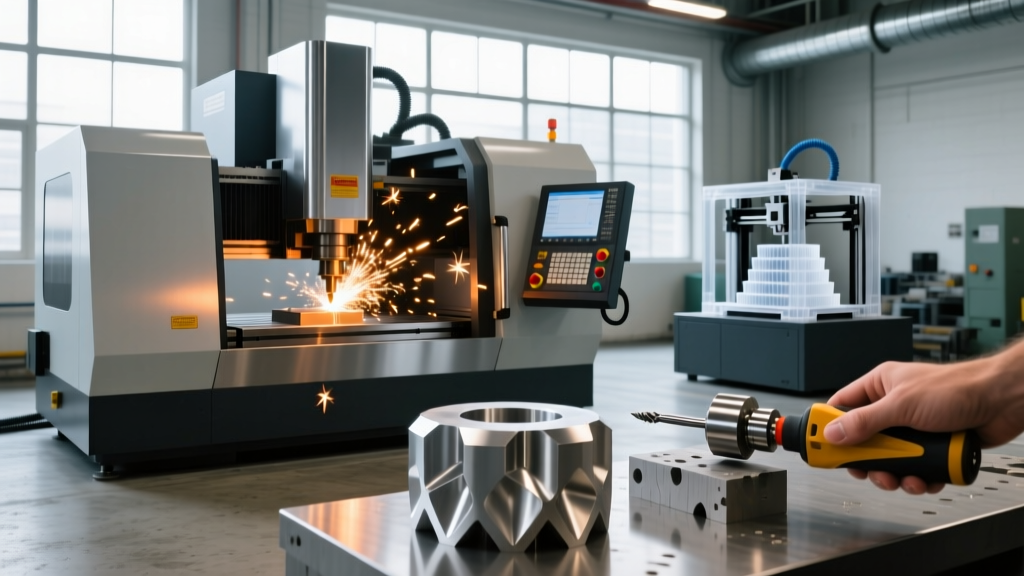
When facility managers and safety auditors ask "what is CNC machines compliance," they are confronting a complex intersection of automated kinetic energy, high-voltage electronics, and pressurized pneumatics. At a foundational level, Computer Numerical Control (CNC) machines are automated manufacturing tools—mills, lathes, and routers—that remove material via computer-programmed toolpaths. However, from a regulatory and safety engineering perspective, a CNC machining center is classified as a severe point-of-operation amputation hazard and a complex hazardous energy source.
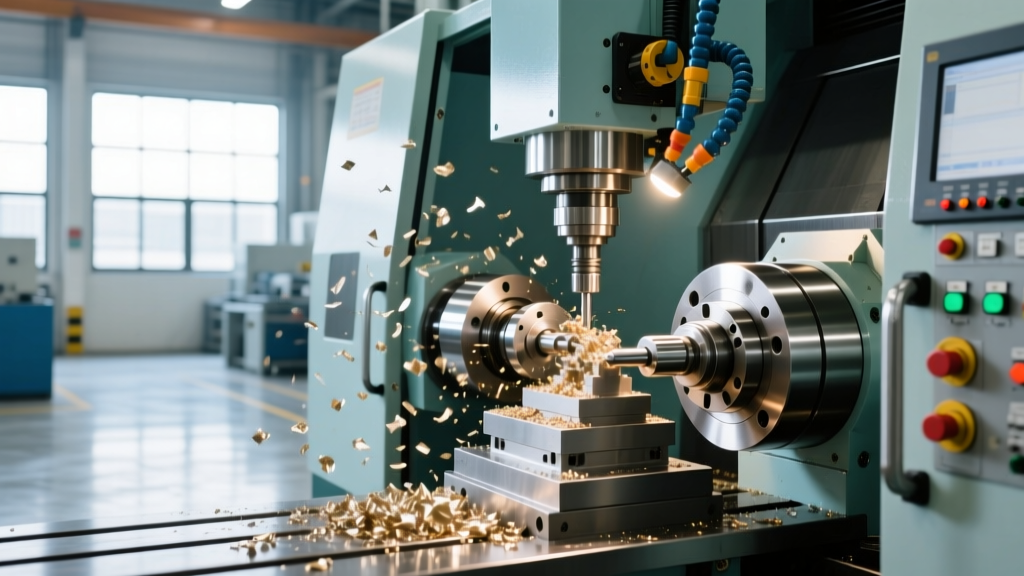
Understanding what CNC machines are requires looking past their productivity metrics and examining their risk profiles. A standard 3-axis vertical machining center (VMC) operating at 12,000 RPM generates enough rotational torque to sever limbs, while its automated tool changer (ATC) and hydraulic workholding fixtures introduce crushing and shearing hazards. In 2026, compliance is no longer just about bolting a polycarbonate shield to the enclosure; it requires integrated safety PLCs, fail-sensored interlocks, and strict adherence to evolving international standards.
Regulatory Definition
Under OSHA and ANSI frameworks, a CNC machine is defined as a power-driven, non-portable machine tool used for material removal, which requires mandatory point-of-operation guarding, automated cycle interlocks, and comprehensive Lockout/Tagout (LOTO) energy isolation procedures.
The Core Regulatory Framework: ANSI, ISO, and OSHA
Compliance for CNC equipment in North America is governed by a triad of overlapping standards. While OSHA provides the legal enforcement mechanism, the technical specifications for how to achieve compliance are detailed in ANSI and ISO documents.
| Standard | Scope & Application | Key 2026 Technical Requirement |
|---|---|---|
| ANSI B11.23 | Machining Centers, Turning Centers, and Boring Machines | Mandates Category 1 or Category 2 stop functions for spindle drives; prohibits reliance on standard machine controllers for safety-critical interlocks. |
| ISO 16090-1 | Machine Tools Safety (Milling, Transfer Machines) | Requires guard interlocks with solenoid locking (e.g., Schmersal AZM201) that prevent door opening until spindle momentum reaches zero. |
| OSHA 1910.212 | General Requirements for All Machines | Dictates that guards must be constructed of materials capable of withstanding impact from ejected workpieces or broken carbide tooling. |
| OSHA 1910.147 | Control of Hazardous Energy (LOTO) | Requires machine-specific LOTO procedures addressing stored kinetic energy (spindle coasting) and potential energy (hydraulic clamps). |
Point-of-Operation Safeguarding: Hardware Specifications
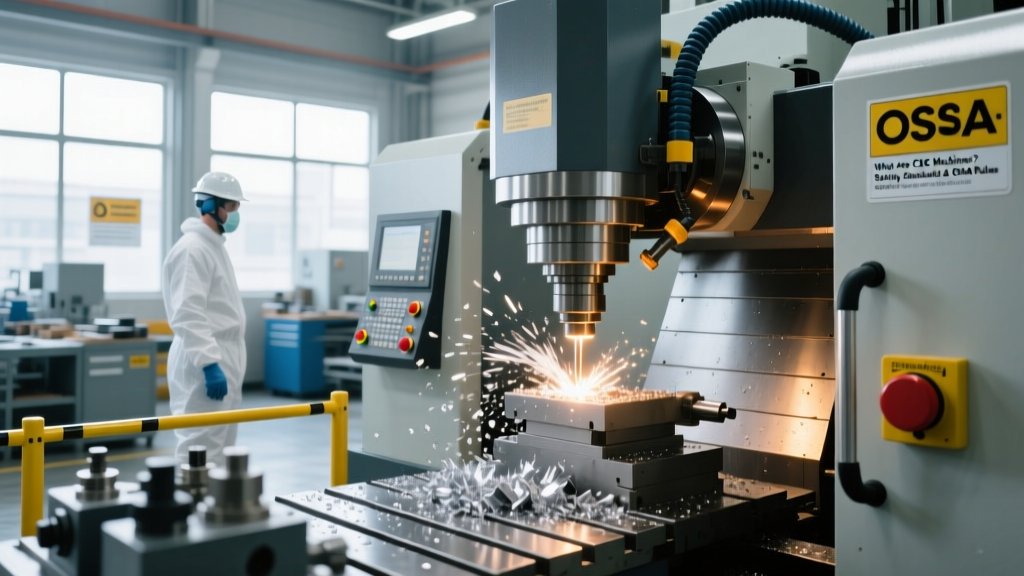
To answer what CNC machines are from a hardware safety perspective, one must examine the safety architecture that separates the operator from the cutting zone. Legacy machines often rely on simple mechanical limit switches to detect door closure. Modern compliance demands redundant, monitored safety circuits.
1. Interlocking Guards with Solenoid Locks
A standard 15,000 RPM spindle on a Haas VF-2SS takes approximately 4.2 seconds to spin down using dynamic braking. If an operator opens the enclosure door during a cycle, a simple Category 0 stop (immediate power removal) will cause the spindle to coast, leaving exposed, rotating tooling. Therefore, ANSI B11.23 requires a Category 1 controlled stop paired with a time-delayed solenoid lock. Devices like the Schmersal AZM201 or Euchner CTM feature RFID-coded actuators to prevent defeat and mechanical locks that physically prevent door opening until the safety PLC confirms zero spindle speed.
2. Light Curtains for Automated Loading
For CNC lathes or mills integrated with robotic tending cells, physical doors are replaced by optical barriers. A compliant setup requires a Type 4 safety light curtain, such as the SICK deTec4 Core. For finger detection at the load/unload station, the optical resolution must be 14mm, with a response time typically under 15ms. The safety distance calculation (based on ISO 13855) must account for the machine's total stopping time, including the PLC scan cycle and hydraulic valve shift time.
⚠️ Critical Warning: The 'Cheat Key' Epidemic
OSHA citation data consistently highlights the bypassing of interlock switches as a leading cause of CNC-related amputations. Operators frequently tape over limit switches or use fabricated 'cheat keys' to run cycles with doors open for faster part inspection. Upgrading to RFID-coded, tamper-proof actuators (like the Euchner CET3) eliminates the ability to bypass guards with spare magnets or raw stock.
Lockout/Tagout (LOTO): Managing Stored Energy
Understanding what CNC machines are requires recognizing that turning off the main disconnect switch does not make the machine safe. CNC equipment stores hazardous energy in multiple forms that must be isolated or bled down before maintenance. According to OSHA's LOTO standard (1910.147), failure to address stored energy is a frequent citation trigger.
- Kinetic Energy: Heavy spindles and rotary tables (e.g., Haas HRT210) can coast for minutes after power loss. LOTO procedures must mandate a 'wait for zero speed' verification step.
- Pneumatic Potential Energy: Air-over-oil boosters and pneumatic chuck actuators retain pressure. Machines must be equipped with lockable dump valves (e.g., SMC residual pressure relief valves) that exhaust downstream air when locked out.
- Gravitational Energy: Vertical machining centers with heavy Z-axis saddles can drop if hydraulic counterbalance pressure is lost or if the servo brake fails during maintenance. Physical Z-axis blocking pins must be inserted before working under the spindle head.
- Thermal & Chemical Energy: High-pressure coolant pumps and heated probe enclosures require specific cool-down and isolation steps.
Environmental Compliance: Metalworking Fluid (MWF) Exposure
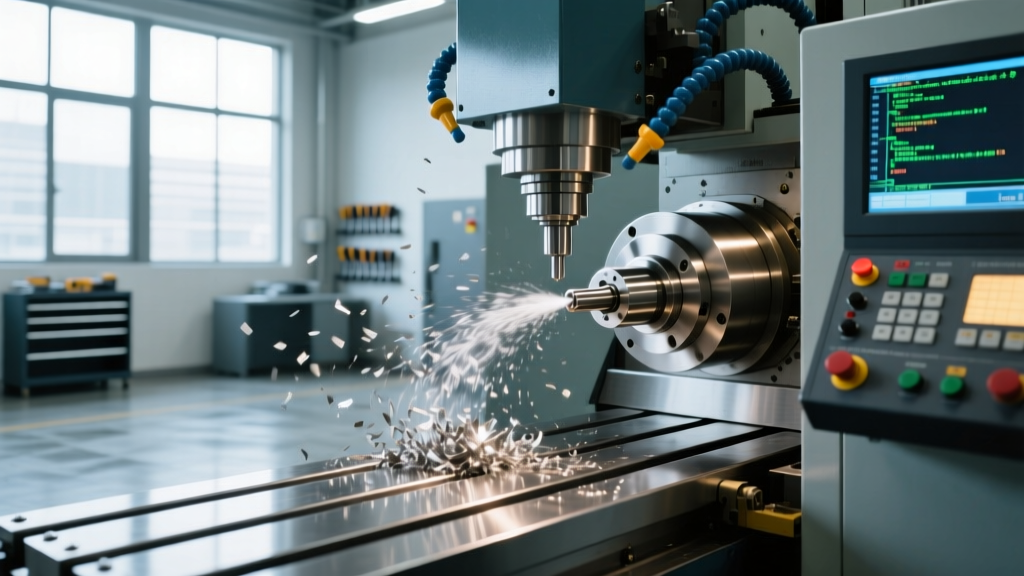
Safety compliance extends beyond mechanical hazards to respiratory and dermatological risks. CNC machining generates aerosolized metalworking fluids (MWFs) and microscopic particulate matter. While OSHA does not have a specific standard exclusively for MWF, they enforce the Particulates Not Otherwise Regulated (PNOR) standard, limiting exposure to 5 mg/m³ as an 8-hour Time-Weighted Average (TWA).
To maintain compliance and pass industrial hygiene air sampling, modern CNC enclosures must be sealed and paired with appropriately sized mist collectors. A standard 4-axis machining center requires a mist collector capable of 600 to 800 CFM with a multi-stage filtration system, culminating in a HEPA filter (99.97% efficiency at 0.3 microns). Failure to capture these aerosols not only violates OSHA air quality mandates but also degrades the machine's internal electronics and linear guideways.
The Economics of Compliance: Retrofit Costs vs. OSHA Fines
Many shop owners delay safety upgrades due to perceived costs. However, when evaluating what CNC machines are as financial assets, the cost of non-compliance vastly outweighs the capital expenditure of proper safeguarding. In 2026, OSHA's maximum penalty for a willful or repeated machine guarding violation exceeds $165,000 per instance.
| Safety Upgrade Scenario | Estimated Capital Cost (Parts & Labor) | Potential OSHA Fine (Willful Violation) |
|---|---|---|
| Upgrade mechanical limit switch to RFID solenoid interlock (e.g., Pilz PSENmlock) | $850 - $1,400 | Up to $165,324 |
| Install standalone Safety PLC (e.g., Pilz PNOZ Multi 2) to monitor E-Stops and Guards | $3,200 - $5,500 | Up to $165,324 |
| Add HEPA Mist Collector and seal enclosure leaks | $4,000 - $7,500 | Up to $16,532 (Serious) |
| Comprehensive Machine-Specific LOTO Procedure Creation & Training | $1,500 - $3,000 | Up to $165,324 |
Real-World Edge Cases in CNC Safety
Standard safety manuals rarely address the nuanced edge cases that occur on active shop floors. Safety engineers must design protocols for these specific scenarios:
The Chip Conveyor Entanglement Hazard
While the main spindle is heavily guarded, the chip conveyor at the rear of the machine is a frequent site of entanglement and amputation injuries. Operators often reach into the conveyor trough to clear stringy aluminum chips while the auger is running. Compliance requires the chip conveyor motor to be integrated into the machine's main safety circuit, ensuring that opening the rear maintenance panel triggers an immediate Category 0 stop of the auger drive.
Probing and Tool Setting Cycles
During setup, operators use spindle-mounted probes (e.g., Renishaw OMP60) to set work offsets. This requires the operator to be inside the machine envelope or leaning through the door with the cycle active. Safety standards permit this only under strict 'Setup Mode' conditions: the spindle speed must be limited to under 200 RPM, the feed rate capped, and the operator must utilize a handheld pendant with a dedicated, hardwired enabling switch (dead-man's switch) that requires constant, moderate pressure to keep the machine moving.
Summary: Building a Culture of Compliance
Ultimately, answering what CNC machines are means acknowledging them as highly capable but inherently dangerous industrial robots. Achieving full safety compliance in 2026 requires moving beyond basic physical barriers and implementing monitored, tamper-resistant safety architectures. By investing in RFID interlocks, dedicated safety PLCs, and rigorous LOTO protocols, manufacturing facilities protect their most valuable assets—their operators—while insulating the business from catastrophic regulatory fines and operational downtime.