What Does CNC Machine Stand For? CNC vs Manual vs 3D Printing
Discover what CNC machine stands for and compare Computer Numerical Control against manual machining, 3D printing, and PLC automation for 2026 production.
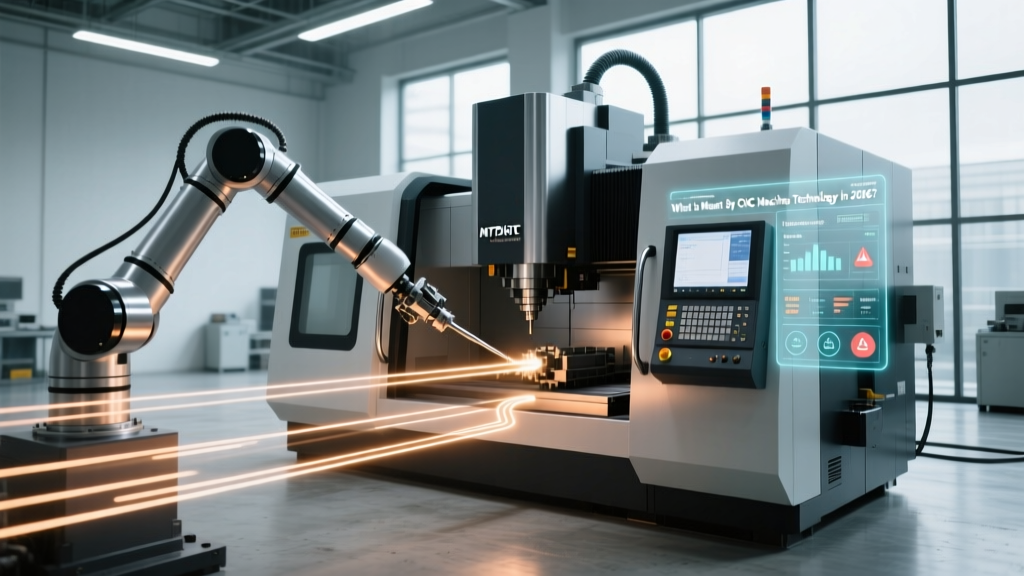
At its core, the acronym CNC stands for Computer Numerical Control. This refers to the automated control of machining tools—such as mills, lathes, routers, and grinders—by means of a computer executing pre-programmed sequences of machine control commands. While the definition is straightforward, understanding where CNC fits into the modern manufacturing ecosystem requires comparing it against its primary alternatives: manual machining, additive manufacturing (3D printing), and programmable logic controller (PLC) automation.
Decoding the Acronym: What Does CNC Machine Stand For?
To fully grasp the technology, we must break down the three components of the acronym:
- Computer: The onboard microprocessor and CAD/CAM software that translate 3D models into machine-readable instructions.
- Numerical: The coordinate system (X, Y, Z, and rotary A, B, C axes) and the specific G-code (RS-274 standard) and M-code instructions that dictate exact positional movements, spindle speeds, and coolant flows.
- Control: The servo motors, ball screws, and closed-loop feedback systems that physically execute the numerical commands with sub-micron precision.
The Manufacturing Matrix: CNC vs. Alternatives
Choosing the right manufacturing method depends on volume, geometric complexity, and material requirements. According to the Society of Manufacturing Engineers (SME), process selection is the most critical factor in determining unit economics. Below is a direct comparison of standard production methods in 2026.
| Manufacturing Method | Standard Tolerance | Setup Time | Cost per Part (Qty 100) | Geometric Freedom |
|---|---|---|---|---|
| CNC Milling (3-Axis) | ±0.001' (0.025mm) | 2-4 Hours (CAM/Fixturing) | $12 - $45 | Low (Requires line-of-sight tool access) |
| CNC Milling (5-Axis) | ±0.0005' (0.012mm) | 4-8 Hours (Complex Fixturing) | $35 - $120 | Medium (Undercuts and complex angles) |
| Manual Machining | ±0.005' (0.127mm) | 10-15 Minutes | $80 - $150 | Low |
| SLM 3D Printing (Metal) | ±0.004' (0.1mm) | 1-2 Hours (Slicing/Support) | $60 - $200 | High (Internal lattices, conformal cooling) |
| Injection Molding | ±0.002' (0.05mm) | 4-8 Weeks (Tooling) | $0.50 - $3.00 | Medium |
CNC vs. Manual Machining: The Tolerance and Throughput Divide
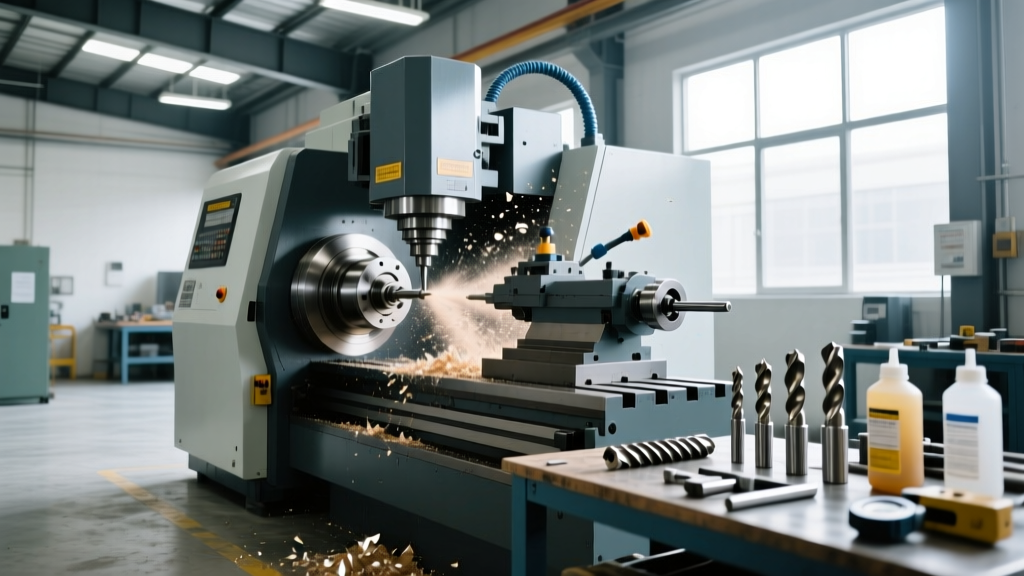
The most common point of confusion for beginners is when to use a CNC machine versus a manual machine. Manual machines, like the iconic Bridgeport Series I knee mill (which costs between $12,000 and $25,000 on the used market in 2026), rely entirely on the operator's hand-eye coordination, utilizing handwheels and digital readouts (DROs).
When Manual Wins
Manual machining is superior for quick, one-off modifications, simple facing operations, or emergency repair parts where programming a CAM toolpath would take longer than simply cutting the part. If you need to drill three holes and mill a flat edge on a steel block, a manual machinist can complete the task in 15 minutes. A CNC workflow requires 3D modeling, CAM programming, post-processing G-code, and indicating the vise—a process that takes a minimum of 45 minutes before the spindle even turns on.
When CNC Dominates
Once the quantity exceeds three parts, or the geometry requires 3D contouring, CNC becomes mandatory. A modern entry-level CNC, such as the Haas Mini Mill (priced around $45,000 to $55,000 new), will run unattended once the first article is proven. Furthermore, human operators cannot reliably hold tolerances tighter than ±0.002 inches over a long production run due to fatigue and thermal expansion of the machine. CNC closed-loop servo systems constantly monitor positional feedback, easily holding ±0.0005 inches on high-precision aerospace components.
Subtractive (CNC) vs. Additive (Industrial 3D Printing)
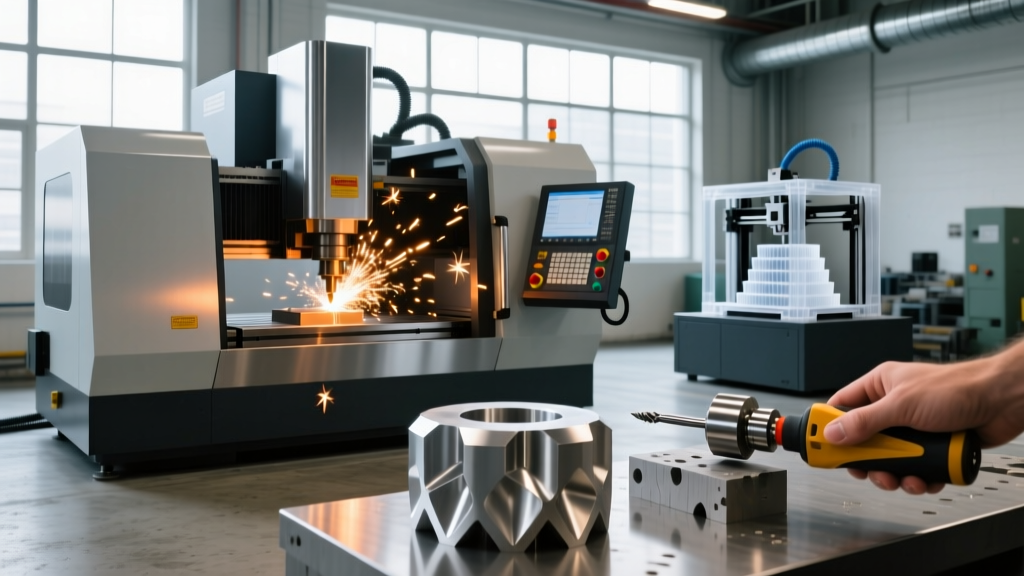
Metal 3D printing, specifically Selective Laser Melting (SLM) and Electron Beam Melting (EBM), is often positioned as a replacement for CNC. In reality, they are complementary processes. The National Institute of Standards and Technology (NIST) highlights that additive manufacturing excels in topology-optimized parts, but struggles with surface finish and absolute dimensional accuracy.
Material and Structural Integrity
CNC machining removes material from a solid billet (e.g., 6061-T6 Aluminum or 304 Stainless Steel). The resulting part retains the isotropic strength of the original wrought material. In contrast, SLM 3D printing builds parts layer by layer from metal powder (e.g., AlSi10Mg or Ti64). This creates anisotropic strength, meaning the part is typically weaker along the Z-axis (the build direction) due to microscopic porosity between layers. For high-stress structural components like aircraft landing gear brackets, CNC machining from a forged billet remains the undisputed standard.
The Hybrid Workflow
In advanced 2026 manufacturing facilities, the most efficient workflow often combines both. A complex titanium turbine blade with internal conformal cooling channels is first 3D printed using SLM to achieve the impossible internal geometry. The part is then moved to a 5-axis CNC mill, which machines the critical mounting surfaces and airfoil edges to achieve the required ±0.001' tolerance and smooth aerodynamic surface finish.
Decision Framework: Selecting Your Manufacturing Process
Use this practical decision tree to determine the optimal manufacturing method for your next project:
- Step 1: Evaluate Volume. If you need 10,000+ identical parts, invest in Injection Molding or Die Casting tooling. If volume is under 5,000, proceed to Step 2.
- Step 2: Check Geometric Complexity. Does the part have internal channels, undercuts inaccessible by a cutting tool, or complex organic lattice structures? If yes, use Metal 3D Printing (SLM/DMLS). If no, proceed to Step 3.
- Step 3: Assess Tolerances and Material. Do you require tolerances tighter than ±0.002' or maximum isotropic material strength? If yes, choose CNC Machining. If the part is a simple bracket with loose tolerances (±0.010') and low stress, consider manual machining or heavy-duty industrial FDM 3D printing.
Real-World Cost Breakdown: 2026 Estimates
Understanding the crossover point where CNC becomes cheaper than manual machining is vital for shop floor profitability. Based on average US machine shop rates ($120-$150/hour):
- Quantity 1 (Simple Aluminum Bracket): Manual Machining = $45 (15 mins setup + 15 mins cut). CNC Machining = $180 (1 hour CAM + 30 mins setup + 15 mins cut).
- Quantity 10: Manual Machining = $450. CNC Machining = $250 (Setup cost amortized, cycle time is 12 mins per part).
- Quantity 100: Manual Machining = $4,500 (Operator fatigue slows cycle time). CNC Machining = $850 (Unattended lights-out machining with automatic tool changers).
Frequently Asked Questions
What is the difference between CNC and PLC?
While CNC (Computer Numerical Control) is specifically designed to control the multi-axis spatial movement of cutting tools using G-code, a PLC (Programmable Logic Controller) is used to automate factory processes, such as conveyor belts, pick-and-place robots, and assembly line sequencing using ladder logic. CNC handles the 'cutting', while PLC handles the 'handling'.
Can a CNC machine cut any material?
No. CNC routers and mills can machine metals (aluminum, steel, titanium), plastics (Delrin, PEEK, Polycarbonate), and woods. However, they cannot easily cut highly brittle materials like tempered glass or advanced ceramics without specialized diamond-grinding attachments and ultrasonic assistance. For those, waterjet cutting (which is also CNC-controlled) is the preferred alternative.
What does 'CNC' mean in the context of 3D printers?
Technically, industrial 3D printers are also CNC machines, as they rely on Computer Numerical Control to move the print head along the X, Y, and Z axes. However, industry parlance reserves the term 'CNC' exclusively for subtractive manufacturing (mills, lathes, routers), while 3D printers are classified under additive manufacturing.