Advanced CNC Machining Work: Aerospace vs Medical Case Studies
Explore real-world CNC machining work through aerospace and medical case studies. Compare tolerances, materials, and 5-axis mill costs for 2026.
The Divergent Demands of High-Stakes CNC Machining Work
When evaluating precision manufacturing, the term CNC machining work encompasses a vast spectrum of capabilities. However, the operational realities between aerospace structural components and medical orthopedic implants represent two entirely different engineering disciplines. While both require 5-axis simultaneous milling, the tooling strategies, spindle requirements, and quality assurance protocols diverge sharply. In 2026, as supply chains for critical raw materials like titanium and medical-grade polymers tighten, understanding these distinct applications is vital for shop owners and procurement engineers alike.
2026 Industry Data Highlight: The global market for precision CNC aerospace components has reached $41.2 billion, driven by next-generation narrow-body aircraft production. Conversely, the CNC medical device manufacturing sector sits at $28.5 billion, with a 14% year-over-year growth in custom orthopedic implants requiring micro-tolerance machining.Case Study 1: Aerospace Structural Bulkheads (Titanium Ti-6Al-4V)
Aerospace CNC machining work is defined by extreme material removal rates (MRR) and the management of high cutting forces. Consider the production of a wing root bulkhead from a solid billet of Ti-6Al-4V. The 'buy-to-fly' ratio—the weight of the raw material versus the finished part—often exceeds 10:1. This means machining away 90% of a $58-per-pound titanium billet.
Material & Tooling Realities
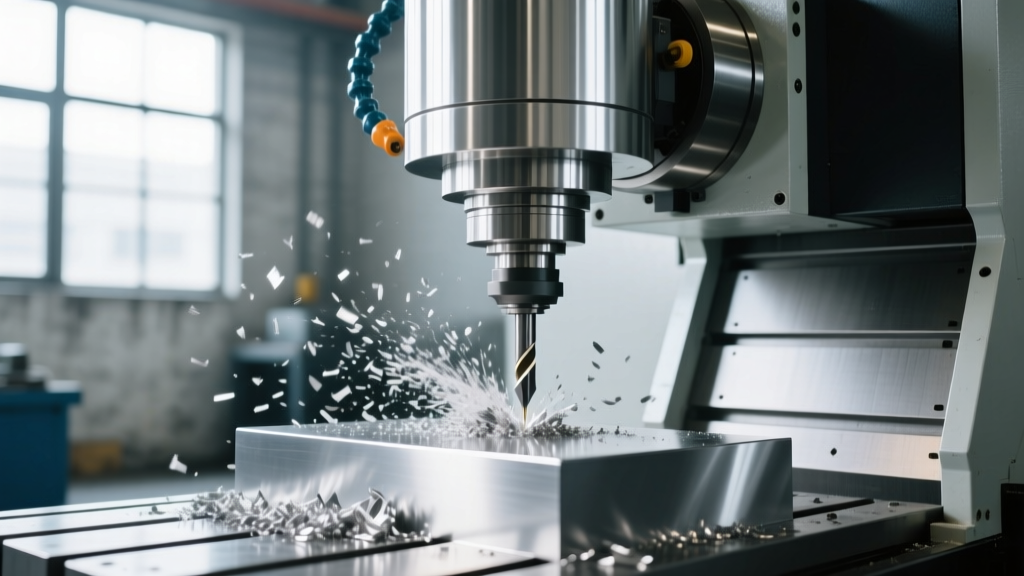
Titanium's low thermal conductivity traps heat at the cutting edge, leading to rapid tool degradation. Shops performing this CNC machining work must utilize specialized carbide end mills with AlTiN (Aluminum Titanium Nitride) coatings. A standard 1-inch diameter roughing end mill costing $185 might only yield 45 minutes of effective cutting time before flank wear exceeds the 0.3mm threshold, risking catastrophic part scrap. High-pressure coolant systems delivering 1,000 PSI directly to the cutting zone are non-negotiable to evacuate chips and prevent re-welding.
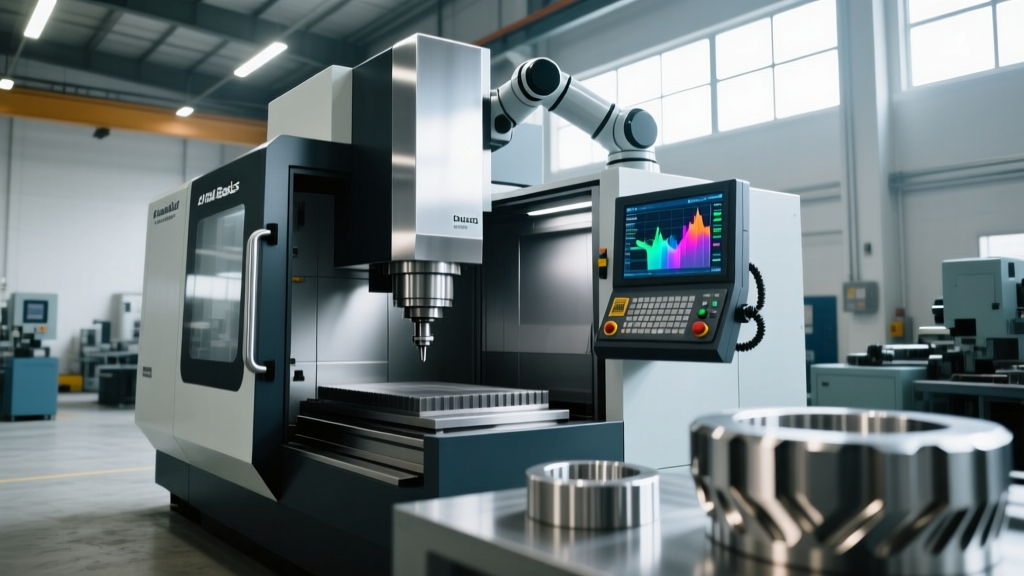
Machine Selection: DMG MORI HSC 105 linear
For heavy aerospace titanium milling, the DMG MORI HSC 105 linear remains a benchmark in 2026. Priced at approximately $850,000 fully configured, this 5-axis machine features a 42,000 RPM spindle and linear motor drives. The linear drives eliminate backlash, which is critical when performing trochoidal milling paths in hardened titanium. A single bulkhead cycle time on this machine averages 38 hours, requiring automated tool breakage detection and in-process probing to ensure dimensional integrity without operator intervention.
Case Study 2: Medical Orthopedic Implants (PEEK & Cobalt Chrome)
Medical CNC machining work shifts the focus from brute-force material removal to microscopic surface finishes and biocompatibility. Manufacturing a spinal interbody fusion cage from PEEK (Polyetheretherketone), specifically Victrex 450G, or a femoral knee component from ASTM F75 Cobalt Chrome, requires an entirely different machine architecture.
The Micro-Tolerance Challenge
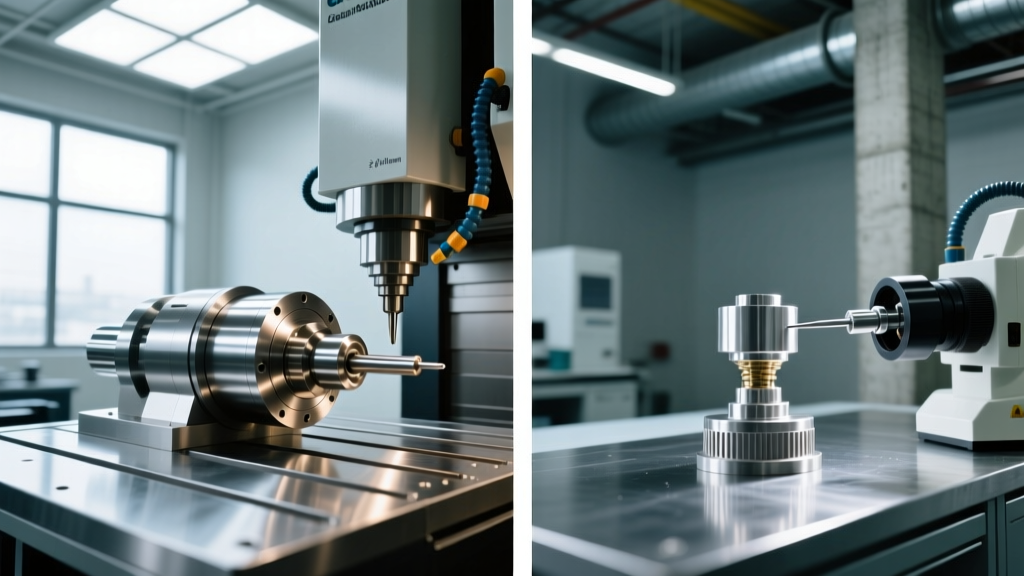
Medical implants demand surface roughness values (Ra) of less than 0.1 µm to prevent bacterial adhesion and ensure proper osseointegration. Achieving this directly off the CNC mill requires spindle speeds exceeding 50,000 RPM and specialized diamond-coated micro-tooling. Unlike aerospace parts, medical CNC machining work generates fine, abrasive dust rather than long stringy chips. This necessitates advanced extraction systems and post-machining ultrasonic cleaning to remove any embedded tooling residue, which could trigger severe biological rejection.
Machine Selection: Willemin-Macodel W408MT
The Willemin-Macodel W408MT is engineered specifically for this tier of medical CNC machining work. Featuring a 50,000 RPM motor spindle and a highly rigid mineral composite bed, it absorbs the high-frequency vibrations generated by micro-milling. The machine's integrated turn-mill capability allows a complex CoCr knee implant to be completed in a single setup, reducing cycle times from 4 hours to 115 minutes while holding tolerances down to ±0.002mm.
Comparative Matrix: Aerospace vs. Medical Parameters
| Parameter | Aerospace (Ti-6Al-4V Bulkhead) | Medical (CoCr Knee Femoral) |
|---|---|---|
| Primary Tolerance | ±0.025mm | ±0.003mm |
| Spindle Speed Requirement | 8,000 - 15,000 RPM (High Torque) | 35,000 - 50,000 RPM (High Speed) |
| Coolant Strategy | 1,000 PSI Through-Tool Flood | MQL (Minimum Quantity Lubrication) or Mist |
| Average Tooling Cost per Part | $420 (Rapid Wear) | $85 (Micro-tooling) |
| Surface Finish (Ra) | 1.6 µm (Standard Machined) | < 0.1 µm (Mirror Finish) |
Navigating the Hidden Costs in Complex CNC Machining Work
When quoting or planning high-precision CNC machining work, novice estimators often calculate raw material and spindle time while ignoring the massive overhead of quality control and fixturing. In 2026, these hidden costs can account for up to 40% of the total part price.
- CMM Inspection Time: A Zeiss CONTURA G3 coordinate measuring machine costs upwards of $185,000. Inspecting a 5-axis aerospace impeller with 80+ critical dimensions can take 3 hours on the CMM, adding $90 to $120 in pure metrology labor per part.
- Custom Tombstone Fixturing: Medical parts are too small and complex for standard Kurt DX6 vises. Designing and machining custom aluminum tombstones with hydraulic clamping to hold 24 small implants simultaneously requires an upfront NRE (Non-Recurring Engineering) investment of $4,500 to $8,000.
- Scrap and Rework Penalties: In medical CNC machining work, a single batch of scrapped PEEK implants due to a thermal expansion error doesn't just lose the $300 material cost; it triggers a mandatory root-cause analysis and FDA documentation audit, costing thousands in administrative downtime.
Strategic Sourcing: In-House vs. Outsource Decision Framework
Determining whether to bring specialized CNC machining work in-house or outsource to a Tier 1 supplier requires a rigid analytical framework. Use the following parameters to guide your capital expenditure decisions:
- Volume vs. Complexity Matrix: If annual volume exceeds 5,000 parts and geometry requires only 3-axis milling, invest in mid-tier VMCs (e.g., Haas VF-2SS). If volume is under 500 parts but requires 5-axis simultaneous contouring and sub-micron tolerances, outsource to a specialized job shop to avoid the $800k+ capital depreciation of a Willemin or Hermle machine.
- Certification Overhead: Do you possess the quality management infrastructure to maintain AS9100 Rev D for aerospace or ISO 13485:2016 for medical devices? Maintaining these certifications requires dedicated quality engineers and annual third-party audits costing $15,000+. If your core competency is general commercial machining, outsource the high-stakes work.
- Material Traceability Requirements: Aerospace CNC machining work demands full heat-lot traceability for every titanium billet. If your current ERP system cannot track material certs from the saw to the shipping box, you are not legally cleared to produce flight-critical hardware.
Regulatory and Certification Overlaps
The regulatory environment surrounding advanced CNC machining work is unforgiving. For medical device manufacturers, compliance with the FDA Quality System Regulation mandates that every machining parameter—from spindle load to coolant concentration—be documented and repeatable. Similarly, the ISO 13485:2016 standard requires rigorous risk management at every stage of the manufacturing lifecycle.
On the aerospace side, the FAA Production Approval processes dictate that shops must prove process capability (Cpk values greater than 1.33) for all critical flight-safety dimensions. Ultimately, mastering CNC machining work in these high-stakes industries is less about the cutting of metal and more about the meticulous control of data, thermodynamics, and regulatory compliance.