What Is a CNC Machine Used For? A Buyer's Guide to Shop Applications
Discover what a CNC machine is used for and how to select the right mill, lathe, or router. Includes current pricing, models, and a buyer's matrix.
The Core Answer: What Is a CNC Machine Used For?
When evaluating shop floor upgrades, the most fundamental question is: what is a CNC machine used for in a modern manufacturing environment? At its core, a Computer Numerical Control (CNC) machine is used to automate subtractive manufacturing processes. By translating CAD/CAM software into G-code and M-code instructions, CNC systems drive servo motors and spindles to remove material from a workpiece with extreme repeatability, routinely holding tolerances within ±0.0005 inches (0.0127 mm).
From a buyer’s perspective, a CNC machine is used to transition a fabrication shop from low-volume, manual prototyping to high-volume, lights-out production. However, 'CNC' is merely the control method, not the machine type. Selecting the right equipment requires matching your specific part geometries, material hardness, and production volumes to the correct machine architecture.
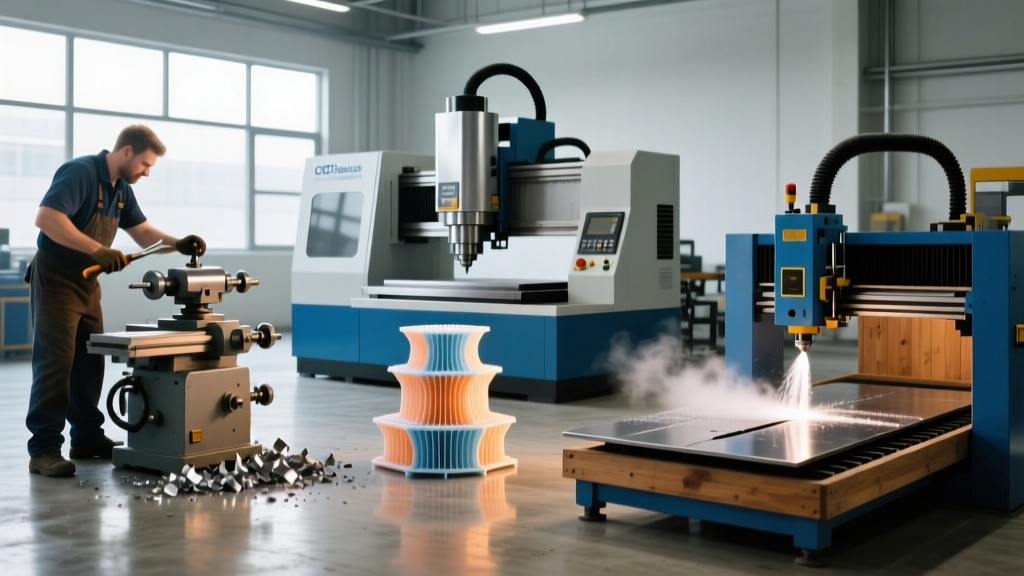
Executive Summary for Buyers: CNC machines are used for milling (prismatic parts), turning (rotational parts), routing (sheet goods/signage), and cutting (plasma/laser/waterjet). Your purchase should be dictated by the bounding box of your most common parts and the required surface finish, not just the machine's price tag.Application-to-Equipment Matrix: Which CNC Type Do You Need?
Before requesting quotes from distributors, map your production needs against the machine categories below. This matrix reflects current market capabilities and baseline pricing for new, entry-to-mid-tier industrial equipment.
| CNC Machine Type | Primary Use Case | Ideal Materials | Approx. Price Range (New) | Industry Benchmark Model |
|---|---|---|---|---|
| Vertical Machining Center (VMC) | Prismatic parts, molds, die plates, 2.5D to 3D contouring | Aluminum, Steel, Titanium, Plastics | $65,000 – $120,000 | Haas VF-2 / DMG MORI M1 |
| CNC Lathe / Turning Center | Shafts, bushings, fasteners, rotational symmetry parts | Brass, Stainless Steel, Aluminum | $90,000 – $180,000 | Mazak Quick Turn 250 |
| Swiss-Type Lathe | High-volume, micro-precision medical/aerospace pins | Medical-grade Titanium, Nitinol | $250,000 – $450,000+ | Citizen L20 / Tsugami B012 |
| CNC Router | Large-format sheet cutting, signage, woodworking | MDF, Acrylic, Aluminum Composite | $15,000 – $45,000 | ShopBot / MultiCam |
| 5-Axis Machining Center | Complex aerospace impellers, turbine blades, single-setup parts | Inconel, Hardened Steels, Alloys | $200,000 – $600,000+ | Haas UMC-750 / Hermle C42 |
Breaking Down the Big Three: Mills, Lathes, and Routers
1. CNC Mills (Vertical & Horizontal)
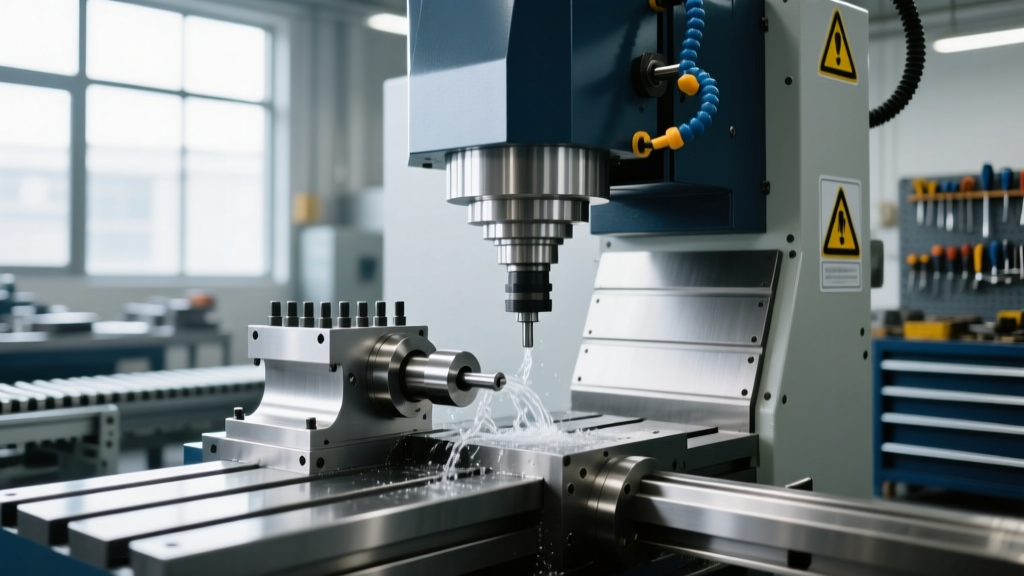
CNC mills are used for creating complex 3D shapes, pockets, slots, and drilled holes in block or plate material. The workpiece remains stationary on a table while a rotating spindle moves along the X, Y, and Z axes. According to Haas Automation, vertical mills (VMCs) dominate the general job shop market due to their smaller footprint and ease of workholding setup.
Buyer Insight: When spec'ing a VMC, pay close attention to the spindle taper and torque curve. A CAT40 taper (common in the US) is ideal for general machining up to 8,000 RPM. If you are machining aluminum aerospace components, you need a high-speed spindle (12,000+ RPM) with a BT40 or HSK63 taper to maintain surface finish and prevent chatter.
2. CNC Lathes & Turn-Mill Centers
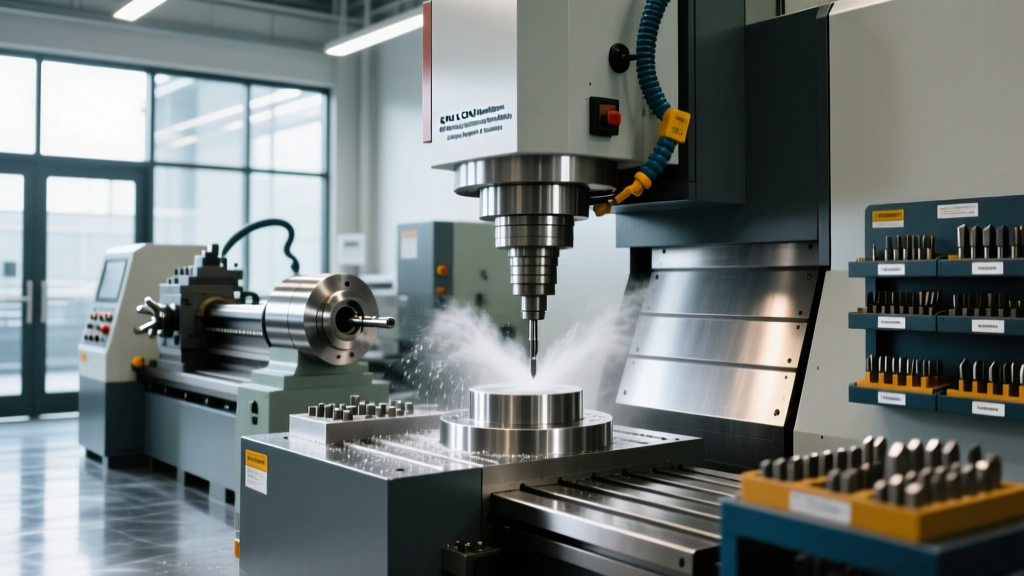
CNC lathes are used for parts with cylindrical geometries. The material rotates in a chuck or collet while stationary or driven cutting tools remove material. Modern turning centers often feature 'live tooling' and a C-axis, allowing the spindle to stop and act as a mill, completing off-center holes or flats without unclamping the part.
Buyer Insight: If your parts require secondary operations on a manual drill press or secondary mill after turning, invest in a mill-turn center. While a basic 2-axis lathe might cost $85,000, a Y-axis mill-turn center from Mazak will push $160,000 but will eliminate secondary setups, reducing total part cycle time by up to 40%.
3. CNC Routers & Plasmas
CNC routers are used primarily for non-ferrous metals, plastics, and composites in large sheet formats (e.g., 4x8 ft or 5x10 ft beds). Unlike VMCs, routers typically utilize a moving gantry rather than a moving table, allowing for massive work envelopes without consuming proportional floor space.
Buyer Insight: Do not buy a wood router to machine aluminum. Wood routers operate at 18,000–24,000 RPM with low torque and lack the rigid cast-iron mass required to dampen vibrations when cutting metal. For aluminum fabrication, specify an industrial router with a helical rack-and-pinion drive system and a liquid-cooled spindle.
⚠️ Warning: The Hidden Costs of CNC AcquisitionThe machine purchase price is only 60% of your total capital expenditure. First-time buyers frequently underbudget for the following mandatory ancillaries:
- Workholding: A pair of high-quality Kurt DX6 double-lock vises will cost ~$2,400. Hydrafeed or Smw-Autoblok hydraulic chucks for lathes can exceed $8,000.
- CAM Software: Mastercam or GibbsCAM licenses range from $6,000 to $12,000 per seat (plus annual maintenance). Subscription models like Fusion 360 (~$545/year) are viable for 3-axis work but lack advanced 5-axis collision avoidance features.
- Facility Upgrades: Most industrial CNCs require 3-phase power (208V or 480V). Installing a rotary phase converter or upgrading your shop's electrical panel can add $5,000–$15,000 to your project.
- Coolant & Extraction: High-pressure coolant pumps and mist collectors (like those from Abanaki or SmogHog) are necessary for OSHA compliance and tool life extension.
The Buyer’s Framework: 4 Steps to Spec Your Machine
To ensure you select a machine that yields a positive ROI, follow this sequential evaluation framework before contacting sales representatives.
- Audit the Part Bounding Box: Gather your top 20 most frequently machined parts. Map the maximum X, Y, and Z dimensions. Add 20% to these dimensions to determine your minimum required machine travel. Buying a machine where your largest part maxes out the table limits your workholding options and increases setup friction.
- Calculate the Chip-to-Chip Time: Evaluate rapid traverse rates. A machine with 1,000 ipm (inches per minute) rapids will shave seconds off every tool change. Over a 50,000-part production run, high rapids can save hundreds of hours of machine time, directly impacting your cost-per-part.
- Verify the Control Ecosystem: The CNC controller dictates operator efficiency. Fanuc and Siemens are global standards with massive talent pools, making it easier to hire experienced programmers. Proprietary controls (like Haas or Mazak Mazatrol) offer excellent conversational programming for quick shop-floor edits but may limit advanced macro capabilities.
- Assess Automation Readiness: Even if you aren't buying a robotic arm loader today, ensure the machine you spec has the necessary I/O ports, automatic doors, and air-blast chip clearing required for future integration with pallet pools or gantry loaders.
Frequently Asked Questions
Can a single CNC machine handle both milling and turning?
Yes. Multitasking machines, often called mill-turn centers or 5-axis turn-mills (such as the Mazak Integrex series), feature a main turning spindle, a secondary sub-spindle, and a milling head. These are used for 'done-in-one' manufacturing of highly complex parts like aerospace fittings and hydraulic manifolds, though they carry a premium price tag starting around $350,000.
What is the difference between a CNC mill and a CNC router?
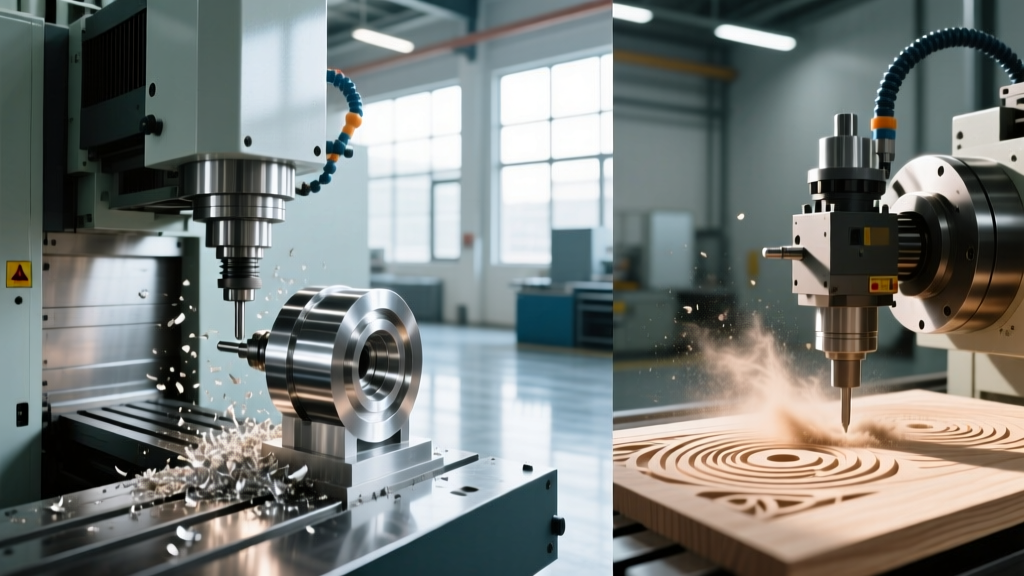
The primary differences are rigidity, spindle torque, and work envelope. CNC mills feature heavy cast-iron or polymer-concrete bases designed to absorb the high cutting forces of steel and titanium. They use automatic tool changers (ATCs) with heavy tool holders. CNC routers use lighter gantry systems optimized for speed and large surface areas, making them ideal for wood, plastics, and thin aluminum sheets.
How much floor space and power does a standard VMC require?
A standard 40-taper VMC (like a Haas VF-2) requires a footprint of approximately 8 ft x 10 ft, but you must allocate an additional 3 feet on the left side for the operator door to fully open, and 3 feet behind for chip conveyor clearance and maintenance access. Electrically, it will draw roughly 30-40 amps of 3-phase 208V/240V power, and requires a dedicated 100 PSI compressed air line for the tool changer and spindle air-blast.
For further reading on advanced manufacturing standards and machining tolerances, refer to the guidelines published by the National Institute of Standards and Technology (NIST) Advanced Manufacturing Office.