What Is a CNC Machine? Industry Applications and Case Studies
Discover what a CNC machine is through real-world aerospace, medical, and automotive case studies, featuring specific models, tolerances, and ROI data.
To understand what is a CNC machine in a modern production environment, one must look past the basic definition of automated toolpaths and G-code. At its core, Computer Numerical Control (CNC) refers to the automated control of machining tools via a computer executing pre-programmed sequences. However, in 2026, a CNC machine is not merely a motorized mill; it is a multi-axis, sensor-integrated, thermally compensated subtractive manufacturing cell capable of holding micron-level tolerances across 72-hour unattended production runs.
Core Technical Definition
A CNC machine translates CAD (Computer-Aided Design) geometry into CAM (Computer-Aided Manufacturing) toolpaths, executing them via servo-driven ball screws or linear motors. Modern 5-axis configurations simultaneously interpolate X, Y, Z, A, and B axes, achieving surface finishes below 0.4 Ra (micrometers) and positional tolerances within ±3 µm, governed by closed-loop feedback systems and in-process probing.
Rather than reviewing generic machine anatomy, we will examine what these machines actually achieve on the shop floor. By analyzing specific industry applications, we can quantify the capabilities, economics, and engineering parameters of modern CNC architectures.
Aerospace Manufacturing: 5-Axis Milling for Titanium Blisks
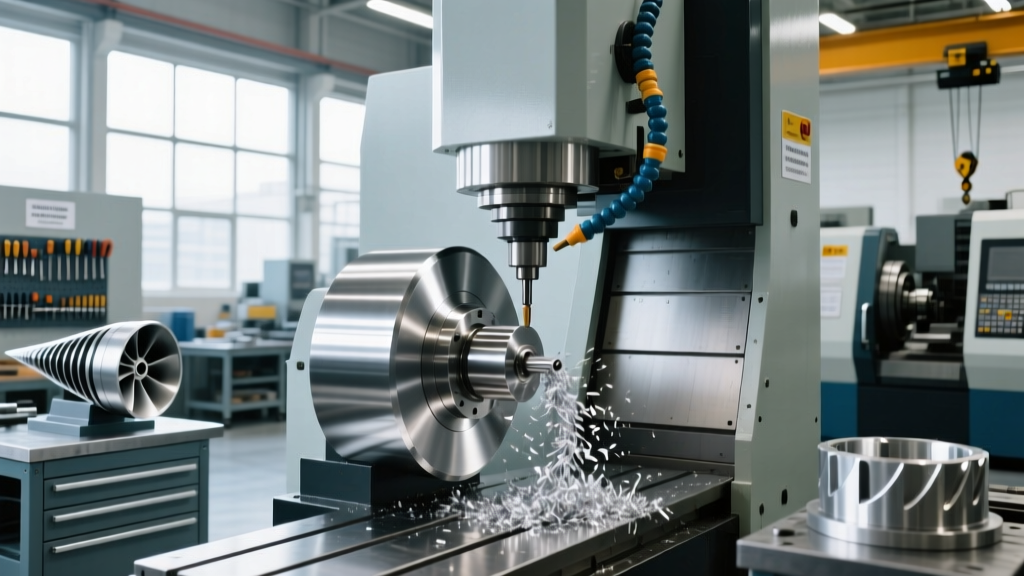
The aerospace sector demands extreme material removal rates (MRR) combined with complex contouring. A primary application is the machining of blisks (blade integrated disks) used in jet engine compressors. These components are milled from solid billets of Ti-6Al-4V titanium alloy, a material notorious for its low thermal conductivity and high tool-wear characteristics.
Case Study: DMG MORI DMU 50 3rd Generation
A tier-one aerospace supplier recently upgraded their blisk production line using the DMG MORI DMU 50 3rd Generation 5-axis machining center. The challenge was to reduce cycle times while preventing tool deflection during the deep-pocket roughing of the blade roots.
- Spindle Configuration: 15,000 RPM, 35 kW SK40 spindle with internal cooling.
- Tooling Strategy: Solid carbide end mills with AlTiN (Aluminum Titanium Nitride) coatings, utilizing trochoidal milling toolpaths to maintain constant tool engagement.
- Coolant Delivery: 70-bar through-spindle coolant to evacuate chips from deep cavities and prevent re-welding of titanium chips to the cutting edge.
Results: By leveraging the machine's high-rigidity cast-iron bed and dynamic 5-axis kinematics, the supplier achieved a 42% reduction in cycle time compared to their legacy 3-axis trunnion setups. Tool life increased from 45 minutes to 110 minutes per roughing tool, drastically reducing consumable costs.
Medical Device Production: Swiss-Type Lathes for Orthopedics
When evaluating what a CNC machine is capable of in the medical sector, Swiss-type automatic lathes represent the pinnacle of micro-machining. Orthopedic bone screws, dental implants, and surgical instrument housings require extreme precision, often machining diameters under 10mm with strict concentricity requirements.
Case Study: Citizen Cincom L32XII
A medical device manufacturer producing 316L stainless steel and PEEK (polyether ether ketone) spinal screws implemented the Citizen Cincom L32XII Swiss-type CNC lathe. Unlike conventional lathes where the tool moves against a stationary or rotating part held in a chuck, Swiss machines utilize a guide bushing located millimeters from the cutting tool, providing maximum support to the bar stock and eliminating deflection.
⚠️ Material Handling Note: When machining PEEK on Swiss-type lathes, thermal expansion is a critical failure mode. The Cincom L32XII utilizes AI-driven thermal compensation algorithms that adjust axis offsets in real-time based on ambient and spindle temperature sensors, maintaining ±2 µm tolerances regardless of shop floor temperature fluctuations.Results: The integration of a hydrodynamic bar feeder allowed for 72 hours of continuous, lights-out unattended machining. The machine's B-axis contouring capability enabled the milling of hexagonal drive sockets and cross-drilled lag features in a single setup, eliminating secondary operations and reducing scrap rates from 4.5% to 0.8%.
Comparative Matrix: CNC Architectures by Industry
The following matrix illustrates how different CNC machine types align with specific industrial requirements, highlighting the divergence in tolerances and surface finish capabilities.
| CNC Machine Type | Primary Industry | Standard Tolerance | Achievable Surface Finish (Ra) | Typical Material Focus |
|---|---|---|---|---|
| 5-Axis Vertical Machining Center | Aerospace / Defense | ±5 µm | 0.4 - 0.8 µm | Titanium, Inconel 718 |
| Swiss-Type CNC Lathe | Medical / Electronics | ±2 µm | 0.2 - 0.4 µm | 316L SS, PEEK, Nitinol |
| Multi-Tasking Turn-Mill | Automotive / Heavy Machinery | ±10 µm | 0.8 - 1.6 µm | 4140 Steel, Cast Iron |
Automotive High-Volume: Multi-Tasking Turning Centers
The transition to electric vehicles (EVs) has radically altered automotive CNC requirements. While engine block machining has decreased, the demand for complex, high-strength EV motor shafts and reduction gear housings has surged. These parts require heavy turning combined with off-center milling and gear hobbing.
Case Study: Mazak INTEGREX i-400
An automotive drivetrain manufacturer tasked with producing 4140 alloy steel EV motor shafts adopted the Mazak INTEGREX i-400 multi-tasking machine. Historically, these shafts required an operation 10 (OP10) turning setup on a standard lathe, followed by an OP20 milling setup on a horizontal machining center, necessitating complex fixture designs and introducing cumulative runout errors.
According to manufacturing data published by the Society of Manufacturing Engineers (SME), multi-tasking architectures reduce floor space requirements by up to 40% while drastically cutting work-in-process (WIP) inventory.
Results: Utilizing the INTEGREX's 'Done-In-One' philosophy, the manufacturer consolidated OP10 and OP20 into a single chucking. Setup time dropped from 4.5 hours to 45 minutes. Concentricity between the bearing journals and the spline drives improved from 15 µm TIR (Total Indicator Runout) to 4 µm TIR, directly reducing NVH (Noise, Vibration, and Harshness) in the final EV drivetrain assembly.
The Economics of CNC Adoption: Cost vs. Output
Understanding what a CNC machine is from a financial perspective requires analyzing capital expenditure (CapEx) against operational expenditure (OpEx). Below is a realistic 2026 pricing and ROI framework for mid-market job shops:
- 3-Axis VMC (e.g., Haas VF-2SS): Base price $115,000 - $140,000. Ideal for aluminum enclosures and basic fixtures. ROI typically realized within 14-18 months based on 2-shift operation.
- Swiss-Type Lathe (e.g., Tsugami S206-II): Base price $280,000 - $350,000. High barrier to entry, but commands $150-$250 per hour shop rates for medical micro-parts. ROI timeline: 24-30 months.
- 5-Axis Machining Center (e.g., Grob G550): Base price $650,000 - $850,000+. Requires specialized CAM programmers ($90k-$120k/year salary). Justified only by high-mix, low-volume aerospace or mold-making contracts.
"The modern CNC machine is no longer an island of automation. Through MTConnect and OPC-UA protocols, these machines stream real-time spindle load and thermal data to centralized MES (Manufacturing Execution Systems), allowing facility managers to predict tool failure before it causes a scrap event."
— Advanced Manufacturing Insights, National Institute of Standards and Technology (NIST)
Selecting the Right CNC Architecture for Your Facility
Do not purchase a machine based solely on axis count or maximum RPM. Use this decision framework to align your capital equipment with your actual production reality:
- If your volume is high (>10,000 parts/year) and diameter is small (<32mm): Bypass standard VMCs and lathes. Invest in a Swiss-type CNC lathe with a high-pressure coolant system and automated bar feeder to achieve lights-out manufacturing.
- If your parts are rotational but feature complex off-axis geometries (e.g., hydraulic valve bodies): A multi-tasking turn-mill center is mandatory. Attempting this on a standard 4-axis VMC will result in unacceptable setup times and fixturing bottlenecks.
- If you machine monolithic aerospace structures from solid billet: Prioritize a 5-axis VMC with high torque (for roughing) and high RPM (for finishing). Ensure the machine includes in-process Renishaw or Blum probing cycles to automatically update work offsets as the raw material stress-relieves and shifts during heavy roughing passes.
Ultimately, answering the question of what a CNC machine is requires looking at the intersection of software, metallurgy, and mechanical rigidity. The machine is merely the execution engine; the true value lies in the integration of advanced toolpath strategies, precise workholding, and rigorous thermal management tailored to your specific industrial application.