What Does CNC Machine Stand For? A Safety & Compliance Guide
Discover what critical CNC machine safety acronyms stand for. A compliance guide covering OSHA, ANSI B11, and ISO standards for shop floor safety.
Many beginners ask what does CNC machine stand for, assuming the answer is simply 'Computer Numerical Control.' While accurate for the operational definition, in the realm of industrial safety and compliance, the acronyms surrounding CNC equipment represent a rigorous framework of legal and operational standards. Misinterpreting or ignoring these codes leads to catastrophic injuries and massive financial penalties. As of 2026, OSHA maximum penalties for willful safety violations exceed $165,000 per instance, making compliance a critical operational priority, not just a legal formality.
Understanding what these safety designations stand for is the first step toward building a resilient, audit-ready manufacturing environment. This guide decodes the critical safety acronyms governing CNC machining centers and turning lathes, providing actionable frameworks for shop floor compliance.
Decoding the Alphabet Soup: Critical CNC Safety Acronyms
Before implementing safeguarding protocols, shop managers must understand the regulatory bodies and consensus standards that dictate machine design and operation. The following table outlines the primary acronyms you will encounter during a CNC safety audit.
| Acronym | Full Name | Scope of Standard |
|---|---|---|
| OSHA | Occupational Safety and Health Administration | Federal enforcement and legal mandates (US) |
| ANSI B11 | American National Standards Institute B11 Series | US consensus machine safety and risk assessment |
| ISO 23125 | International Organization for Standardization | Safety requirements specifically for turning centers |
| NFPA 79 | National Fire Protection Association | Electrical safety standards for industrial machinery |
| CE | Conformité Européenne | European health, safety, and environmental directives |
ANSI B11 Series: The Backbone of US CNC Compliance
While OSHA 1910.212 provides the legal mandate for general machine guarding, it lacks the technical specificity required for modern CNC equipment. This is where the ANSI B11 series becomes the definitive reference. OSHA inspectors frequently cite the ANSI B11 standards under the 'General Duty Clause' when specific federal regulations fall short.
ANSI B11.22 (Turning Machines) and B11.23 (Machining Centers)
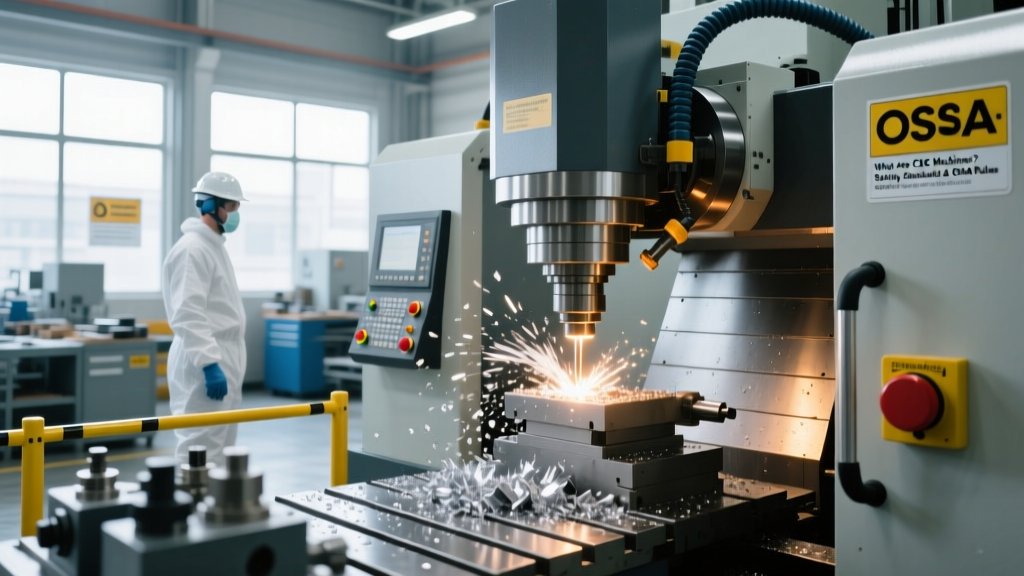
These two standards dictate the physical safeguarding of the point of operation. For CNC lathes (B11.22), the primary hazard is the ejection of heavy workpieces or chuck jaws due to extreme centrifugal forces. The standard mandates that enclosure windows must withstand the kinetic energy of the heaviest part held in the chuck at maximum RPM.
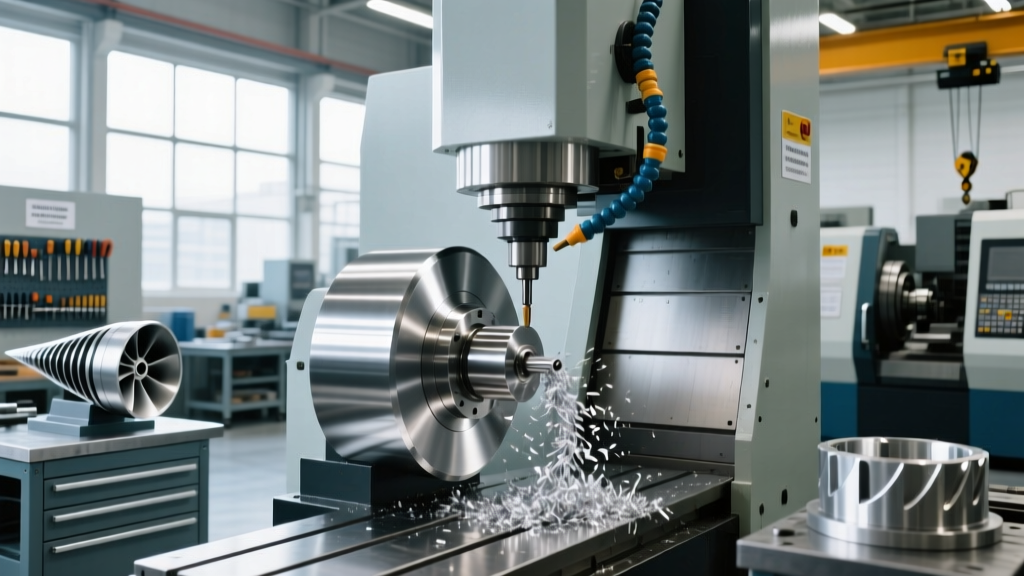
Warning: Polycarbonate Degradation. Standard polycarbonate viewing windows degrade when exposed to synthetic cutting fluids and UV light. ANSI B11.22 requires shops to implement a replacement schedule—typically every 2 to 3 years—or use laminated polycarbonate-glass composites that resist chemical etching while maintaining impact resistance. Failing to date-stamp and replace these shields is a frequent OSHA citation.For CNC vertical and horizontal machining centers (B11.23), the focus shifts to chip ejection and tool fragmentation. The standard requires full enclosure interlocking, meaning the spindle cannot rotate unless all access doors are securely closed and locked via a trapped-key or RFID non-contact safety switch (e.g., Schmersal or Euchner series).
ISO 23125 and CE Marking: Global Safety Harmonization
Even if your shop operates exclusively in the United States, understanding ISO standards is vital, especially if you import CNC machines from Europe or Asia. ISO 23125 governs the safety of turning centers and introduces the concept of 'Performance Levels' (PL) for safety-related control systems.
Under ISO 13849-1 (which informs ISO 23125), safety functions like door interlocks and chuck clamping pressure monitoring must be rated to a specific Performance Level, typically PL d or PL e for CNC equipment. This requires redundant circuit architectures. If a single relay fails, the redundant circuit must detect the fault and prevent the machine from cycling, a concept known as 'control reliability.'
'A machine that relies on a single mechanical limit switch for door interlocking does not meet ISO 13849-1 Performance Level d. Modern compliance requires dual-channel monitoring with cross-fault detection.' — Industrial Safety Systems Engineering Guidelines, 2025.
NFPA 79: Electrical Safety and E-Stop Architectures
Electrical fires and improper emergency stopping sequences are heavily regulated under NFPA 79: Electrical Standard for Industrial Machinery. This standard dictates everything from wire color coding to the precise logic of Emergency Stop (E-Stop) circuits.
The E-Stop Circuit: Category 0 vs. Category 1
A common misconception among novice operators is that an E-Stop should immediately cut all power to the machine (Category 0). However, abruptly cutting power to a CNC spindle mid-cut can cause tool breakage, workpiece ejection, or loss of machine reference points, creating secondary hazards.
- Category 0 (Uncontrolled Stop): Immediate removal of power. Used only when controlled stopping introduces a greater hazard.
- Category 1 (Controlled Stop): Power is maintained to the spindle drive to apply dynamic braking or reverse-torque braking. Once the spindle reaches a safe RPM (or zero), power is mechanically severed via a safety contactor. This is the mandatory standard for most CNC spindles.
- Category 3 (Safe Torque Off - STO): A modern solid-state drive function where the drive electronics safely remove torque-generating power while keeping the control logic active for monitoring.
NFPA 79 strictly requires that E-Stop circuits be hardwired and independent of the CNC's programmable logic controller (PLC) or software. Software-based stopping is not compliant for emergency scenarios.
Pro-Tip for Retrofitting Older CNCs: If you are retrofitting a legacy Haas or Mazak machine, upgrade the E-Stop circuit to utilize a dedicated safety relay module (like a Pilz PNOZ series) rather than standard industrial relays. Safety relays feature forced-guided contacts that physically prevent the relay from resetting if a contact welds shut, ensuring NFPA 79 compliance.Actionable Compliance Audit Checklist for Shop Managers
To ensure your facility meets current safety standards, conduct a quarterly audit using the following framework. This checklist synthesizes OSHA, ANSI, and NFPA requirements into actionable shop-floor tasks.
- Verify Interlock Redundancy: Open each CNC enclosure door while the machine is in a paused, ready-to-cycle state. Ensure the control panel registers a fault and prevents cycle-start. Test both the primary and secondary switch channels if equipped.
- Inspect Polycarbonate Shields: Check all viewing windows for micro-cracking, yellowing, or chemical clouding. Verify the manufacturer's date stamp and replace any shield older than 36 months.
- Test Chuck Pressure Interlocks (Lathes): Slowly bleed the hydraulic pressure on CNC lathes equipped with hydraulic chucks. The machine must trigger an alarm and halt the spindle before the clamping force drops below the minimum threshold required to hold the workpiece at max RPM.
- Audit E-Stop Wiring: Open the main electrical cabinet. Verify that E-Stop circuits are wired with red wires on a white background (or red with yellow tracers) as mandated by NFPA 79, and ensure they bypass all software logic.
- Review Risk Assessment Documentation: Ensure a formal Risk Assessment (per ANSI B11.0) is on file for every CNC machine, documenting specific hazards, safeguarding methods, and residual risk levels.
Frequently Asked Questions (FAQ)
Does OSHA require CNC machines to have safety light curtains?
OSHA does not explicitly mandate light curtains for CNC machines by name, but B11 Standards Inc. and ANSI B11.19 dictate that if the point of operation is accessible during setup or manual data input (MDI), presence-sensing devices like safety light curtains or laser scanners are required to halt the machine before a human hand breaches the hazard zone.
What is the penalty for bypassing a CNC safety interlock?
Bypassing an interlock using a 'cheater key' or zip-tie is classified as a willful violation by OSHA. As of 2026, willful violations carry a minimum penalty of approximately $11,700 and a maximum exceeding $165,000 per instance, alongside potential criminal liability if an injury occurs.
Are desktop CNC routers subject to the same ANSI B11 standards?
Desktop CNC routers (under 1 horsepower, typically used in prototyping or education) are generally classified under different consumer or light-duty guidelines rather than heavy industrial ANSI B11.23 standards. However, basic OSHA 1910.212 guarding requirements still apply to prevent contact with the spinning router bit.