Best Friction Welding Equipment Manufacturers: 2026 Cost Guide
Analyze 2026 CapEx and OpEx for the best friction welding equipment manufacturers. Compare MTI, KUKA, and FSW pricing, tooling costs, and ROI frameworks.
Transitioning to solid-state joining processes eliminates filler metals, shielding gases, and post-weld heat treatment, but the initial capital expenditure (CapEx) remains a formidable barrier. In 2026, evaluating the best friction welding equipment manufacturers requires looking far beyond the machine's sticker price. Procurement teams must model the total cost of ownership (TCO), factoring in hydraulic maintenance, specialized tooling wear rates, and facility preparation.
2026 Friction Welding CapEx Snapshot
- Rotary Friction (Mid-Tier): $180,000 – $350,000
- Linear Friction (Aerospace/Heavy): $1.5M – $4.5M+
- Friction Stir Welding (FSW Gantry): $250,000 – $850,000
- Average Annual Tooling OpEx: $15,000 – $45,000
Process-to-Cost Matrix: Rotary, Linear, and Stir
Before requesting quotes from manufacturers, it is critical to align your specific joint geometry with the correct friction process. As noted by The Welding Institute (TWI), friction welding encompasses several distinct mechanical processes, each with vastly different equipment architectures and cost profiles.
| Process Type | Primary Use Case | Estimated Machine CapEx | OpEx Drivers |
|---|---|---|---|
| Inertia / Rotary Friction | Automotive drivetrains, hydraulic cylinders | $180k - $450k | Spindle bearings, hydraulic fluid, flywheel maintenance |
| Linear Friction | Titanium blisks, aerospace structural components | $1.5M - $4.5M+ | Massive servo/hydraulic power, custom fixturing, foundation pits |
| Friction Stir (FSW) | EV battery trays, aluminum ship hulls, space tanks | $250k - $850k | FSW pin/shoulder tooling wear, CNC gantry calibration |
Evaluating the Best Friction Welding Equipment Manufacturers
The market is highly consolidated at the top end, with a few legacy engineering firms dominating the heavy machinery space, while agile robotics integrators are capturing the FSW sector. Here is a financial and operational breakdown of the industry leaders.
1. Manufacturing Technology Inc. (MTI) – The Inertia Standard
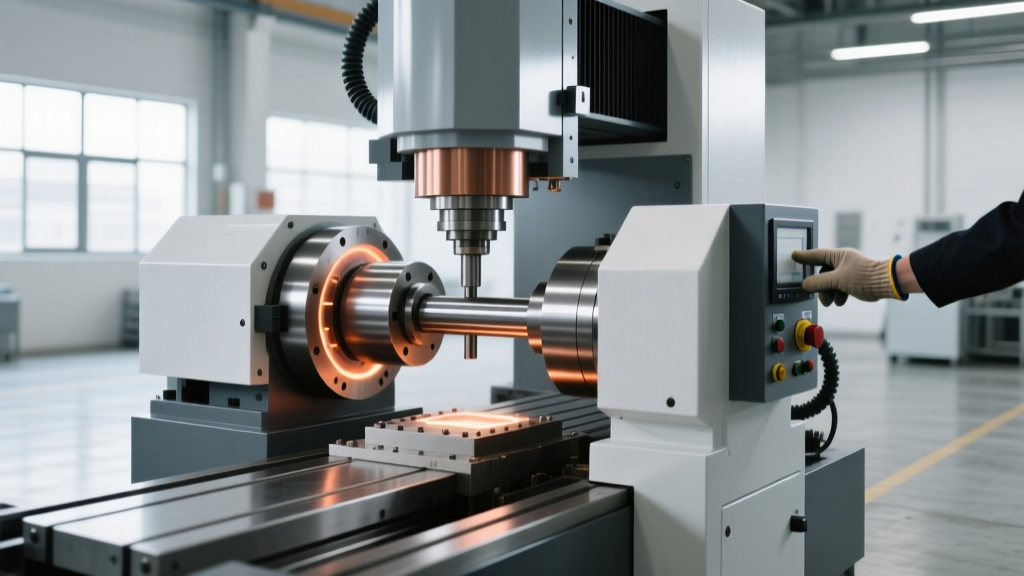
Based in the US, MTI is the undisputed heavyweight in inertia and continuous drive friction welding. Their machines utilize stored kinetic energy via flywheels to forge joints. According to MTI's technical documentation, inertia friction welding allows for precise control over the thermal cycle, making it ideal for dissimilar metals like aluminum-to-steel.
- Target Models: MTI 120 and MTI 200 series.
- Cost Profile: Expect to budget between $220,000 and $380,000 for a fully equipped, mid-range inertia machine. High-tonnage models (exceeding 200 tons of forge force) push past $500,000.
- Budget Advantage: MTI's proprietary WeldWindow software reduces scrap rates by providing real-time parametric feedback, saving an estimated $30,000+ annually in rejected aerospace or automotive components.
2. KUKA – Premium Linear and Rotary Automation
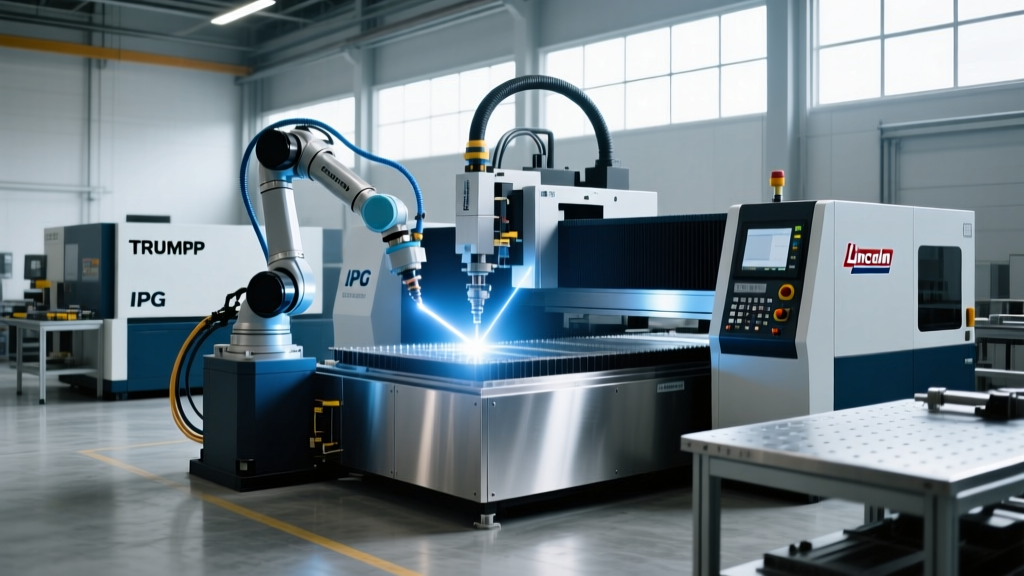
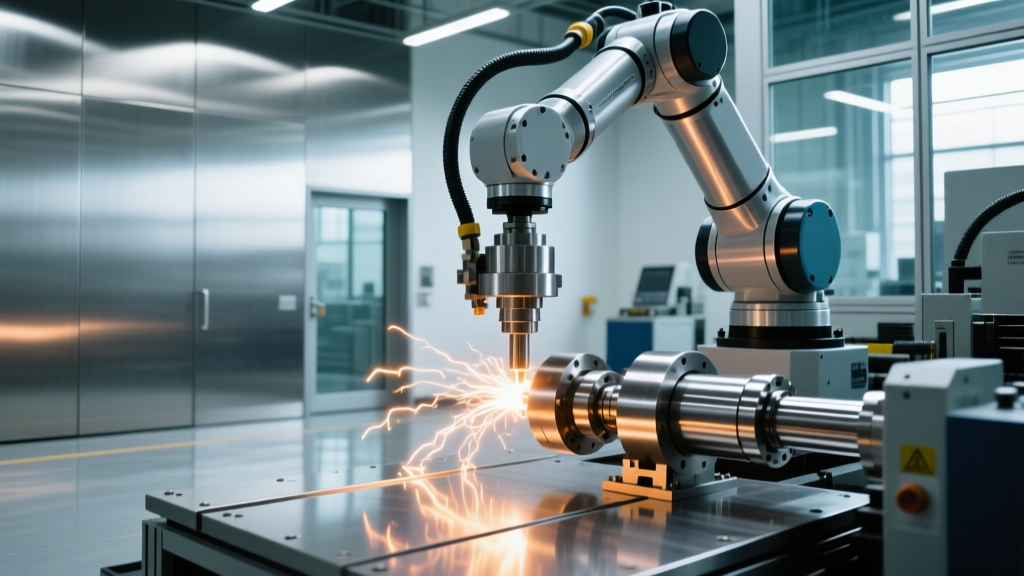
KUKA provides the most advanced automated friction welding cells, particularly their SRS (Schweiß-Raum-System) series for rotary welding and their massive linear friction welding (LFW) portals. KUKA is the go-to manufacturer when integrating friction welding into a fully automated, lights-out manufacturing line.
- Target Models: KUKA SRS 100 (Rotary) and KUKA LFW portals.
- Cost Profile: A standalone SRS 100 rotary machine starts around $350,000. However, KUKA's LFW machines—required for joining titanium compressor blades to disks (blisks) in jet engines—routinely exceed $2.5 million.
- Budget Advantage: While the CapEx is steep, KUKA's integration of automated part loading and post-weld flash removal (machining) within the same cell reduces secondary handling costs by up to 40%.
3. Stirweld & ESAB – Leaders in Friction Stir Welding (FSW)
For flat or contoured butt joints in aluminum and copper, Friction Stir Welding is the dominant 2026 technology, especially for electric vehicle (EV) battery enclosures. Companies like Stirweld (which converts standard CNC mills into FSW machines) and ESAB (dedicated FSW gantries) offer distinct budget pathways.
- Stirweld Pathway: By retrofitting an existing 3-axis or 5-axis CNC mill with a Stirweld FSW head and force-control software, CapEx drops to $60,000 – $120,000. Ideal for job shops.
- ESAB Pathway: Dedicated heavy-duty FSW gantries (like the ESAB Rossmore series) cost $400,000 to $850,000. These are mandatory for high-volume EV battery tray production where continuous 24/7 uptime and extreme clamping forces (up to 40,000 N) are required.
⚠️ Facility Prep Warning: Linear Friction Welding
Do not underestimate site preparation for Linear Friction Welding. LFW machines generate violent, high-frequency oscillating forces (up to 100+ tons). Standard concrete slabs will fracture. Budget an additional $80,000 – $150,000 for excavating isolated foundation pits, pouring mass concrete, and installing active vibration dampening mounts.
Hidden OpEx: Tooling and Consumables
Unlike MIG or TIG welding, friction welding does not use wire or gas. However, the mechanical tooling required—specifically in Friction Stir Welding—represents a massive, ongoing operational expense that must be modeled into your budget.
FSW Pin and Shoulder Wear Economics
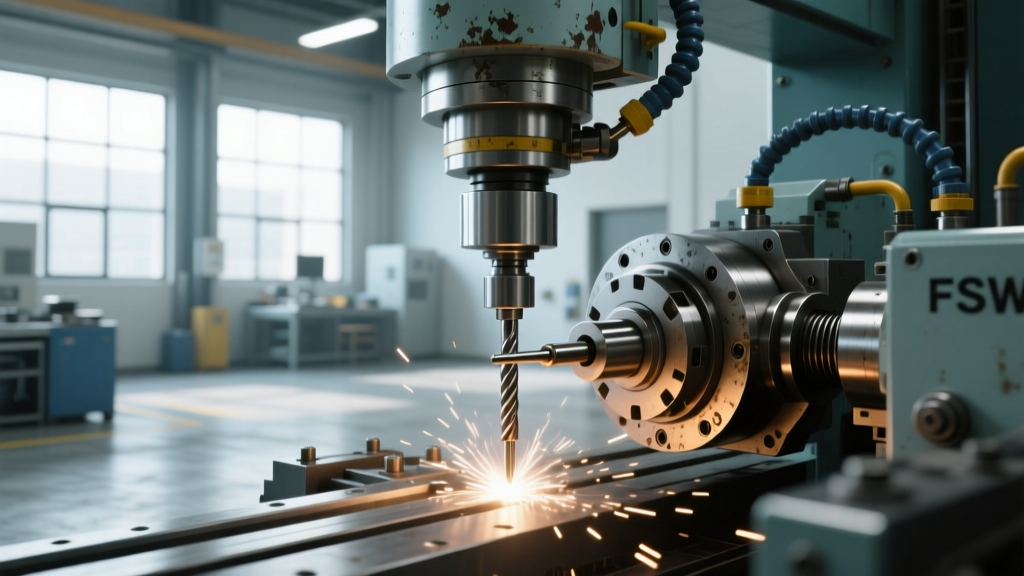
The FSW tool (pin and shoulder) is plunged into the workpiece and traverses the joint. The friction and plastic deformation cause severe tool wear, especially when welding high-strength alloys like 7075 aluminum or steel.
- H13 Tool Steel: Costs $800 – $1,500 per tool. Suitable for soft aluminum (e.g., 6061). Yields 500 – 1,000 meters of weld life.
- Tungsten Carbide: Costs $2,500 – $4,000. Used for abrasive aluminum alloys and copper. Yields 1,500 – 3,000 meters of weld life.
- PCBN (Polycrystalline Cubic Boron Nitride): Mandatory for welding steel or titanium. A single PCBN pin/shoulder assembly costs between $12,000 and $25,000. While expensive, it is the only material capable of surviving the extreme heat and shear forces of steel FSW.
The ROI Decision Matrix: Justifying the CapEx
When pitching a friction welding investment to a CFO or board of directors, use this decision framework to calculate the break-even point against traditional arc welding processes.
- Calculate Consumable Savings: Multiply your annual wire/gas spend by 100%. Friction welding eliminates this entirely. (e.g., $40,000/year saved).
- Calculate Post-Weld Machining Savings: Friction welding produces a near-net-shape joint. If you currently spend $12 per part on X-ray inspection and TIG rework, and you run 20,000 parts a year, that is $240,000 in eliminated OpEx.
- Factor in Energy Efficiency: According to data from KUKA's friction welding division, modern servo-driven rotary machines consume up to 30% less electrical energy per joint compared to legacy hydraulic continuous-drive machines, reducing utility overhead.
- Determine Payback Period: Divide the total CapEx (Machine + Tooling + Facility Prep) by the sum of annual savings. In high-volume automotive applications, payback frequently occurs within 18 to 24 months.
Strategic Sourcing: New vs. Refurbished Markets
Given the robust mechanical nature of friction welders—essentially massive, reinforced lathes and presses—the secondary market is a viable budget strategy. A refurbished MTI inertia welder, rebuilt with new spindle bearings, modernized servo-valves, and updated PLC controls, typically costs 40% to 50% less than a new build. However, buyers must ensure the original manufacturer still supports the legacy PLC architecture (e.g., migrating from older Allen-Bradley SLC 500 systems to modern ControlLogix) to avoid catastrophic downtime risks.
Ultimately, selecting from the best friction welding equipment manufacturers in 2026 is not about finding the cheapest machine; it is about matching the machine's force architecture to your specific metallurgical requirements while accurately forecasting the long-term tooling and maintenance footprint.