Top Friction Stir Welding Equipment Manufacturers: 2026 Innovations
Compare the top friction stir welding equipment manufacturers in 2026. Explore FSW tech trends, pricing, AI integration, and EV battery applications.
Friction Stir Welding (FSW) has transitioned from a niche aerospace joining method to a cornerstone of EV battery tray and structural aluminum manufacturing. As we navigate 2026, the top friction stir welding equipment manufacturers are differentiating not just through mechanical rigidity, but via closed-loop AI force control, acoustic defect detection, and digital twin integration. According to The Welding Institute (TWI), the solid-state nature of FSW continues to yield superior fatigue life compared to traditional fusion welding, but the capital equipment required to achieve these results has evolved dramatically.
The 2026 FSW Innovation Landscape
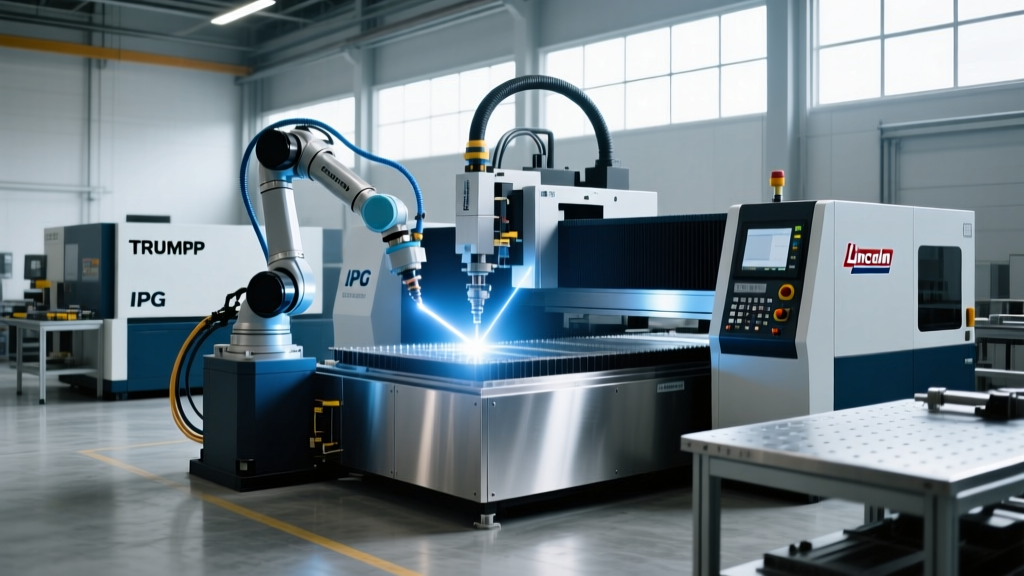
Historically, FSW equipment was judged solely by its axial force capacity and structural stiffness. While a minimum structural resonance of 500 Hz remains critical to prevent chatter during high-force plunge phases, 2026's leading machines integrate real-time adaptive path correction. When welding complex 3D contours—such as extruded aluminum EV battery enclosures—thermal expansion and part warping can shift the seam by up to 2mm. Modern FSW heads now utilize laser-vision tracking paired with sub-millisecond robotic compensation to maintain the tool pin's exact position within a 0.05mm tolerance.
💡 2026 Technology Shift: The integration of acoustic emission (AE) sensors directly into the spindle housing is now standard on premium FSW gantries. These sensors detect the specific high-frequency sound signatures of internal voids or 'kissing bonds' as they form, allowing the machine to automatically adjust downward force and traverse speed in real-time to heal the defect before the tool passes.Evaluating the Top Friction Stir Welding Equipment Manufacturers
Selecting a manufacturer requires aligning their specific technological strengths with your production volume and part geometry. Below is a technical breakdown of the industry leaders dominating the 2026 market.
1. ESAB (StirWeld) - The Automation & Retrofit Leader
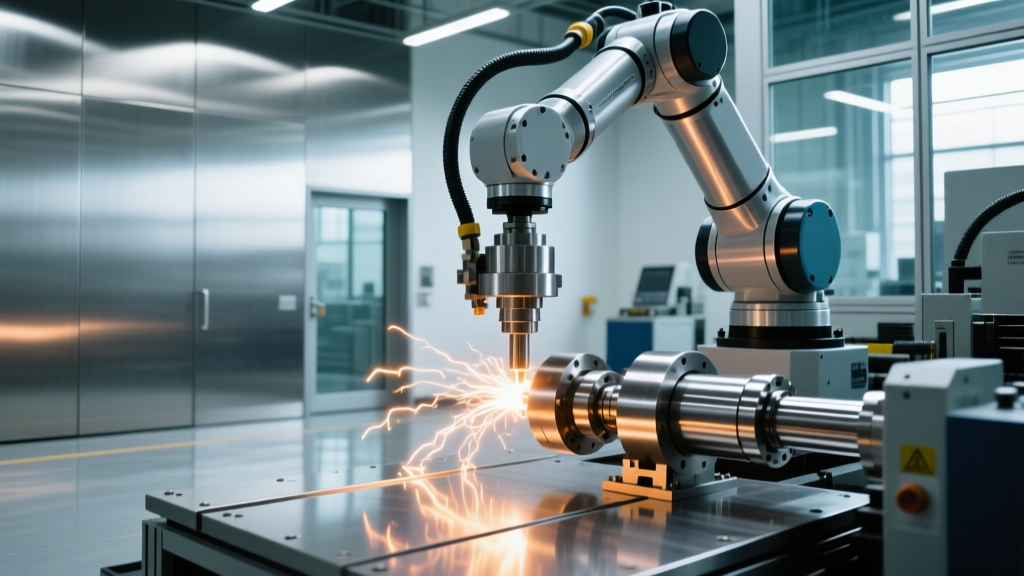
ESAB’s StirWeld division remains the premier choice for manufacturers looking to integrate FSW into existing robotic cells. Rather than purchasing a $500,000 dedicated gantry, manufacturers can retrofit a 6-axis robot (like a FANUC M-900iB) with a StirWeld end-effector.
- Flagship Tech: The I-STIR robotic FSW head features an integrated force-control module that maintains constant axial pressure regardless of the robot arm's varying stiffness across its work envelope.
- Capacity: Up to 15 kN axial force, ideal for 1mm to 6mm thick aluminum alloys (5xxx and 6xxx series).
- Pricing: End-effectors range from $85,000 to $130,000, excluding the host robot and safety enclosure.
2. Hitachi - Heavy-Duty Gantry & Aerospace Specialist
For aerospace bulkheads and thick-section shipbuilding, robotic arms lack the necessary rigidity. Hitachi manufactures ultra-high-stiffness CNC gantry FSW machines designed for continuous, high-force operations.
- Flagship Tech: Hitachi's heavy-duty spindles deliver up to 80 kN of downward force. Their proprietary real-time monitoring software maps temperature and torque data to a digital twin, predicting tool wear with 94% accuracy.
- Capacity: Capable of welding 25mm+ thick 2xxx and 7xxx series aerospace aluminum in a single pass.
- Pricing: Purpose-built gantry systems start at $350,000 and can exceed $750,000 for multi-axis, dual-head configurations.
3. Grenzebach - 3D Contour & EV Battery Enclosures
Grenzebach has captured significant market share in the e-mobility sector. Their systems are specifically engineered for the high-mix, high-volume production of battery trays and e-axle housings.
- Flagship Tech: Their 2D/3D FSW systems utilize specialized bobbin tools that eliminate the need for a backing anvil, allowing for the welding of closed-profile extrusions (like hollow battery cooling channels) without internal support.
- Capacity: Optimized for 2mm to 8mm thicknesses with exceptionally high traverse speeds (up to 3,000 mm/min on thin sections).
- Pricing: Complete turnkey cells, including automated part loading and post-weld CNC machining, range from $450,000 to $900,000.
2026 FSW Equipment Comparison Matrix
The following matrix contrasts the core specifications of purpose-built gantries versus robotic retrofit solutions to aid in capital expenditure planning.
| System Type | Max Axial Force | Spindle Power | Path Complexity | Est. Base Price (USD) |
|---|---|---|---|---|
| Robotic End-Effector (StirWeld) | 15 - 20 kN | 15 - 25 kW | High (3D Contours) | $85,000 - $130,000 |
| Mid-Range CNC Gantry | 30 - 40 kN | 30 - 45 kW | Low (2D/2.5D) | $250,000 - $400,000 |
| Heavy-Duty Aerospace Gantry | 60 - 100 kN | 50 - 75 kW | Low (Flat/Curved 2D) | $500,000 - $850,000+ |
Decision Framework: Matching FSW Tech to Application
Purchasing FSW equipment without aligning the machine's stiffness profile to your specific metallurgical requirements is a primary cause of capital waste. Use this framework to guide your specification process:
- For EV Battery Trays (1mm - 4mm Al 6061-T6): Prioritize robotic FSW end-effectors. The low axial force required (under 10 kN) means robotic arm deflection is negligible. The 6-axis flexibility is mandatory for welding the complex 3D perimeter seals of battery lids. Recommended: ESAB StirWeld or Grenzebach robotic cells.
- For Structural Automotive Subframes (5mm - 10mm Al 5083): You need a hybrid approach. A heavy-payload robot (e.g., KUKA KR 1000) equipped with a high-force FSW head can handle the thickness, but only if the weld path remains relatively flat. If the path is highly contoured, step up to a 3-axis CNC gantry with a tilting spindle head.
- For Aerospace Fuselage Barrels & Bulkheads (12mm - 25mm Al 2219): Robotic solutions are physically incapable of maintaining the 60+ kN of downward force required without severe chatter. You must specify a dedicated, massive-cast-iron gantry system with hydrostatic bearings. Recommended: Hitachi or custom Trilogy Manufacturing gantries.
If you attempt to weld 10mm thick aluminum on a machine with insufficient dynamic stiffness, the resulting spindle chatter will not only ruin the surface finish but will cause catastrophic micro-fractures in the tungsten carbide or PCBN tool pin. A single shattered tool embedded in an aerospace workpiece can scrap a $50,000 component. Always demand a 'witness coupon' weld test from the manufacturer using your exact material and thickness before signing the PO.
Tooling Economics: The Ongoing Consumable Reality
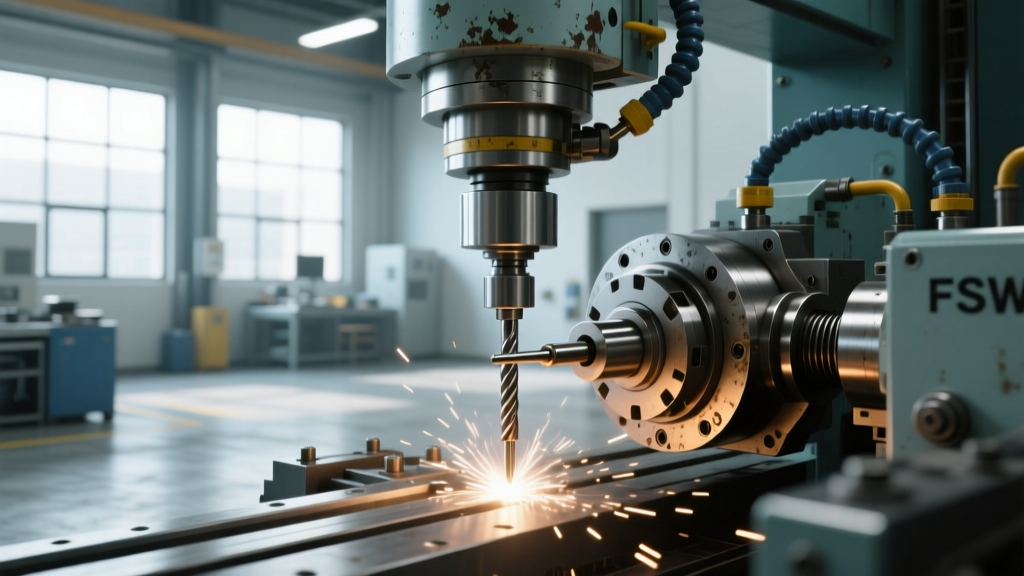
While FSW eliminates shielding gases and filler wire, the tooling costs are substantial and must be factored into your 2026 operational budgets. The FSW tool consists of a shoulder and a threaded/fluted pin.
- H13 Tool Steel Pins: Cost between $150 and $400 each. Suitable for standard 6xxx series aluminum. Expect a tool life of 1,000 to 3,000 meters of weld length before shoulder wear degrades the forging force.
- Polycrystalline Cubic Boron Nitride (PCBN) Pins: Required for high-temperature alloys, copper, or abrasive metal matrix composites (MMCs). These tools cost between $2,500 and $4,500 each. While the upfront cost is steep, PCBN tools can achieve 10,000+ meters of weld life in aluminum, ultimately lowering the cost-per-meter.
According to welding qualification standards outlined by the American Welding Society (AWS), tool wear directly impacts the macroscopic geometry of the weld flash and the depth of the shoulder impression. Automated tool-length measurement (ATLM) probes are now a mandatory add-on for 2026 FSW machines to automatically compensate for shoulder wear in the Z-axis, ensuring consistent penetration depth over the life of the tool.
Emerging 2026 FSW Trends to Watch
As detailed in recent materials engineering research on ScienceDirect, the boundaries of FSW are expanding beyond aluminum. Manufacturers are currently beta-testing Micro-FSW heads capable of joining 0.5mm copper foils for solid-state battery current collectors. Furthermore, Stationary Shoulder FSW (SSFSW) technology is gaining traction; by keeping the shoulder stationary and only rotating the internal pin, manufacturers are achieving mirror-like surface finishes that require zero post-weld CNC machining, saving up to 14% in total cycle time for consumer electronics chassis.
When evaluating the top friction stir welding equipment manufacturers this year, look past the basic spindle RPM and feed rate specifications. The true ROI in 2026 lies in adaptive force control, acoustic defect monitoring, and the vendor's ability to supply application-specific tooling geometries that minimize your cost-per-meter of weld.