Operator Training for Safety Guards on Machinery: 5 Best Practices
Master operator training for safety guards on machinery. Learn interlock protocols, defeat prevention, and OSHA compliance best practices.
Installing physical barriers is only half the battle in industrial hazard mitigation. According to enforcement data, a significant percentage of machine guarding citations stem not from missing equipment, but from operators deliberately bypassing, improperly adjusting, or failing to inspect safety guards on machinery. When production quotas clash with safety protocols, operators often view guards as impediments to cycle times. Bridging this gap requires moving beyond passive, sign-off-sheet training toward active, competency-based operator education.
The Psychology and Mechanics of Guard Defeat
Before training operators on how to use guards, safety managers must address why operators defeat them. Defeat is rarely malicious; it is usually a workaround for a poorly designed human-machine interface. Common defeat mechanisms include using cable ties to hold down interlock plungers, applying electrical tape over optical sensors, or keeping a 'dummy' RFID actuator in a pocket to trick the safety relay into thinking the door is closed.
⚠️ Warning: The Cost of BypassingUnder OSHA 1910.212(a), employers are responsible for ensuring guards are in place and functional. If an operator bypasses a guard and management fails to enforce the rule through training and audits, the facility faces willful violation penalties exceeding $16,000 per instance, alongside catastrophic liability in the event of an amputation or fatality.
Deconstructing Safety Guards on Machinery: Core Training Modules
Effective training requires operators to understand the specific engineering controls on their exact machines. A generic 'machine safety' video is insufficient. Training must be segmented by guard typology.
1. Fixed Barrier Guards and Fastener Awareness
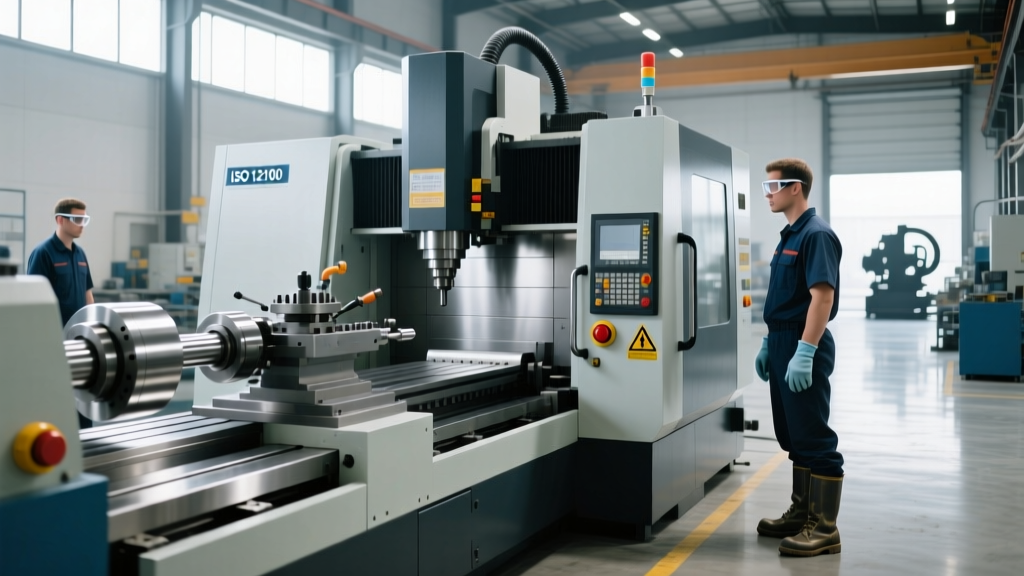
Fixed guards (e.g., polycarbonate shields bolted to CNC lathe chucks) do not have interlocks. Operators must be trained to recognize the specific fasteners used—typically Torx or security hex bolts that require specialized tools. Training must emphasize that removing a fixed guard for cleaning or maintenance immediately triggers Lockout/Tagout (LOTO) protocols. Operators must know that a missing or stripped bolt on a fixed guard is a critical stop-work condition.
2. Interlocked Guards and RFID Sensor Logic
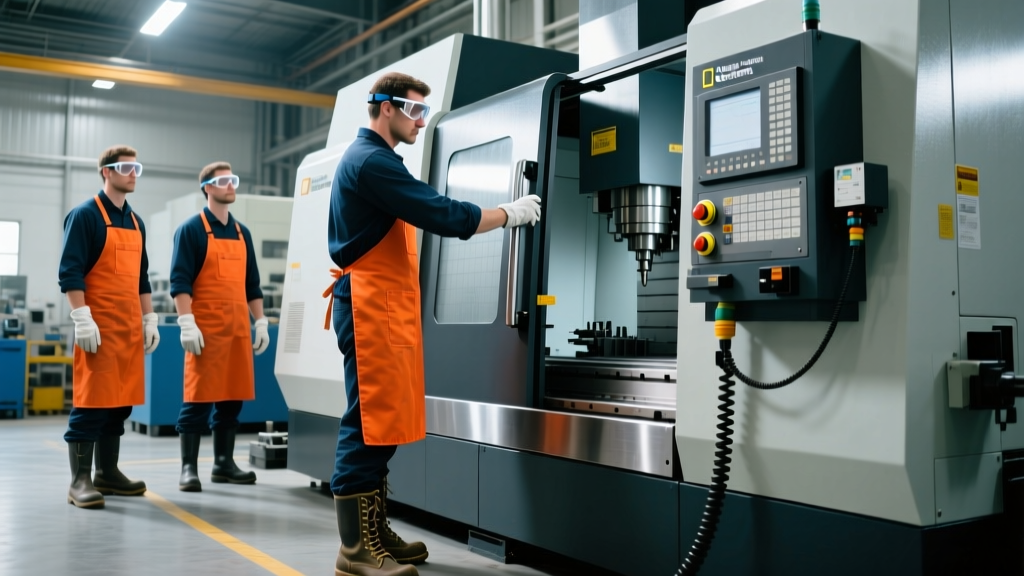
Modern CNC mills (like the Haas VF series) and laser cutters use interlocked access doors. Operators must understand the difference between mechanical limit switches and RFID-coded sensors. Mechanical switches can be defeated with a simple zip-tie. Facilities should upgrade to Type 4 interlocks with unique RFID coding (e.g., Schmersal AZM400 or Pilz PSENcode) which comply with ISO 14119. Operators must be trained that these sensors read a unique cryptographic code; taping a piece of metal or a standard magnet to the sensor will not bypass the safety relay, preventing the dangerous 'dummy actuator' workaround.
3. Presence-Sensing Devices (Light Curtains and Laser Scanners)
For press brakes and stamping presses, physical barriers are often impractical. Operators rely on light curtains (e.g., SICK deTec4) or Active Opto-electronic Protective Devices (AOPD). Training must cover the 'safety distance formula' (ISO 13855). Operators need to understand that leaning on the machine table or placing raw material too close to the light curtain can mute the sensor or cause a premature trip, leading them to improperly adjust the curtain brackets to gain reach-in space.
Guard Type vs. Operator Protocol Matrix
Use the following matrix during floor-level training to clarify exact operator responsibilities for different guarding technologies.
| Guard Category | Common Application | Operator Pre-Shift Action | Strict Prohibition |
|---|---|---|---|
| Fixed Barrier | Lathe Chuck Guards, Gearbox Enclosures | Visual check for cracks, missing bolts, or oil-fog degradation. | Operating machine if any fastener is missing or stripped. |
| Interlocked Door | CNC Milling Centers, Laser Cutting Cells | Cycle the door; verify spindle/beam stops immediately upon latch release. | Using tape, zip-ties, or wedges to hold the plunger/sensor engaged. |
| Adjustable Guard | Table Saws, Band Saws, Drill Presses | Adjust guard to within 1/4 inch of the material thickness before startup. | Leaving the guard elevated at maximum height for convenience. |
| Presence-Sensing | Press Brakes, Hydraulic Stamping Presses | Perform the test-piece block check to verify muting/trip response. | Repositioning emitter/receiver brackets to widen the access gap. |
Addressing the 'Cycle Time' Complaint: A Practical Framework
The most common reason operators bypass safety guards on machinery is the perception that the guard slows down production. When an operator complains that an interlocked door takes too long to lock/unlock, or that a light curtain trips prematurely, safety managers must not dismiss the complaint. Instead, apply this troubleshooting framework:
- Validate the Delay: Time the actual lock-to-unlock sequence. If a solenoid guard takes 4 seconds to release after the spindle stops, that is 4 seconds of dead time per cycle. On a high-volume cell, this is a massive bottleneck.
- Engineering Adjustment: Can the machine's PLC be reprogrammed to initiate the spindle deceleration sequence simultaneously with the solenoid unlock request? (This requires a safety-rated monitoring relay to ensure the spindle is at zero RPM before the physical lock releases).
- Ergonomic Repositioning: If a light curtain is tripping due to operator reach-in angles, consult a safety engineer to recalculate the safety distance. Moving the curtain closer to the hazard (while maintaining the ISO 13855 minimum stopping distance) can reduce the operator's walking footprint and shave seconds off the load/unload cycle.
For manual band saws and cold saws, operators frequently leave adjustable blade guards raised to accommodate varying stock sizes without making adjustments. Train operators on the 'Pinch-and-Slide' method: modern adjustable guards should feature quick-release levers that allow height adjustment in under two seconds, eliminating the 'time-sink' excuse for leaving the guard fully open.
Competency Verification Beyond the Sign-Off Sheet
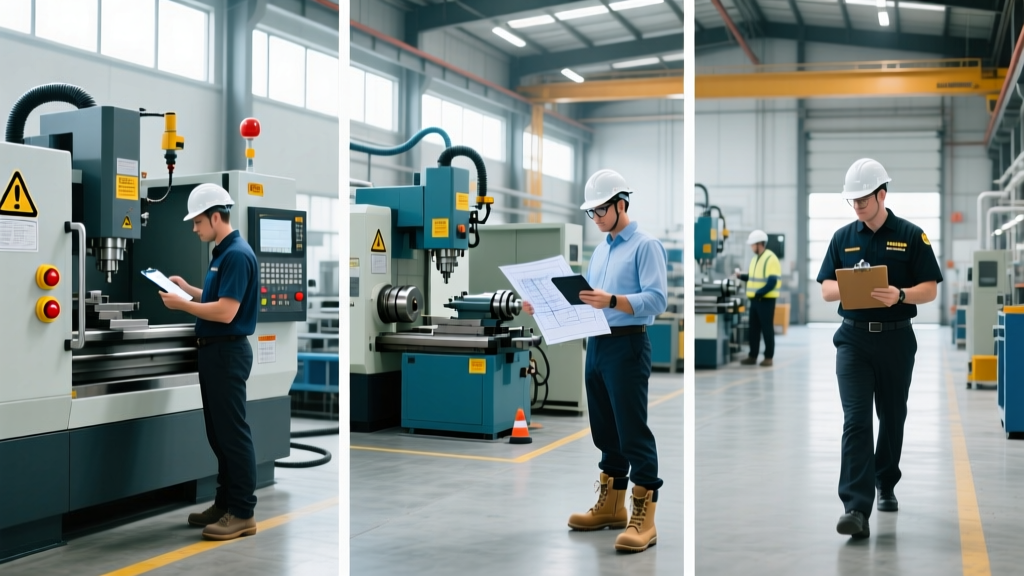
As detailed in OSHA Publication 3170 on Safeguarding Equipment, simply handing an operator a manual and asking for a signature does not constitute training. Competency must be verified through practical, floor-level demonstration.
The 'Red Tag' Practical Exam
During the probationary period or annual recertification, safety supervisors should conduct a 'Red Tag' audit. The supervisor intentionally introduces a safe, simulated fault to the machine's guarding system—such as placing a piece of opaque tape over one lens of a light curtain, or loosening a single bolt on a fixed polycarbonate shield. The operator is then asked to perform their standard pre-shift startup routine. If the operator initiates the machine cycle without identifying and tagging out the compromised guard, they fail the competency check and must undergo retraining. This shifts the paradigm from passive memorization to active hazard recognition.
Establishing a Frictionless Reporting Chain
Operators will only report damaged or malfunctioning guards if the reporting process does not penalize them for downtime. Implement a 'Guard-Down Priority' maintenance protocol. If an operator reports a broken interlock switch or a cracked viewing window, the maintenance ticket must be coded as a Safety-Critical Priority 1, bypassing standard production maintenance queues. When operators see that guard repairs are executed within hours rather than days, the cultural reliance on bypassing diminishes significantly.
Ultimately, the efficacy of safety guards on machinery relies entirely on the operator at the controls. By combining anti-defeat sensor technology with empathetic, cycle-time-aware training and rigorous practical verification, facilities can achieve true OSHA compliance while maintaining production throughput.