ISO 12100 Safety of Machinery Risk Assessment Standard Overview & Costs
Analyze the true costs of ISO 12100 compliance. This risk assessment standard overview breaks down budget planning, hardware expenses, and consulting rates.
Capital expenditure planning for industrial automation often overlooks the financial weight of safety compliance until a machine fails validation or an OSHA inspector issues a citation. Implementing the ISO 12100 safety standard is not merely a technical exercise; it is a significant line-item budget event. For plant managers and systems integrators, understanding the cost architecture of risk assessment, mitigation hardware, and validation documentation is critical for preventing project overruns.
Financial Risk Callout: The average OSHA penalty for a serious machinery guarding violation in 2026 sits at $16,131 per instance, while willful violations can exceed $161,000. When factoring in unplanned downtime and civil liability, the ROI on proactive ISO 12100 compliance typically breaks even within 14 months of deployment.The Scope of ISO 12100 in Modern Manufacturing
ISO 12100 provides the foundational methodology for identifying hazards, estimating risks, and implementing protective measures on industrial machinery. Unlike prescriptive standards that dictate specific guard dimensions, ISO 12100 is a framework standard. It forces engineering teams to iterate through a three-step method: inherent safety design, safeguarding, and information for use. Because the standard requires documented proof of every risk-reduction decision, the budgetary impact extends far beyond physical hardware into engineering labor and specialized software.
Phase 1: Scoping and Engineering Labor Budgeting
The first major cost center is the risk assessment itself. Facilities must decide whether to allocate internal engineering hours or contract external TÜV-certified Functional Safety Experts (FSExp). Internal assessments often suffer from scope creep and bias, while external consultants command premium rates but deliver defensible, legally robust documentation.
| Assessment Route | Estimated Hourly Rate | Hours per Complex Cell | Total Labor Cost |
|---|---|---|---|
| Internal Sr. Controls Engineer | $65 - $95 (Burdened) | 60 - 90 hours | $3,900 - $8,550 |
| External FSExp Consultant | $185 - $275 | 30 - 45 hours | $5,550 - $12,375 |
| Hybrid (External Lead + Internal Support) | Blended $130 | 40 - 50 hours | $5,200 - $6,500 |
For a facility upgrading five CNC machining cells, a hybrid approach usually yields the highest information gain and cost-efficiency, keeping total assessment labor under $35,000.
Phase 2: Risk Estimation Software and Tooling
Spreadsheets are no longer sufficient for auditing complex, multi-zone robotic cells. Modern ISO 12100 compliance requires dedicated risk assessment software to map hazards to specific ISO 13849 Performance Levels (PLr). Budgeting for software licenses is a recurring operational expense.
- Pilz PASms (Safety Manager): Approximately $1,400 per annual license. Excellent for integrating risk assessment directly with safety PLC configuration.
- Omron Risk Assessment Tool: Often provided as a free utility, but lacks the advanced reporting and custom hazard libraries required for large-scale enterprise deployments.
- SISTEMA (IFA): Free, open-source tool specifically for calculating ISO 13849 safety integrity. Mandatory for validating the architecture of your safety circuits post-assessment.
Phase 3: Capital Expenditure for Mitigation Hardware
Once the risk assessment identifies unacceptable risks, the budget must absorb the physical mitigation. The cost variance here is massive, depending on whether the machine requires simple perimeter guarding or advanced, muting-capable optoelectronic systems.
Hardware Cost Matrix (2026 Market Averages)
| Mitigation Component | Specific Model / Brand | Unit Cost Range | Installation Labor Multiplier |
|---|---|---|---|
| Safety Light Curtain (Type 4) | SICK deTec4 Core (900mm) | $2,800 - $3,600 / pair | 1.5x hardware cost |
| Safety PLC (Failsafe CPU) | Siemens SIMATIC S7-1500F | $4,200 - $6,500 | 2.5x (requires programming) |
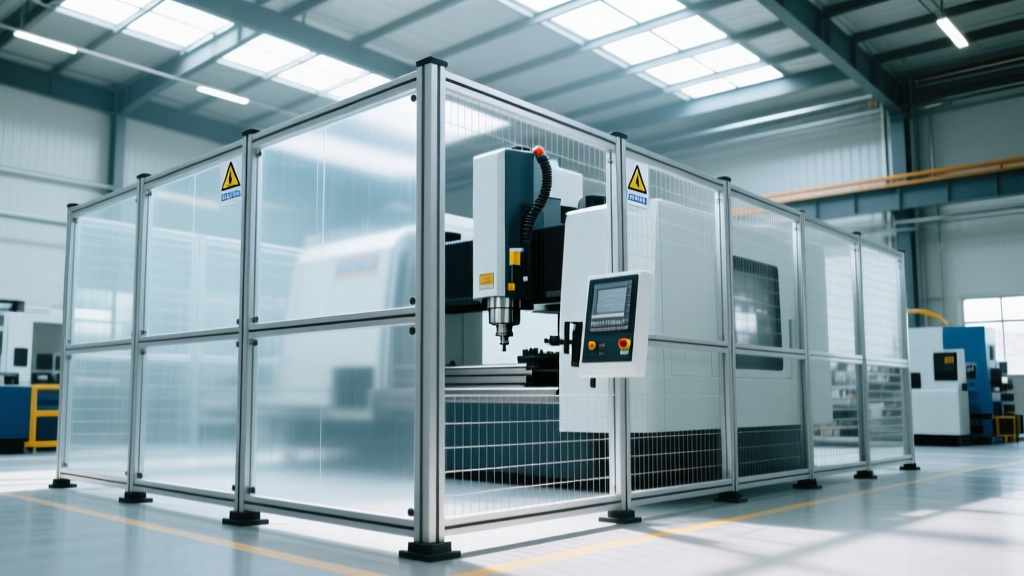
| Perimeter Guarding Mesh | Troax ST30 (30mm mesh) | $55 - $75 / linear foot | 0.8x hardware cost |
| RFID Interlock Switch | Schmersal AZM400 | $650 - $850 | 1.2x hardware cost |
Hidden Costs: Validation, Documentation, and Training
The most frequent cause of budget overruns in machinery safety projects is the underestimation of validation testing. ISO 12100 requires that every protective measure be verified against the original risk estimation. This means fault-injection testing—deliberately triggering sensors, cutting wires, and simulating PLC failures to prove the machine enters a safe state.
'Engineering teams often budget 10 hours for safety validation. On a highly automated robotic palletizing cell with multiple muting zones and manual override sequences, fault-injection testing routinely demands 40 to 60 hours of specialized controls engineering time.'
— Lead Functional Safety Auditor, Automotive Tier 1 Supplier (2025)
Furthermore, operator training must be documented. Budget $1,500 to $3,000 per shift for specialized safety training led by third-party vendors to ensure operators understand the difference between an E-stop and a safety-rated monitored stop, a critical distinction in ISO 12100 compliance.
The Strategic Budgeting Framework for Plant Managers
To prevent margin erosion on integration projects or surprise CapEx hits on internal upgrades, utilize this phased budgeting framework:
- Initiate Pre-Scoping (Weeks 1-2): Allocate 5% of the total machine budget to preliminary hazard analysis. Identify if the machine requires SIL 2 / PLd or SIL 3 / PLe architectures, as this dictates the safety PLC tier.
- Lock Hardware BOM (Weeks 3-4): Source guarding and optoelectronics early. Lead times for specialized safety lasers (e.g., SICK microScan3 Core) can stretch to 12 weeks in high-demand quarters.
- Reserve a 15% Contingency for Validation: Assume that at least one safety circuit will fail initial fault-injection testing, requiring redesign, rewiring, and re-programming.
- Factor in Lifecycle Maintenance: Safety components degrade. Budget for annual proof-testing of E-stops and interlocks, as mandated by OSHA machinery guarding guidelines and ISO 12100 lifecycle requirements.
By treating the ISO 12100 safety of machinery risk assessment standard overview not as a bureaucratic hurdle, but as a structured engineering and financial roadmap, facilities can achieve compliance while maintaining strict control over capital deployment.