Safety Fence for Machinery: 2026 Buying Guide & Standards
Discover how to select the right safety fence for machinery in 2026. Compare mesh vs. polycarbonate, ISO 14120 standards, and top guarding systems.
The Physics of Machine Guarding: Beyond Basic Compliance
Selecting the correct safety fence for machinery requires balancing kinetic impact resistance, optical visibility, and strict adherence to international safety standards. A 500-gram steel slug ejected from a CNC lathe spindle at 1,500 RPM carries enough kinetic energy to penetrate standard drywall and inflict fatal injuries. In 2026, facility managers and safety engineers must look beyond basic OSHA 1910.212 General Requirements for All Machines and engineer guarding systems that address specific hazard trajectories, maintenance access, and total cost of ownership.
This buying guide provides a technical framework for specifying, pricing, and installing industrial machine guarding systems, ensuring your facility passes both internal hazard assessments and external regulatory audits.
Decoding ISO 14120 and ISO 13857: Mesh Aperture vs. Safe Distance
ISO 14120 dictates the general requirements for the design and construction of guards, but the actual geometry of your safety fence for machinery is governed by ISO 13857. This standard defines the safe reaching distances to prevent operators from accessing hazard zones through the guard's apertures. Specifying the wrong mesh size is one of the most common failures in industrial hazard assessments.
When procuring welded wire mesh panels, you must cross-reference the aperture size with the distance from the fence to the nearest hazard point (e.g., the robot arm's maximum reach envelope or the lathe chuck).
| Mesh Aperture Size | Minimum Safe Distance to Hazard | Common Use Case |
|---|---|---|
| ≤ 4 mm | 2 mm | Finger-tip protection; small assembly automation |
| > 4 mm to ≤ 20 mm | 120 mm (4.7 in) | Hand protection; light packaging machinery |
| > 20 mm to ≤ 30 mm | 230 mm (9.0 in) | Arm protection; standard palletizing cells |
| > 30 mm to ≤ 40 mm | 850 mm (33.5 in) | Full body reach; heavy CNC machining perimeters |
Material Showdown: Welded Wire Mesh vs. Polycarbonate Panels
The choice between wire mesh and solid polycarbonate dictates both the safety rating and the operational workflow of the machine cell. According to machine guarding guidelines from the CCOHS, guards must not create new hazards (such as sharp edges or shear points) and must allow for adequate ventilation and visibility.
10-Gauge Welded Wire Mesh
- Specifications: Typically 0.135-inch (10-gauge) steel wire, welded at intersections. Standard apertures are 1x1 inch or 2x2 inch.
- Pros: Excellent ventilation for coolant mist and heat dissipation; high structural rigidity; lower material cost.
- Cons: Poor containment for fine chips or liquid splash; limits visibility of internal machine diagnostics.
- 2026 Pricing: $15 to $22 per square foot (panel only).
Polycarbonate (Lexan) Solid Panels
- Specifications: 0.250-inch (1/4") or 0.375-inch (3/8") thick PETG or Polycarbonate sheets. Must be UV-stabilized if exposed to sunlight to prevent yellowing and embrittlement.
- Pros: Superior optical clarity for camera-based vision systems; complete containment of coolant and micro-chips; high impact resistance (250x stronger than glass).
- Cons: Traps heat inside the enclosure; prone to scratching from abrasive dust; higher replacement frequency in harsh environments.
- 2026 Pricing: $35 to $55 per square foot.
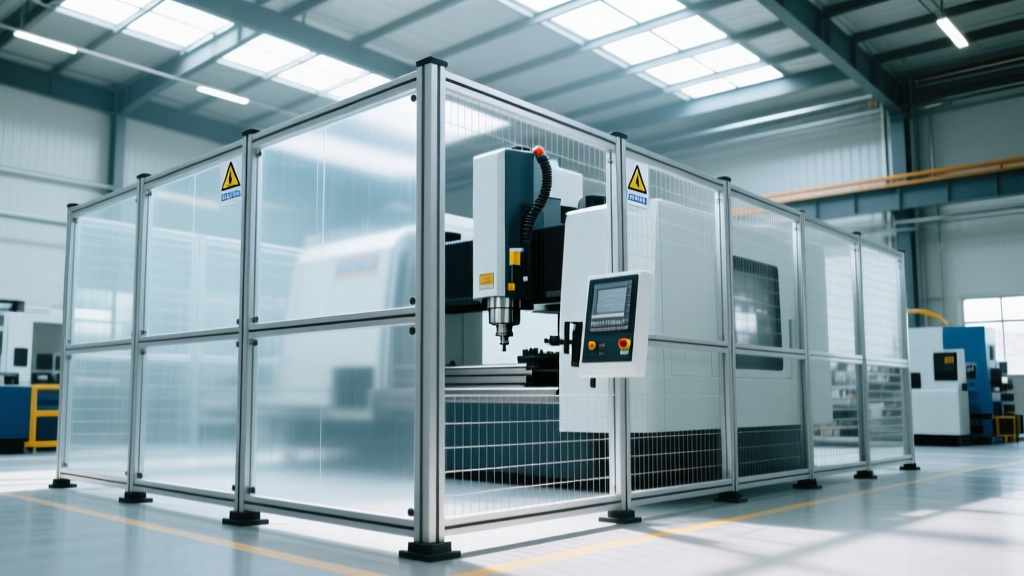
For CNC machining centers, specify a hybrid approach. Use 0.250-inch polycarbonate on the lower 48 inches of the fence to contain high-velocity coolant splash and heavy chip ejection, and transition to 2x2 inch welded wire mesh on the upper 36 inches to allow heat exhaust and overhead crane access visibility.
Framing Systems: Aluminum Extrusion vs. Tubular Steel
The structural skeleton of your safety fence for machinery must withstand both static loads (leaning, accidental bumps) and dynamic impacts (ejected parts, robotic arm collisions).
Aluminum T-Slot Extrusion (40x40mm Profile)
Systems like Bosch Rexroth or 80/20 Inc. utilize modular T-slot aluminum framing. These are bolted together using internal gussets and T-nuts. They are ideal for light-duty automation, cleanrooms, and electronics assembly where impact forces are minimal. Installation is rapid, requiring only hex keys and torque wrenches, which drastically reduces downtime during facility reconfigurations. However, a 40x40mm aluminum profile will yield and permanently deform under a 50-joule impact.
Welded 2x2-Inch 11-Gauge Steel Tubing
For heavy robotics (e.g., FANUC M-710 series handling 50kg payloads) or high-speed stamping presses, welded steel tubing is mandatory. The framing must be anchored to the concrete substrate using 1/2-inch wedge anchors at 48-inch intervals. While material costs are lower than aluminum ($8 to $12 per linear foot vs. $15 to $22), the labor cost for cutting, welding, grinding, and powder-coating steel framing increases total installation costs by 40% to 60%.
Interlock Hardware: Matching the Switch to the Hazard
A safety fence is only as effective as its access points. Procurement teams frequently make the mistake of specifying the wrong interlock switch type for the machine's stopping characteristics.
Non-Contact RFID Switches (e.g., Allen-Bradley 442G)
RFID switches use coded actuators to prevent defeat by standard magnets. They are ideal for machines with instantaneous stop times (under 0.5 seconds), such as servo-driven presses or laser cutters. The moment the door breaks the RF field, the safety relay drops the power. Cost: $250 - $350 per set.
Solenoid Guard Locking Switches (e.g., Schmersal AZM40)
If a machine has a high rotational inertia and a run-down time exceeding 1 second (e.g., a lathe chuck, a large centrifuge, or a milling spindle), you must specify a solenoid locking switch. These switches physically lock the door shut via a steel bolt and will not release the actuator until the safety controller confirms the machine has reached zero speed via a zero-speed monitor. Cost: $400 - $650 per set.
Calculating Total Cost of Ownership (TCO) for a 10x10 Machine Cell
When budgeting for a safety fence for machinery, initial material cost is only a fraction of the lifecycle expense. Below is a realistic 2026 TCO breakdown for a standard 10ft x 10ft robotic welding cell with one access gate.
| Component | Modular Aluminum/Mesh System | Custom Welded Steel/Polycarbonate |
|---|---|---|
| Framing Materials | $1,400 | $650 |
| Panel Materials (Mesh vs Poly) | $450 | $1,200 |
| Interlocks & Safety Relays | $550 | $550 |
| Installation Labor (Union Rates) | $800 (8 hours) | $2,400 (24 hours + fab time) |
| Total Initial CapEx | $3,200 | $4,800 |
| Future Relocation Cost | $400 (Disassemble/Reassemble) | $3,500 (Torch, Reweld, Paint) |
OSHA and ISO standards require guards to be secured to prevent unauthorized access from underneath. A common installation error is leaving a 4-inch gap at the floor for sweeping. If the machine processes small fasteners, springs, or generates high-pressure coolant mist, this gap renders the lower fence useless. Specify a flush-mount bottom rail, or install a 14-gauge steel toe-kick plate spanning the bottom 4 inches of the perimeter to contain debris while allowing floor cleaning.
Procurement Checklist for Safety Engineers
Before issuing a purchase order for your next machine guarding project, verify the following specifications against your hazard assessment:
- Aperture Validation: Does the mesh size strictly comply with ISO 13857 reaching distances based on the exact measurement from the fence plane to the nearest moving part?
- Impact Rating: Have you calculated the maximum kinetic energy (Joules) of a potential ejection? If >50J, polycarbonate or heavy-gauge steel mesh is mandatory.
- Interlock Logic: Does the machine require a zero-speed monitor and solenoid lock, or is an instantaneous RFID switch sufficient?
- Ergonomic Access: Are maintenance panels hinged with captive fasteners to prevent hardware from dropping into the machine bed during routine servicing?
- Grounding: If using metal mesh and steel framing near high-voltage automation, is the entire fence perimeter bonded to the facility's main grounding bus to prevent static buildup and shock hazards?
By prioritizing modularity, precise adherence to reaching distance standards, and correct interlock selection, facilities can deploy safety fences that protect personnel without bottlenecking production throughput.