Heavy Safe Moving Equipment: Operator Training Guide
Master heavy safe moving equipment operation. Learn OSHA-compliant training protocols, hazard assessments, and rigging best practices for heavy loads.
The Hidden Costs of Inadequate Heavy Load Training
Moving multi-ton industrial assets—such as 5-axis CNC machining centers, 400-ton stamping presses, or industrial turbine generators—requires far more than standard forklift certification. As of 2026, OSHA enforcement priorities heavily target the intersection of material handling and precision machinery installation. According to OSHA 1910.176 standards for handling materials, improper load securing and equipment misuse remain leading causes of catastrophic facility damage and fatal crush injuries.
Operators tasked with maneuvering heavy safe moving equipment must master the physics of load distribution, substrate limitations, and precision rigging. A dropped 80,000-pound load does not just destroy the asset; it compromises the structural integrity of the facility floor and risks severe regulatory fines exceeding $160,000 per willful violation. This guide outlines the exact technical competencies, equipment matrices, and hazard assessment protocols required for elite machinery moving teams.
Critical Safety Alert: Never rely solely on the original equipment manufacturer (OEM) lifting points for horizontal movement. OEM lift lugs are engineered for vertical crane lifts, not the lateral shear forces generated by machinery skates or air casters.Equipment Selection and Training Matrix
Heavy safe moving equipment is not a monolith. Training must be segmented by the specific mechanical principles of the chosen transport method. Below is a technical matrix detailing the primary equipment classes, their operational thresholds, and the specific training focus required for each.
| Equipment Type | Example Model | Max Capacity | Floor Substrate Requirement | Primary Operator Training Focus |
|---|---|---|---|---|
| Machinery Skates | Hilman Series 6 Rollers | 400 Tons | 250+ psi concrete, steel plate | Steer-axle geometry, load equalization, incline shimming |
| Air Casters | AeroGo Load Float System | 500+ Tons | Sealed epoxy, smooth concrete (no expansion joints) | PSI regulation, hose management, pneumatic failure contingencies |
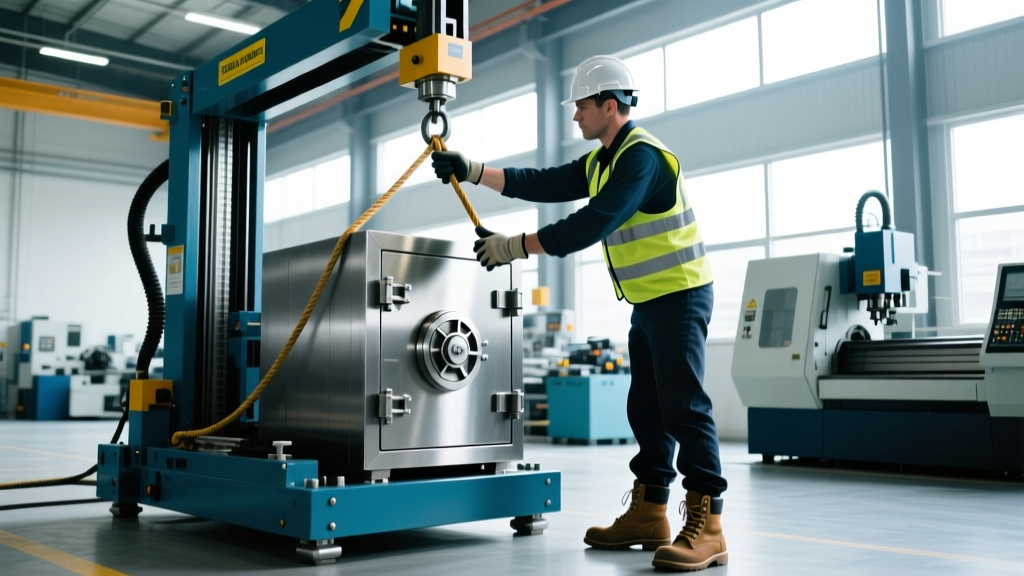
| Modular Gantry Cranes | Spanco 4000 Series | 15 Tons | Level pad footings, reinforced slab | Load swing control, rigging angle calculations, dynamic braking |
The 4-Point Pre-Move Hazard Assessment Protocol
Before any heavy safe moving equipment is deployed, lead operators must execute a documented 4-point hazard assessment. This framework eliminates the guesswork that leads to mid-move equipment failure.
Step 1: Center of Gravity (CoG) Verification
Never assume the CoG listed in a 10-year-old OEM manual is accurate. Aftermarket modifications, added coolant tanks, and chip conveyors drastically shift the CoG. Operators must use digital tension meters (such as Crosby Group load cells) to perform a trial lift or calculate the exact weight distribution across all four corners. If the CoG is offset by more than 15%, skate placement must be adjusted asymmetrically to prevent individual skate overload.
Step 2: Substrate and Route Analysis
Heavy machinery skates concentrate immense point loads onto the floor. A standard 6-inch concrete slab may crack under a 50-ton press if the skate footprint is too small. Operators must review facility core-drilling reports to verify concrete thickness and rebar placement. For air casters, the route must be inspected for unsealed expansion joints or cracks wider than 1/16th of an inch, which will cause immediate pneumatic pressure loss and drop the load.
Step 3: Rigging Hardware Inspection
All chain slings used to secure the load to the moving skates must be Grade 100 alloy chain. Operators must perform a magnetic particle inspection on high-stress master links and verify that chain elongation has not exceeded 5% of the original length. Synthetic slings should be avoided in heavy machinery moving due to their vulnerability to sharp machined edges and cutting fluids.
Step 4: Pinch Point and Egress Mapping
Map the entire travel path and identify all pinch points. Heavy safe moving equipment requires operators to walk alongside the load. If the clearance between the load and a structural column is less than 36 inches, the operator must not enter that zone while the load is in motion. Remote-controlled electric tugger systems should be utilized in sub-36-inch clearance areas.
Pro Tip: Use high-visibility laser levels projected onto the floor to mark the exact travel path and the 36-inch exclusion zones. This provides a real-time visual boundary for the entire moving crew.Real-World Failure Modes and Edge Cases
Understanding how heavy safe moving equipment fails in the field is critical for operator training. Standard manuals rarely cover the nuanced edge cases that occur in active manufacturing environments.
Failure Mode: Skate Steer-Axle Binding on Inclines
Machinery skates are designed for perfectly level surfaces. When moving a 60-ton injection molding machine over a floor with a mere 2-degree incline (such as a loading dock ramp), the steer-axle bearings can bind under the lateral load. This causes the skate to track sideways, violently shifting the load off the skates. Correction: Operators must use precision-machined steel shims under the leading skates to artificially level the load before engaging the push-pull tugger.
Failure Mode: Air Caster Pressure Drop at Thresholds
Air casters require a continuous film of air (typically 15-25 PSI) to float the load. When crossing a metal door threshold or a heavy-duty floor grate, the air seal breaks. If the operator does not preemptively increase the manifold pressure by 10-15 PSI just before crossing the threshold, the caster will bottom out, causing a sudden shock load that can crack the machine base casting. Correction: Install temporary steel bridge plates over all thresholds and grates prior to the move.
2026 Certification and Recertification Standards
As outlined by OSHA material handling guidelines, employers must certify that operators are trained and evaluated on the specific equipment they will use. In 2026, industry-leading heavy machinery moving firms require a tiered certification process:
- Tier 1 (Rigging & Skate Basics): 40 hours of classroom and practical training. Focuses on CoG calculation, Grade 100 sling inspection, and basic Hilman skate configuration. Average cost: $1,800 per operator.
- Tier 2 (Air Caster & Pneumatic Systems): Advanced 24-hour module covering pneumatic schematics, pressure regulation, and substrate sealing techniques. Average cost: $1,200 per operator.
- Tier 3 (Complex Multi-Point Moves): Required for moves exceeding 150 tons or involving multi-axis gantry integration. Requires annual practical recertification and a 3-year written exam cycle.
Investing in rigorous, equipment-specific training for heavy safe moving equipment is not merely a compliance exercise. It is a critical operational strategy that protects multi-million-dollar assets, preserves facility infrastructure, and ensures the safety of the personnel executing the move. Facilities that mandate strict adherence to the 4-point hazard assessment and equipment-specific matrices drastically reduce their risk of catastrophic load failures.