Selecting Manufacturer Packaging Equipment: Shrink vs Stretch Wrap
Compare shrink and stretch wrapping machinery for end-of-line operations. Explore costs, specific models, and technical specs to optimize your packaging.
The End-of-Line Dilemma: Containment Force vs. Visual Merchandising
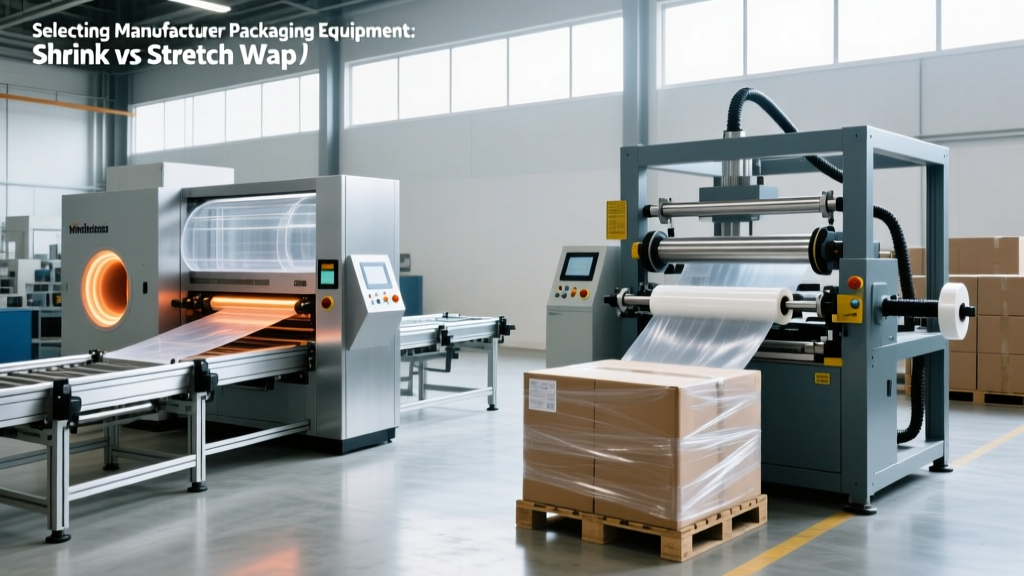
When evaluating manufacturer packaging equipment for end-of-line operations, the choice between shrink wrapping and stretch wrapping is rarely interchangeable. While both utilize polymeric films to unitize products, their mechanical applications, thermodynamics, and economic models diverge sharply. Stretch wrapping relies on elastic recovery (containment force) to secure palletized loads for transit, whereas shrink wrapping utilizes thermal contraction to create a tamper-evident, rigid, or visually optimized package.
Misallocating capital toward the wrong technology results in either excessive film waste, load failures during transit, or bottlenecks at the heat tunnel. This guide breaks down the exact machinery specifications, real-world pricing, and operational edge cases required to make a definitive selection.
Technical Comparison Matrix
Before evaluating specific OEM models, map your application against these fundamental engineering differences.
| Parameter | Stretch Wrapping Equipment | Shrink Wrapping Equipment |
|---|---|---|
| Primary Function | Pallet stabilization & transit security | Multi-pack bundling, tamper evidence, retail display |
| Typical Throughput | 20–120 pallets/hour | 15–150 individual packages/minute |
| Facility Power Draw | Low (120V/240V, 15-30 Amps) | High (480V 3-Phase, 40-80 Amps for heat tunnels) |
| Primary Film Resin | LLDPE (Cast or Blown) | POF (Polyolefin), PVC, or Heavy-gauge PE |
| Capital Cost Range | $18,000 – $160,000+ | $12,000 – $140,000+ |
Stretch Wrapping: Mechanics, Models, and Pre-Stretch Economics
Stretch wrappers are engineered to apply LLDPE film under tension. The critical metric here is containment force, not just the number of film layers. As of 2026, resin pricing volatility makes advanced pre-stretch carriage technology mandatory for any high-volume facility.
Turntable vs. Rotary Arm Architectures
- Turntable Wrappers (e.g., Lantech Q-300XT): The load spins on a rotating base while the film carriage moves vertically. Ideal for stable loads up to 4,000 lbs. Throughput maxes out around 40–50 loads per hour. Capital Cost: $22,000 – $38,000.
- Rotary Arm Wrappers (e.g., Lantech QL-400 or Robopac Octopus): The load remains stationary on the floor while a robotic arm orbits it with the film carriage. Mandatory for ultra-heavy loads (5,000+ lbs), unstable payloads, or high-speed lines requiring 80–120+ loads per hour. Capital Cost: $85,000 – $165,000.
Shrink Wrapping: Sealers, Heat Tunnels, and Thermodynamics
Shrink wrapping equipment is categorized by the sealing mechanism and the subsequent thermal contraction phase. According to testing protocols outlined by the International Safe Transit Association (ISTA), the integrity of the shrink seal is the primary failure point in multi-pack bundling.
Sealing Configurations
- L-Bar Sealers: Creates a single continuous seal around the product in one stroke. Suitable for low-to-medium speeds (10–25 packages per minute). Models like the Eastey Auto L-Bar ($14,000 – $19,000) dominate this space.
- Continuous Side Sealers: Utilizes a hot knife or heated wire in a continuous motion, allowing for unlimited package length and higher speeds (up to 80 ppm). Ideal for long, narrow products like moldings or window frames.
- Sleeve Wrappers (Bundlers): Applies a band of heavy-gauge Polyethylene (PE) film around products (e.g., water bottle multi-packs) leaving open ends. Heavy-duty models like the ARPAC Hawk ($65,000+) are standard for beverage and building materials.
Heat Tunnel Airflow Dynamics
The heat tunnel is where capital expenditure directly impacts package quality. Cheap tunnels use single-pass, unidirectional airflow, resulting in uneven shrinkage and "dog-ears" (unshrunk film corners). Premium tunnels utilize recirculating cross-flow air systems. For heavy PE bundling, high-velocity bottom-up airflow is required to lift the thick film and shrink it tightly against the base of the container. Expect to allocate $15,000–$30,000 for an industrial-grade recirculating tunnel alone.
Hidden OPEX: Film Yield and Energy Consumption
When calculating total cost of ownership (TCO), facility managers must account for the stark contrast in energy and material consumption between the two systems.
"End-of-line packaging machinery must be evaluated on a cost-per-thousand-packages basis, not just initial invoice price. Energy draws for industrial shrink tunnels frequently exceed 30kW per hour, requiring dedicated 480V 3-phase drops that can cost upwards of $12,000 to install in older facilities." — Industry guidelines from PMMI, The Association for Packaging and Processing Technologies.
Stretch Film Economics: A standard 20-inch roll of 80-gauge machine stretch film costs approximately $65–$80 and yields 40–60 pallet wraps depending on pre-stretch ratios. The electrical cost to run a turntable wrapper is negligible (under $2/day).
Shrink Film Economics: Polyolefin (POF) shrink film is significantly more expensive per pound than LLDPE. Furthermore, the natural gas or heavy electrical draw required to maintain a tunnel at 350°F–400°F adds a substantial fixed overhead to every shift, regardless of throughput volume.
Troubleshooting Common Failure Modes
Anticipating edge cases during equipment selection prevents costly line stoppages post-installation.
Stretch Wrapper Failures
- Film Tail Whipping: Occurs when the film cut-off mechanism fails to heat-seal the tail to the load. During transit, the tail catches wind, unraveling the entire wrap. Fix: Specify a wrapper with a thermal film clamp and wipe-down brush assembly.
- Load Crushing: Over-tensioning thin-walled corrugated boxes. Fix: Utilize equipment with load-cell feedback that automatically adjusts tension based on the payload's crush-resistance profile.
Shrink Wrapper Failures
- Dog-Ears and Fish-Eyes: Unshrunk corners or circular blemishes on the film surface. Fix: Increase tunnel conveyor speed to reduce dwell time, or switch from center-fold film to tubular film to eliminate the side-seam weakness.
- Burn-Through on Thin Substrates: The heat tunnel melts the product packaging (e.g., thin PET bottles or chocolate). Fix: Implement a tunnel with variable-speed recirculating fans to lower air velocity while maintaining ambient thermal thresholds.
The Final Selection Framework
Use this definitive logic tree to finalize your equipment requisition:
- Is the primary goal pallet stabilization for LTL/FTL freight? Select a Stretch Wrapper. Choose a turntable for standard stable loads, and a rotary arm for unstable, lightweight, or ultra-heavy loads.
- Is the product a retail-ready multi-pack requiring tamper evidence? Select an L-Bar or Side-Seal Shrink Wrapper with POF film and a recirculating heat tunnel.
- Are you bundling heavy, rigid containers (water, solvents, cement)? Select a Sleeve Shrink Bundler with heavy-gauge PE film and a high-velocity bottom-air tunnel.
- Does your facility lack 480V 3-phase power? You must either invest in heavy electrical infrastructure upgrades to run a shrink tunnel, or pivot your packaging design to cold-stretch or stretch-hood technologies.