Food Packaging Machinery News: Aseptic Filler Troubleshooting
Diagnose and repair aseptic food and beverage packaging machinery. Expert troubleshooting for H2O2 baths, sterile air faults, and seal failures.
The Critical Link Between Sterility Loss and Machine Faults
Recent food packaging machinery news indicates that high-speed aseptic lines—now routinely exceeding 24,000 packs per hour for dairy and plant-based beverages in 2026—are highly sensitive to micro-stoppages. Unlike standard form-fill-seal (FFS) equipment, aseptic fillers (such as the Tetra Pak A3/Speed or SIG Combibloc systems) operate under strict thermodynamic and microbiological constraints. A minor deviation in sterile air overpressure or hydrogen peroxide (H2O2) bath temperature does not just cause a mechanical jam; it triggers an automatic safety abort to prevent commercial sterility loss.
Troubleshooting these systems requires moving beyond basic PLC error codes to understand the physical chemistry of the sterilization tunnel and the fluid dynamics of the sterile chamber. This guide provides field-tested diagnostic frameworks for the three most costly failure modes in modern aseptic packaging machinery.
⚠️ CRITICAL SAFETY WARNING: Aseptic machinery relies on 35% to 50% concentration Hydrogen Peroxide (H2O2) for web and cap sterilization. The OSHA Permissible Exposure Limit (PEL) for H2O2 vapor is strictly 1.0 ppm over an 8-hour TWA. Never bypass safety interlocks on the sterilization tunnel exhaust system to diagnose a fault. Always consult the OSHA Chemical Data guidelines for Hydrogen Peroxide before performing maintenance on the bath heating elements or squeeze rollers.Diagnosing Sterile Chamber Overpressure Failures
The sterile chamber must maintain a positive pressure relative to the external factory environment to prevent the ingress of airborne contaminants. According to FDA guidance on aseptic processing and packaging, the loss of positive overpressure is a critical control point (CCP) that mandates an immediate line stop and re-sterilization cycle (SIP).
Symptom: PLC Abort Code 'Sterile Air Pressure Low'
If the machine aborts during the run phase citing a pressure drop below 15 Pa (Pascals), do not immediately replace the HEPA filter. In 80% of field cases, the root cause is a leak in the dynamic sealing interfaces or a faulty differential pressure sensor.
| Component | Target Parameter | Failure Mode | Corrective Action |
|---|---|---|---|
| Differential Pressure Transmitter (e.g., Setra Model 264) | 15 - 25 Pa | Sensor drift due to condensation in the sensing tube. | Purge the sensing lines with dry instrument air; recalibrate zero-point. |
| HEPA Pre-Filter (G4 Grade) | < 150 Pa pressure drop | Loading with ambient dust restricts airflow, starving the sterile blower. | Replace pre-filter. Never wash or vacuum HEPA pre-filters. |
| Web Entry/Exit Air Knives | 0.3 - 0.5 bar | Misaligned air knife nozzles allow sterile air to escape the chamber. | Verify air knife gap (typically 1.5mm) using feeler gauges; realign parallel to the web. |
| Chamber Door Seals (Silicone Gaskets) | Zero leakage | Micro-tears from repeated CIP/SIP thermal cycling. | Inspect with UV dye; replace gaskets every 4,000 operating hours. |
Hydrogen Peroxide Bath and Web Drying Faults
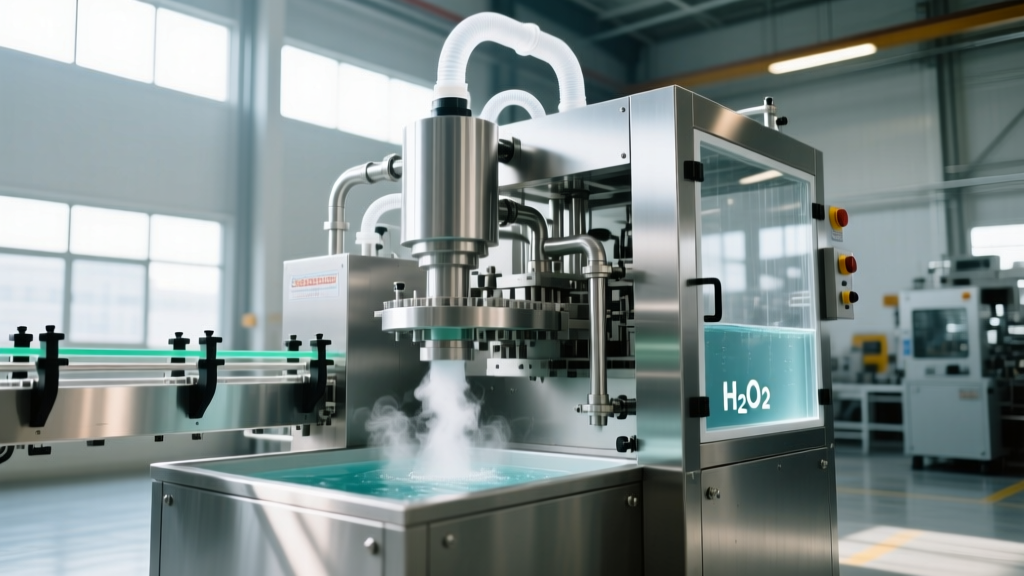
The sterilization tunnel relies on a heated H2O2 bath to achieve a 4-log to 6-log reduction in microbial load on the packaging web. The bath must be maintained precisely at 70°C to 75°C with a concentration of 35% ± 2%. If the web exits the bath with excess moisture, the subsequent drying air (typically 120°C) will fail to evaporate the residual liquid, leading to 'wet spots' that compromise the longitudinal induction seal.
Step-by-Step Troubleshooting for Wet Web Exits
- Verify Bath Concentration: Use a refractometer or inline conductivity sensor to ensure the H2O2 concentration hasn't dropped below 33% due to water carry-over from the preceding rinse cycle.
- Inspect Squeeze Rollers: The primary mechanical barrier to excess H2O2 is the nip pressure of the squeeze rollers. Check the pneumatic cylinder pressure; it should be set to exactly 2.5 bar. Worn polyurethane roller covers will leave a microscopic film of H2O2 on the web.
- Check Drying Air Temperature: Measure the air temperature at the nozzle exit using a K-type thermocouple. If it reads below 115°C, inspect the electrical heating banks for blown thyristors or tripped thermal overloads.
- Evaluate Web Tension: Excessive web tension can cause the material to stretch and thin out, altering its thermal mass and preventing proper drying. Verify the dancer arm potentiometer voltage matches the OEM specification (usually 2.0V to 8.0V).
"In high-speed aseptic lines, a 2°C drop in the drying air temperature or a 0.2 bar loss in squeeze roller pressure will not trigger an immediate alarm, but it will cause catastrophic seal delamination 400 packs down the line. Predictive maintenance on these thermodynamic variables is non-negotiable." — Lead Automation Engineer, European Dairy Packaging Consortium
Induction Sealing and Cross-Seal Jaw Troubleshooting
Once the web is formed into a tube, the cross-seal jaws must create a hermetic seal through the liquid product zone. Modern aseptic fillers utilize inductive heating for the longitudinal seal and direct thermal conduction (or ultrasonic welding) for the cross-seals. Seal integrity failures are the most common cause of downstream leakers.
Comparison Matrix: Seal Failure Diagnostics
| Visual Defect | Probable Root Cause | Machine Adjustment Required |
|---|---|---|
| Wrinkled longitudinal seal (Fin Seal) | Induction generator power too high; polymer melting unevenly. | Reduce generator output by 5%; verify web tracking is centered over the inductor. |
| Pinholes in cross-seal | Product entrapment in the seal area due to faulty dosing valve timing. | Advance the dosing valve cut-off timing by 15-20 milliseconds. |
| Delamination at cross-seal edges | Insufficient jaw pressure or worn Teflon coating on the sealing jaws. | Increase hydraulic jaw pressure to 140 bar; inspect jaws for carbon buildup. |
| Asymmetrical seal bead | Misalignment of the forming collar or uneven web tension. | Adjust forming collar set-screws; re-calibrate the web tension brake. |
Web Tracking and Splicing Errors in Roll-Fed Systems
Aseptic roll-fed packaging material is highly sensitive to edge tracking errors. If the web drifts by more than 1.5mm, the longitudinal seal will miss the designated aluminum foil overlap zone, resulting in an unsterile package. In 2026, most advanced fillers utilize ultrasonic sensors for splice detection and optical edge-guides for tracking.
💡 Pro Tip for Splice Detection: Ultrasonic splice sensors often fail when the packaging material composition changes (e.g., switching from standard PE/Alu/PE laminate to newer mono-material or bio-based barrier films). When introducing a new packaging SKU, always perform a 'teach' cycle on the ultrasonic sensor to recalibrate the acoustic impedance baseline, otherwise the machine will falsely reject every splice or fail to detect them entirely.Resolving Chronic Edge Drift
If the edge guide actuator is constantly hunting (oscillating back and forth), the issue is rarely the sensor itself. Instead, check the mechanical path of the web:
- Idler Roll Parallelism: Use a precision laser alignment tool to verify that all idler rolls in the magazine and sterilization tunnel are perfectly parallel. A deviation of just 0.5mm over a 1-meter span will cause continuous drift.
- Brake Dust Accumulation: The magnetic particle brakes on the unwind shaft generate fine metallic dust. If this dust contaminates the web guide linear bearings, the friction will cause the PID control loop to overshoot, resulting in a 'hunting' effect.
- Splice Tape Application: Manual splices applied at an angle greater than 2 degrees relative to the web edge will force the material into a helical path as it passes through the tension rollers.
Preventative Maintenance Intervals for Aseptic Systems
Relying on reactive troubleshooting for aseptic machinery guarantees product recalls. Implementing a rigid, condition-based maintenance schedule is the only way to sustain OEE (Overall Equipment Effectiveness) above 85% on high-speed aseptic lines. Prioritize the calibration of H2O2 concentration sensors, the replacement of sterile air pre-filters, and the ultrasonic testing of cross-seal jaw integrity every 500 operating hours. By aligning your maintenance protocols with the latest food packaging machinery news and OEM bulletins, you can eliminate the micro-stoppages that destroy profitability in aseptic beverage production.