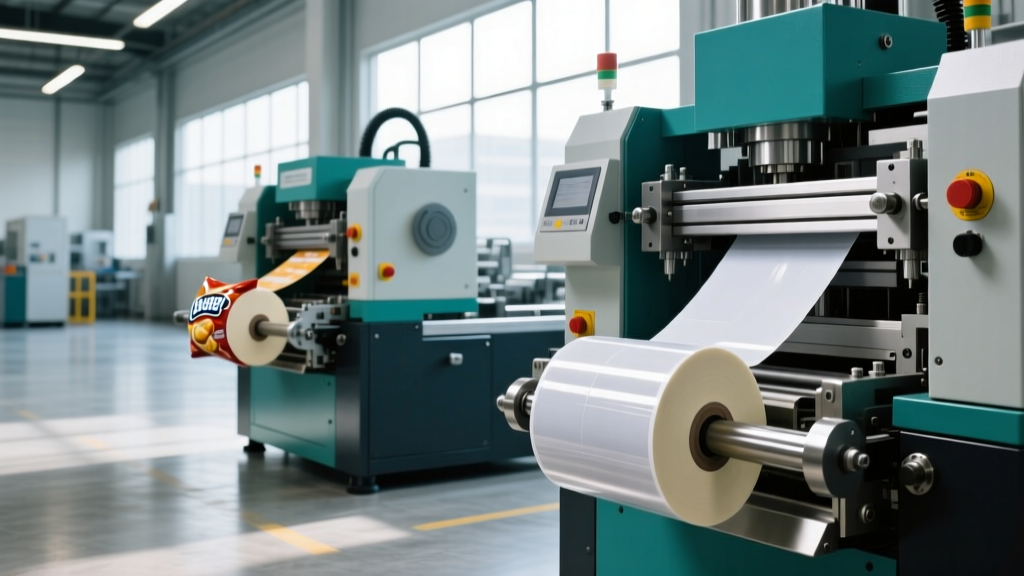
FFS Case Studies: Packaging Machinery News November 2025 Analysis
Analyzing form-fill-seal case studies and packaging machinery news November 2025 trends, featuring mono-material VFFS specs and heavy-duty FFS ROI data.
When synthesizing the packaging machinery news November 2025 cycle, the dominant narrative across the form-fill-seal (FFS) sector was the forced transition to mono-material films and the integration of AI-driven web tension control. As we navigate 2026, the theoretical upgrades and pilot programs announced in late 2025 are now yielding measurable Overall Equipment Effectiveness (OEE) data on production floors. This analysis examines real-world FFS case studies, translating recent industry announcements into actionable CapEx and operational frameworks for packaging engineers and plant managers.
The Late-2025 FFS Shift: What Actually Changed?
The primary catalyst driving FFS innovation over the last six months has been the strict enforcement of extended producer responsibility (EPR) regulations regarding multi-layer laminates. Machinery OEMs responded by completely redesigning sealing jaw architectures to handle the narrow thermal window of mono-polyethylene (mono-PE) and mono-polypropylene (mono-PP) films. Furthermore, the integration of machine vision for real-time seal inspection has moved from an optional $45,000 add-on to a standard baseline feature on mid-tier vertical form fill seal (VFFS) systems.
Case Study 1: Snack Food VFFS and the Mono-PE Mandate
A major North American snack food manufacturer recently retrofitted three production lines with Syntegon SVE 2520 VFFS systems, replacing legacy equipment that relied on PET/PE laminates. The objective was to transition to a 60-micron mono-PE high-barrier film (metallized for UV protection) without sacrificing line speed.
The Thermal Window Challenge
Unlike traditional PET laminates where the outer layer provides heat resistance, mono-PE films shrink and distort if the sealing jaw temperature exceeds the film's melting point by even a few degrees. The manufacturer faced a 14% reject rate during initial 2025 trials due to leakers and channel burns.
Operational Data Highlight: Mono-PE Retrofit- Previous Film: 75-micron PET/PE laminate
- New Film: 60-micron Mono-PE (Metallized)
- Speed Target: 120 bags/min
- Initial Reject Rate: 14.2% (Seal distortion)
- Post-Optimization Reject Rate: 0.8%
The solution involved upgrading to specialized cross-hatched sealing jaws with integrated PID temperature controllers that sample jaw heat every 10 milliseconds. By holding the jaw temperature precisely at 132°C (±1°C) and applying 3.5 bar of pressure with a 0.35-second dwell time, the line achieved 115 bags/min with a 99.2% seal integrity rate.
Heavy-Duty FFS for Bulk Chemicals: The Tubular Revolution
While VFFS dominates food and consumer goods, the heavy-duty FFS (HFFS) segment for 25kg and 50kg bags underwent a massive shift in late 2025, driven by moisture-sensitivity requirements in the agricultural and chemical sectors. The industry is rapidly abandoning multi-wall paper bags in favor of woven polypropylene (PP) block-bottom bags produced via tubular FFS technology.
Systems utilizing Windmöller & Hölscher (W&H) AD*STAR technology have become the benchmark for this transition. These machines form, fill, and seal block-bottom bags from tubular PP fabric in a single continuous operation, applying a micro-perforation pattern that allows trapped air to escape during high-speed palletizing without letting moisture in.
Comparative Matrix: Multi-Wall Paper vs. Tubular PP FFS
| Metric | Traditional Multi-Wall Paper (3-Ply + 1 PE) | Tubular PP FFS (AD*STAR Style) |
|---|---|---|
| Material Cost per Bag | $0.38 - $0.42 | $0.22 - $0.26 |
| Moisture Barrier | Moderate (degrades in >70% humidity) | Excellent (Hydrophobic PP + coating) |
| Drop-Test Survival (1.5m) | 78% survival rate | 96% survival rate |
| Changeover Time (25kg to 50kg) | 45 - 60 minutes | 15 - 20 minutes (Automated format) |
| Storage Footprint (Empty Bags) | High (bulky, rigid) | Low (flat-foldable, 1/3 the volume) |
Troubleshooting Tubular PP Seal Failures
A common failure mode in HFFS tubular PP systems is bottom-seal delamination during the drop-palletizing phase. This is rarely a material defect; it is almost always a thermal management issue at the sealing station. If the PP coating is not heated uniformly to 185°C before the folding and pressing stage, the micro-welds will fracture under the 25kg dynamic load. Plant engineers must calibrate the hot-air pre-heaters and verify that the ambient plant temperature hasn't dropped below 18°C, which drastically alters the cooling curve of the PP seal.
2026 CapEx Planning: FFS Machinery Pricing and Lead Times
Based on current OEM pricing structures and supply chain data compiled by industry watchdogs like PMMI (The Association for Packaging and Processing Technologies), capital expenditure planning for FFS equipment requires precise budgeting. The post-2025 stabilization of servo-motor supply chains has normalized lead times to 16–22 weeks, down from the 35-week peaks seen in previous years.
- Entry-Level VFFS (Intermittent Motion, 60 bags/min): $65,000 – $85,000. Ideal for co-packers and short runs. Typically lacks advanced mono-film tension controls.
- Mid-Tier VFFS (Continuous Motion, 120+ bags/min): $110,000 – $165,000. Includes ultrasonic sealing options and integrated vision inspection.
- Heavy-Duty HFFS (Tubular PP, 1,200 bags/hour): $450,000 – $600,000+. Requires significant facility footprint and specialized dust-extraction integration for chemical applications.
'The ROI on a modern HFFS tubular system for cement or fertilizer is no longer just about labor savings. The material cost reduction of switching from multi-wall paper to coated PP pays for the machinery in roughly 14 to 18 months for facilities running two shifts a day.' — Senior Packaging Engineer, Global Building Materials Manufacturer
Frequently Asked Questions (FFS Procurement)
Can legacy VFFS machines be retrofitted for mono-PE films?
Yes, but it requires more than a software update. You must replace the standard sealing jaws with specialized profiled jaws (usually cross-hatched or linear-serrated depending on the film thickness) and upgrade the temperature controllers to high-frequency PID units. Expect a retrofit cost of $12,000 to $18,000 per sealing station, plus new film-roll tension brakes to handle the higher stretch coefficient of mono-PE.
What is the primary cause of web-tracking errors in high-speed VFFS?
Static electricity buildup on mono-material films. Unlike laminates, mono-PP and mono-PE generate significant static as they pass over the forming collar, causing the film to cling to the stainless steel and drift off the photo-eye registration mark. Installing active ionized air blowers directly above the forming collar and at the film-unwind station resolves 90% of high-speed tracking drift.
How does ultrasonic sealing compare to thermal sealing for FFS applications?
Ultrasonic sealing vibrates the film layers at 20–40 kHz to generate friction-based heat, melting the sealant layer without heating the entire jaw. It is vastly superior for sealing through contaminated areas (e.g., powder dust or oily snack residues) and reduces energy consumption by up to 25%. However, the initial tooling cost is roughly 3x higher than standard thermal jaws, making it most viable for high-margin pharmaceutical or premium food applications.