Integrating Robotic Packaging Machinery into FFS Lines
Discover how integrating robotic packaging machinery with form-fill-seal (FFS) systems boosts throughput. Real-world case studies and 2026 ROI data.
The Shift from Mechanical Linkages to Robotic End-of-Line
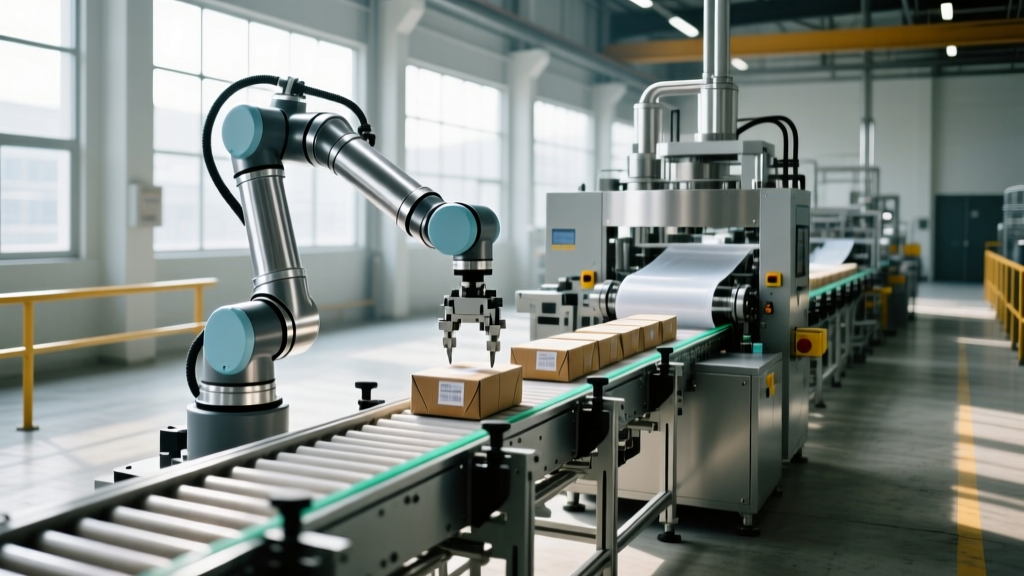
Form-fill-seal (FFS) technology has long been the backbone of high-volume packaging, creating bags, pouches, and blister packs from a continuous roll of film. However, the downstream discharge—where primary packs are collated and loaded into secondary cartons—has historically relied on rigid mechanical drop packers and wrap-around case packers. As SKU proliferation accelerates and lightweighting reduces film thickness, mechanical linkages cause excessive product damage and require hours of changeover time. Integrating robotic packaging machinery at the discharge of vertical (VFFS) and horizontal (HFFS) systems resolves these bottlenecks, offering sub-millisecond adaptability and non-contact handling.
Key Information Gain: Upgrading from a mechanical wrap-around case packer to a delta-robotic cell at the discharge of a VFFS line typically reduces changeover time from 45 minutes to under 8 minutes, while increasing Overall Equipment Effectiveness (OEE) by 12-18% due to the elimination of mechanical jamming.Case Study 1: High-Speed Snack Food VFFS Integration
A major North American snack food manufacturer faced a critical bottleneck on their 140g potato chip lines. The existing Syntegon SVE 2520 VFFS machines were capable of producing 120 bags per minute, but the downstream mechanical drop packer frequently crushed the nitrogen-flushed bags during the collation phase, resulting in a 4.2% scrap rate and frequent line stoppages.
The Robotic Solution
The engineering team replaced the mechanical collator with a dual-cell robotic setup featuring four ABB IRB 360 FlexPicker delta robots. The system utilizes a Cognex In-Sight 990 vision system mounted above the FFS discharge conveyor to identify bag orientation and verify seal integrity before picking.
- Robot Model: ABB IRB 360-3/1130 (3kg payload, 1130mm reach)
- End-of-Arm Tooling (EOAT): Custom 3D-printed TPU (Thermoplastic Polyurethane) soft-touch suction cups with Piab piGRIP bellows to prevent film puncture.
- Conveyor Tracking: ABB PickMaster 3 software synced with a Sick AFS60 absolute encoder on the FFS discharge belt.
Performance Metrics and ROI
| Metric | Mechanical Drop Packer | ABB Delta Robotic Cell |
|---|---|---|
| Throughput (Bags/Min) | 95 (bottlenecked) | 120 (matched VFFS max) |
| Product Scrap Rate | 4.2% | 0.3% |
| SKU Changeover Time | 45 minutes | 6 minutes (recipe recall) |
| Footprint | 42 sq ft | 28 sq ft |
Case Study 2: Medical Device HFFS Thermoforming
In the medical device sector, packaging integrity is a regulatory requirement, not just a quality metric. A surgical instrument manufacturer utilized a Multivac R 535 Horizontal Form-Fill-Seal (HFFS) thermoformer to produce sterile barrier pouches. The mechanical stacking mechanism used to group the pouches prior to cartoning caused micro-abrasions on the Tyvek lids, compromising the sterile barrier and failing ISO 11607 validation tests.
Articulated Arm Implementation
The facility integrated a FANUC M-20iD/25 articulated robot to handle the delicate thermoformed trays. Unlike delta robots, the articulated arm provided the necessary reach to span the wide web of the HFFS discharge and the precise path control required to slide the trays into tight-fitting corrugated trays without scuffing.
Warning on EOAT Selection: When handling medical Tyvek/Foil pouches, standard vacuum cups often leave micro-residue or cause delamination. The integration team utilized Schmalz SBP (Sterile Barrier Packaging) vacuum grippers with PEEK (Polyether ether ketone) contact surfaces, ensuring zero particulate generation and compliance with cleanroom ISO Class 7 standards.Control Architecture: Syncing FFS Film Pulls with Robot Tracking
The most common point of failure when integrating robotic packaging machinery with FFS equipment is the communication handshake between the FFS PLC and the Robot Controller. If the FFS machine alters its film pull length or sealing jaw timing, the robot's conveyor tracking window must update instantaneously to avoid missed picks or collisions.
Protocol Selection and Latency Management
Standard TCP/IP or standard PROFINET RT (Real-Time) is insufficient for high-speed FFS lines running above 80 cycles per minute. The industry standard for 2026 upgrades is PROFINET IRT (Isochronous Real-Time) or EtherCAT.
- Encoder Placement: Mount the master encoder directly on the FFS film pull servo shaft, not the discharge conveyor. This provides the robot controller with predictive data before the bag even hits the belt.
- Jitter Reduction: Configure the PLC to send setpoint position updates every 1ms. Ensure the robot controller's interpolation cycle is set to 2ms or lower.
- Fly-Pick Calibration: For VFFS lines where bags overlap slightly on the discharge belt, enable 'fly-pick' routines where the robot matches the belt speed and picks the product in motion, rather than waiting for the belt to index and stop.
2026 Capital Expenditure and ROI Timelines
Budgeting for robotic end-of-line integration requires a clear understanding of current hardware and software licensing costs. Based on Q1 2026 pricing from major integrators, here is the capital expenditure breakdown for a single-lane FFS discharge cell:
- Delta Robot Cell (e.g., ABB IRB 360): $135,000 - $175,000. Includes robot, IRC5P controller, PickMaster software license, carbon fiber EOAT, and 3-meter tracking conveyor.
- Articulated Arm Cell (e.g., FANUC M-20iD): $110,000 - $150,000. Includes robot, R-30iB Plus controller, iRVision 2D package, and custom machined EOAT.
- Controls & Safety Integration: $25,000 - $40,000. Includes Siemens S7-1500 safety PLC, SICK microScan3 laser scanners, and PROFINET network infrastructure.
For high-margin goods (pharmaceuticals, premium snacks), the reduction in product scrap and the ability to run 24/7 without mechanical changeover fatigue typically yields an ROI of 14 to 18 months.
Troubleshooting Common FFS-Robotic Sync Failures
When the robotic cell faults out at the FFS discharge, maintenance teams often misdiagnose the issue as a robot hardware failure. In reality, 80% of faults stem from upstream FFS inconsistencies. Use this diagnostic framework:
Symptom: Robot Frequently Drops Product Mid-Transfer
Root Cause: The FFS sealing jaw temperature fluctuated, causing the film to stretch during the cut-off phase. This alters the bag's center of gravity, causing the vacuum cups to lose their seal during the robot's high-G acceleration phase.
Fix: Install a closed-loop thermocouple feedback system on the FFS sealing jaws and implement a vacuum-decay sensor on the robot EOAT to verify grip integrity before initiating the high-speed transfer arc.
Symptom: 'Tracking Window Missed' Faults on HMI
Root Cause: The FFS discharge belt tension has degraded, causing micro-slippage between the belt and the drive roller. The encoder on the drive roller is reporting accurate motor movement, but the belt (and the product) is moving slower than the robot expects.
Fix: Relocate the tracking encoder from the drive motor shaft to a passive idler pulley that rides directly on the belt surface, ensuring the robot tracks actual belt surface speed, not motor shaft speed.