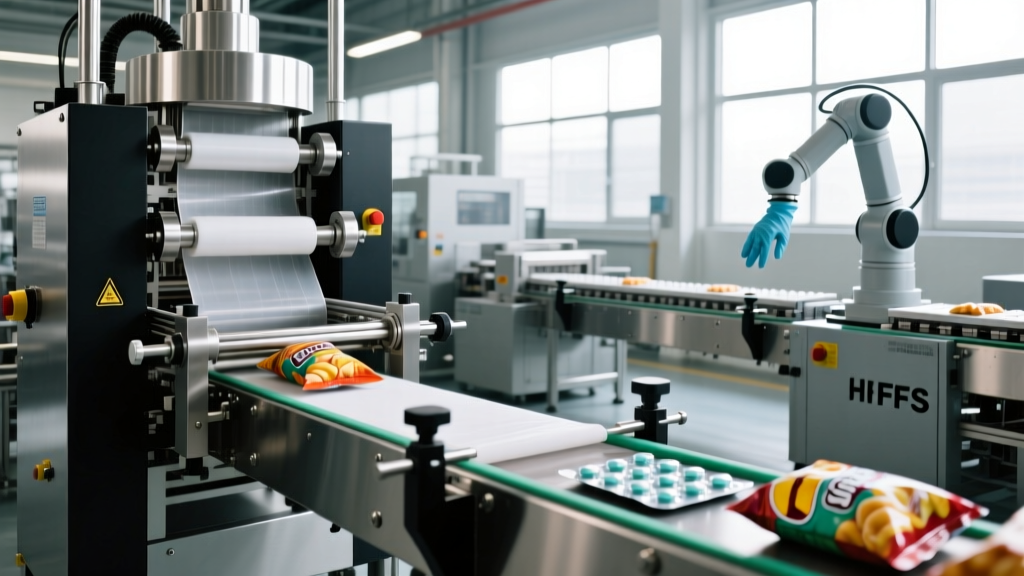
FFS Machinery for Packaging Industry: Food & Pharma Case Studies
Explore real-world case studies of FFS machinery for packaging industry. Analyze VFFS snack food lines and HFFS medical device thermoforming ROI.
Beyond the Brochure: Real-World FFS Performance in 2026
Form-fill-seal (FFS) technology remains the backbone of high-volume automated packaging. However, manufacturer spec sheets rarely reflect the physical realities of factory floors. When evaluating machinery for packaging industry applications, engineers must look past theoretical cycle times and examine how equipment handles film drift, particulate contamination, and rapid changeovers. This analysis dissects two distinct FFS deployments—a high-speed vertical snack food line and a sterile horizontal medical thermoformer—to provide actionable data on OEE (Overall Equipment Effectiveness), capital expenditure, and failure mode troubleshooting.
Line Profile: Snack Food VFFS Deployment
- Application: Salted potato chips (high-dust, high-oil product)
- Equipment Class: Continuous-motion Vertical Form Fill Seal (VFFS)
- Film Structure: 45-micron metallized BOPP/PE laminate
- Target Speed: 140 bags per minute (bpm)
- Weighing Integration: 14-head multihead scale with 2.5-liter buckets
Case Study 1: Overcoming Seal Contamination in High-Speed VFFS
In snack food extrusion, product dust and oil aerosolization are the primary enemies of seal integrity. A mid-western co-packer operating a continuous-motion VFFS tube experienced a 4.2% leaker rate on their metallized BOPP film. The root cause was poly-dust accumulation on the cross-seal jaws, which created microscopic channels in the 3mm seal area, leading to nitrogen flush loss and premature staling.
The Ultrasonic Sealing Retrofit
Rather than increasing thermal jaw temperatures—which risked burning the 45-micron film and causing longitudinal seal wrinkling—the facility retrofitted the machine with 20 kHz ultrasonic sealing jaws. Unlike thermal jaws that rely on conductive heat transfer, ultrasonic jaws use high-frequency acoustic vibrations to melt the inner PE sealant layer exclusively at the interface.
According to data published by Packaging World, ultrasonic sealing effectively ignores surface contaminants like dust and oil because the vibrations physically displace particulates from the seal area before the polymer chains cross-link. Post-retrofit, the co-packer's leaker rate dropped to 0.15%, and seal jaw cleaning intervals expanded from every 4 hours to once per 72-hour shift. The capital cost for the ultrasonic generator and titanium horn assembly was $42,500, yielding a payback period of just 4.5 months through reduced film waste and eliminated rework.
Case Study 2: HFFS Thermoforming for Sterile Medical Devices
Horizontal Form Fill Seal (HFFS) thermoformers operate under entirely different constraints, particularly in Class 7 cleanrooms. A medical device manufacturer producing pre-filled saline syringes utilized a rotary-chamber HFFS thermoformer to process a 250-micron PETG forming web and a 64gsm Tyvek 1073B lidding web.
'For sterile barrier systems, the seal must withstand EtO (ethylene oxide) sterilization and maintain a 99.5% vacuum without channeling. The FFS machinery for packaging industry applications in the medical sector must comply strictly with ISO 11607 standards for terminally sterilized medical devices.' — FDA Medical Devices Guidance Documentation
Servo-Driven Cutting and Particulate Mitigation
The primary challenge in this HFFS application was particulate generation during the cross-cut and slit phases, which threatened cleanroom validation. The manufacturer replaced standard pneumatic punch-and-die cutters with servo-driven rotary shear knives. By synchronizing the rotary knife velocity precisely with the web index speed via an Allen-Bradley Kinetix drive, the system achieved a shear-cut rather than a crush-cut. This eliminated PETG micro-shards. Furthermore, integrating a 100% inline high-voltage leak detection system (HVLD) immediately after the sealing station ensured that any micro-channels in the Tyvek heat-seal were flagged and rejected at 160 packages per minute.
Application Matrix: VFFS vs. HFFS Thermoform FFS
Selecting the correct FFS architecture depends on product geometry, required barrier properties, and floor space constraints. The following matrix outlines the operational realities of both systems based on 2026 industry benchmarks.
| Parameter | Continuous VFFS (Pillow Bags) | HFFS Thermoform (Rigid Blister/Tray) |
|---|---|---|
| Typical CapEx Range | $220,000 – $380,000 | $550,000 – $950,000+ |
| Material Costs | Low (Pre-printed rollstock film) | High (Thick forming web + lidding) |
| Changeover Time | 15–30 mins (Former tube swap) | 45–90 mins (Die & mold swap) |
| Footprint | Vertical (Small floor footprint) | Horizontal (Requires 20-40 ft length) |
| Ideal Product Type | Free-flowing granules, powders, liquids | Rigid solids, medical devices, fresh proteins |
Financial Realities: OEE Targets and Hidden Costs
When procuring machinery for packaging industry integration, buyers frequently underestimate the ancillary costs required to achieve an 85% OEE target. Based on current PMMI (The Association for Packaging and Processing Technologies) operational benchmarks, consider these specific financial factors:
- Servo Pull-Down Belt Wear: In VFFS machines, vacuum-assisted servo pull-down belts degrade when exposed to abrasive films (like kraft paper laminates). Budget $8,500 annually for belt replacements and tension spring recalibration.
- Nitrogen Flush Consumables: For modified atmosphere packaging (MAP) on HFFS lines, achieving a residual oxygen level of <1% requires precise gas flushing. Liquid nitrogen dosing systems can reduce gas consumption costs by 30% compared to traditional gas-flush nozzles, but add $65,000 to initial CapEx.
- Tool-less Changeover Premium: Machines equipped with quick-release, tool-less forming collars and color-coded HMI recipes command a 15-20% price premium but reduce format changeover downtime by up to 60%, a critical ROI driver for facilities running 5+ SKUs per shift.
Troubleshooting Decision Tree: Common FFS Seal Failures
Maintenance teams must diagnose seal failures rapidly to prevent massive scrap generation. Use this diagnostic framework for the most frequent FFS anomalies:
- Symptom: Longitudinal (Fin) Seal Wrinkling
- Root Cause: Film tension mismatch or misaligned forming collar.
- Fix: Verify the drag brakes on the film carriage. Adjust the collar alignment so the film enters the sealing tube with equal tension on both left and right edges. Check for product buildup on the Teflon coating of the seal band.
- Symptom: Cross-Seal 'Bite' Marks or Film Punctures
- Root Cause: Product trapped in the seal area (common with leafy greens or irregularly shaped hardware).
- Fix: Install a vibrating settling cone or increase the drop-delay timing in the PLC. If using a VFFS, ensure the multihead weigher's gate-opening sequence is staggered to prevent product cascading into the cross-seal zone.
- Symptom: Thermoformed Web Thinning (HFFS)
- Root Cause: Uneven heating platen distribution or excessive vacuum draw rate.
- Fix: Calibrate the ceramic heating elements using a thermal imaging camera to ensure the PETG web reaches exactly 135°C uniformly. Reduce the vacuum draw ramp rate to allow the plastic to stretch gradually into deep-draw mold corners.
Strategic Procurement Takeaways
Specifying FFS equipment requires matching the machine's mechanical architecture to the specific rheology of the product and the chemical properties of the film. Whether deploying ultrasonic jaws to conquer oily snack dust or utilizing servo-driven shear knives for cleanroom medical blisters, the focus must remain on mitigating specific failure modes. By prioritizing rapid changeover mechanics and advanced sealing technologies over raw, theoretical cycle speeds, packaging engineers can secure sustainable OEE and protect profit margins in highly competitive manufacturing environments.