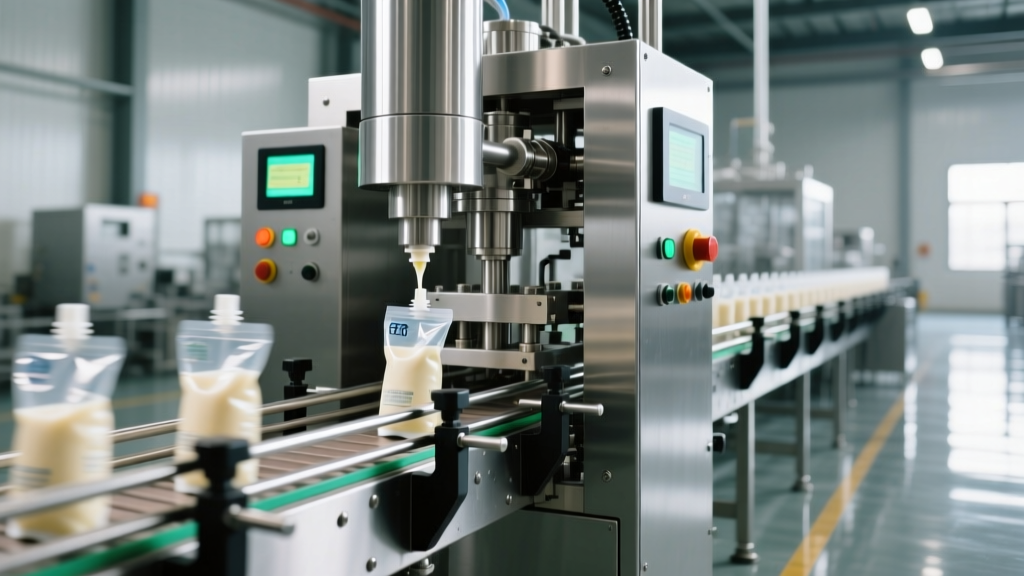
FFS Liquid Packaging Machinery: Beverage & Dairy Case Studies
Explore how vertical form-fill-seal liquid packaging machinery optimizes dairy and beverage production with real-world 2026 case studies and ROI data.
The Economics and Engineering of Liquid FFS Technology
Liquid form-fill-seal (FFS) technology has fundamentally altered the economics of flexible pouch packaging. By forming the pouch directly from rollstock immediately before filling, FFS liquid packaging machinery eliminates the need for pre-made bags, reducing material costs by 20% to 35% while offering unprecedented format agility. However, handling low-viscosity and particulate-heavy liquids introduces complex fluid dynamics, seal contamination risks, and strict hygienic requirements that dry product FFS systems simply do not face.
This analysis examines two distinct 2026 production environments—a mid-sized dairy processor and a high-volume beverage co-packer—to demonstrate how specific FFS configurations solve real-world liquid packaging challenges. Data and machine configurations are sourced from current industry deployments and engineering specifications from leading OEMs like Syntegon and insights tracked by PMMI, The Association for Packaging and Processing Technologies.
2026 Liquid FFS Market Snapshot
- Material Savings: Rollstock costs average $3.20/kg vs. $7.80/kg for pre-made spouted pouches.
- Changeover Time: Modern servo-driven VFFS liquid lines achieve format changes in under 12 minutes.
- OEE Benchmarks: Top-quartile liquid FFS lines now sustain 82-86% Overall Equipment Effectiveness, up from 74% in 2022.
Case Study 1: Mid-Sized Dairy (Drinkable Yogurt & Kefir)
A regional dairy processor producing 500ml drinkable yogurt and kefir faced a critical bottleneck: a 3.2% seal leak rate on their legacy thermal-seal VFFS equipment. The high viscosity and particulate nature of the fruit-on-the-bottom formulations caused micro-splashes during the fill cycle, contaminating the seal area and resulting in catastrophic leakers during palletization.
The Engineering Solution
The facility upgraded to a Syntegon SVE 2520 LR vertical form-fill-seal system equipped with a 35 kHz ultrasonic sealing unit and an Endress+Hauser Promass Coriolis mass flow meter. Unlike thermal jaws that require pristine seal areas and consistent dwell times, ultrasonic sealing uses high-frequency mechanical vibrations to melt the inner PE layer of the film, effectively pushing product contamination out of the seal zone before the molecular bond forms.
Technical Specifications & Film Structure
- Film Web: 110-micron PET/ALU/PE laminate (aluminum foil core for UV and oxygen barrier).
- Filling System: Coriolis mass flow meter providing ±0.15% volumetric accuracy, critical for minimizing giveaway on high-cost dairy formulations.
- Nitrogen Dosing: Inline liquid nitrogen injection prior to final seal to displace headspace oxygen, extending shelf life from 21 to 45 days.
Financial and Operational Results
The capital expenditure for the ultrasonic-equipped VFFS liquid packaging machinery was approximately $285,000. Within six months, the seal leak rate dropped to 0.04%. The elimination of secondary packaging (previously required to contain leaks) and the reduction in product giveaway yielded a verified ROI payback period of 11.4 months.
Sealing Technology Matrix: Ultrasonic vs. Thermal for Liquids
Selecting the correct sealing mechanism is the most critical decision when procuring liquid packaging machinery. The table below contrasts the two dominant technologies for flexible liquid pouches.
| Parameter | Thermal Sealing (Constant Heat) | Ultrasonic Sealing (35 kHz) |
|---|---|---|
| Seal Contamination Tolerance | Low (fails if product touches seal area) | High (vibrations clear particulates/liquids) |
| Energy Consumption | High (continuous heating of jaws) | Low (energy only applied during seal cycle) |
| Film Compatibility | Broad (works with most PE/PP sealants) | Restricted (requires specific thermoplastic layers) |
| Jaw Maintenance | Frequent cleaning of Teflon tapes | Low (no sticking, but horn wear monitoring required) |
| Capital Cost Premium | Baseline | +$45,000 to $65,000 |
Case Study 2: Beverage Co-Packer (Aseptic Cold-Pressed Juices)
Horizontal form-fill-seal (HFFS) machinery is often preferred for aseptic liquid applications where low-profile, stand-up pouch formats are required. A West Coast co-packer specializing in 200ml cold-pressed juices needed to transition from glass bottles to flexible aseptic pouches to reduce freight weights and meet 2026 sustainability mandates.
The Aseptic HFFS Configuration
The co-packer installed a Hassia-Redatron aseptic HFFS liquid packaging line. The system utilizes a multi-stage sterilization process where the packaging web is passed through a heated hydrogen peroxide (H2O2) bath, followed by sterile hot-air drying, achieving a 6-log reduction in microbial load before entering the sterile filling chamber.
Overcoming Web Tension and Foaming Challenges
Cold-pressed juices are highly prone to foaming during high-speed filling, which can compromise headspace and seal integrity. The engineering team implemented a bottom-up fill nozzle configuration paired with a servo-driven vacuum-assisted pouch opening system. Furthermore, handling the 80-micron PA/EVOH/PE film required precision web tension control; the HFFS system utilizes active load cells to maintain tension within ±0.5 Newtons, preventing film stretching that would otherwise distort the final pouch geometry.
"Transitioning to aseptic HFFS liquid packaging machinery required a complete overhaul of our CIP (Clean-in-Place) protocols. The machine's internal sterile chamber demands a 45-minute automated vapor sterilization cycle before every production run, which must be factored into your OEE calculations."
— Plant Engineering Director, Pacific Beverage Co-Packers
Capital and Operational Impact
Aseptic HFFS systems represent a significant premium, with fully integrated lines (including rollstock sterilization, sterile tank integration, and CIP systems) costing between $650,000 and $850,000. However, the co-packer reduced packaging weight by 88% compared to glass, slashing outbound freight costs by $1.2 million annually and achieving a 14-month payback.
⚠️ Critical Troubleshooting: Liquid FFS Failure Modes
When commissioning liquid packaging machinery, monitor these three specific edge cases:
- Hydraulic Shock (Water Hammer): Rapid valve closures on volumetric fillers cause pressure spikes that rupture flexible tubing. Fix: Program servo-valve closure profiles to decelerate over the final 15% of the stroke.
- Film Tracking Drift: Liquid weight pulling on the film web during the vertical drop causes misalignment. Fix: Install active edge-guides with ultrasonic sensors immediately prior to the forming collar.
- Capillary Wicking: Oils in the product wick up the inner film layer into the seal area. Fix: Specify films with an inner anti-wick PE coating or utilize ultrasonic sealing to burn off surface oils.
Procurement Framework: Calculating True FFS Payback
Procurement teams often miscalculate the ROI of FFS liquid packaging machinery by only comparing rollstock costs to pre-made pouch costs. A rigorous 2026 financial model must account for the following variables:
- Material Delta: Rollstock ($3.20/kg) vs. Pre-made ($7.80/kg). For a 20g pouch, material cost drops from $0.156 to $0.064.
- Spout Application: If your liquid requires a dispensing spout, VFFS machines require an inline spout-insertion and welding module, adding $75,000 to the capital cost and reducing line speeds by roughly 15%.
- Floor Space Premium: FFS machinery requires adjacent rollstock storage and film splicing stations, increasing the footprint by 20% compared to pre-made pouch fillers.
- Scrap Rates during Changeover: Expect 15-25 meters of film waste per format changeover while the web tracking and fill volumes stabilize.
For production volumes exceeding 15 million pouches annually, the capital expenditure of advanced liquid packaging machinery is almost always justified by the per-unit material savings and the elimination of supply chain vulnerabilities associated with sourcing pre-made flexible packaging.