End of Line Packaging Machinery: Case Packer Tech Specs
Explore technical specifications and mechanics of end of line packaging machinery, focusing on automated case packing and cartoning systems.
The Mechanics of Automated Case Packing and Cartoning
Within the broader ecosystem of end of line packaging machinery, automated case packers and cartoners serve as the critical bridge between primary packaging (bottles, pouches, blisters) and tertiary palletizing. These systems must handle high-speed collation, precise case erection, and secure sealing without bottlenecking upstream fillers. Modern facilities demand equipment that balances high cases-per-minute (CPM) throughput with rapid SKU changeovers, driving a shift from purely mechanical linkages to advanced servo-driven kinematics.
Industry Definition: End of line packaging machinery encompasses all equipment situated after primary filling and sealing, including cartoning, case packing, shrink bundling, and palletizing systems designed to prepare goods for warehousing and distribution.
Core Operational Stages
Regardless of the specific architecture, automated case packing follows a strict four-stage mechanical sequence:
- Case Erection: Flat corrugated blanks are pulled from a magazine using Venturi vacuum cups. The blank is squared and the bottom flaps are folded and sealed via hot melt adhesive (typically applied at 350°F / 175°C) or mechanical interlocking.
- Product Collation: Upstream products are grouped into the required matrix (e.g., 3x4, 4x6) using servo-driven flight bars, spider wheels, or delta robotic pick-and-place arrays.
- Loading Mechanism: The collated product is inserted into the erected case. This is achieved via top-load drop packing, side-load push packing, or wrap-around folding.
- Case Sealing: Top flaps are compressed and sealed using hot melt glue or pressure-sensitive tape, ensuring uniform compression across the corrugated fluting.
Technical Specifications Comparison Matrix
Selecting the correct architecture depends heavily on product fragility, SKU variance, and required throughput. The following matrix compares the three dominant case packing technologies utilized in modern end of line packaging machinery.
| Parameter | Drop Packer (Mechanical/Servo) | Wrap-Around Case Packer | Robotic Pick-and-Place (Gantry/Delta) |
|---|---|---|---|
| Max Speed (CPM) | 60 - 120 CPM | 30 - 70 CPM | 15 - 45 CPM (per robot cell) |
| Product Handling | Rigid containers (cans, glass, PET) | Fragile items, multi-packs, pouches | Mixed SKUs, delicate primary packs |
| Changeover Time | 15 - 45 minutes (tooling swaps) | 20 - 60 minutes (mechanical adjustments) | < 5 minutes (recipe-driven EOAT swaps) |
| Footprint (Approx.) | 120 sq. ft. to 200 sq. ft. | 150 sq. ft. to 250 sq. ft. | 80 sq. ft. to 140 sq. ft. |
| Capital Cost Range (2026) | $85,000 - $140,000 | $130,000 - $220,000 | $180,000 - $350,000+ |
Actuation: Servo-Driven vs. Pneumatic Systems
Legacy end of line packaging machinery relied heavily on pneumatic cylinders and mechanical line-shafts. Current technical specifications heavily favor closed-loop servo motors (e.g., Allen-Bradley Kinetix or Siemens SINAMICS) for all primary axes.
Why Servo Actuation Dominates
- Precision and Repeatability: Servo motors provide positional accuracy of +/- 0.1mm, critical for side-load cartoners pushing fragile glass vials into tight partitioned cartons.
- Electronic Camming: Instead of physical gears, servo axes use electronic cam profiles. This allows operators to alter the acceleration and deceleration curves of the pusher head via the HMI, reducing product tip-overs without mechanical wrench adjustments.
- Energy Efficiency: Pneumatic systems suffer from continuous air leakage and require massive compressors. Servo-driven machines reduce energy consumption by up to 35% and eliminate the need for plant air drops at the machine location.
In case erection modules, Venturi vacuum generators pull corrugated blanks from the magazine. Corrugated dust rapidly clogs the porous surfaces of standard nitrile suction cups, leading to micro-leaks and dropped blanks. Specify silicone-free, wear-resistant polyurethane cups with integrated mesh filters and schedule automatic blow-off purge cycles every 500 cycles to maintain vacuum integrity above -60 kPa.
Control Systems and PackML Integration
A critical specification for any modern end of line packaging machinery is its control architecture and adherence to industry communication standards. Isolated PLCs create data silos that prevent accurate Overall Equipment Effectiveness (OEE) tracking.
The OMAC PackML Standard
Top-tier manufacturers now mandate compliance with the OMAC PackML standard. PackML defines a unified state model (e.g., Execute, Hold, Abort, Clear) and a standardized tag structure for machine data. When a case packer is PackML-compliant, the upstream filler and downstream palletizer share a common data dictionary, allowing the plant's SCADA system to instantly identify whether a line stoppage was caused by a lack of incoming product, a case jam, or a sealing fault.
Network Protocols
For high-speed I/O and motion control, EtherNet/IP or PROFINET are the baseline requirements. For vertical integration (sending OEE data to MES/ERP systems), OPC UA is the mandatory protocol, providing secure, encrypted, and platform-independent data exchange.
Real-World Failure Modes and Mitigation
Understanding edge cases and failure modes is essential for specifying reliable equipment. Below are the most frequent technical faults encountered in automated cartoning and case packing:
- Flap Folding Jams (Top Sealers): Occurs when corrugated warp (curvature in the cardboard) causes the minor flaps to spring back before the compression belt engages. Mitigation: Specify pre-breaker rollers in the magazine feeder and adjustable top-compression belts with independent speed control.
- Product Shingling (Drop Packers): Happens when the drop grid opens too slowly, causing cylindrical containers to overlap and jam the case. Mitigation: Utilize servo-driven drop grids with programmable opening profiles that accelerate the initial 20% of the drop sequence.
- Adhesive Charring (Hot Melt Systems): Continuous heating of hot melt glue tanks during machine idle states causes the adhesive to carbonize, clogging the nozzle heads. Mitigation: Specify smart melters with automatic temperature step-down features that drop the tank to 140°F during 'Hold' or 'Idle' states.
Sizing and Selection Framework
Do not size a case packer based solely on the maximum theoretical speed of your upstream filler. Use the following framework to calculate the required machine CPM:
- Identify Upstream Output: Determine the actual sustained output of the filler (e.g., 400 bottles per minute).
- Calculate Base CPM: Divide the upstream output by the pack pattern. (400 BPM / 24 bottles per case = 16.6 CPM).
- Apply the OEE Buffer: End of line packaging machinery must run faster than upstream equipment to absorb micro-stoppages. Multiply the Base CPM by 1.35 (a 35% buffer). 16.6 x 1.35 = 22.4 CPM.
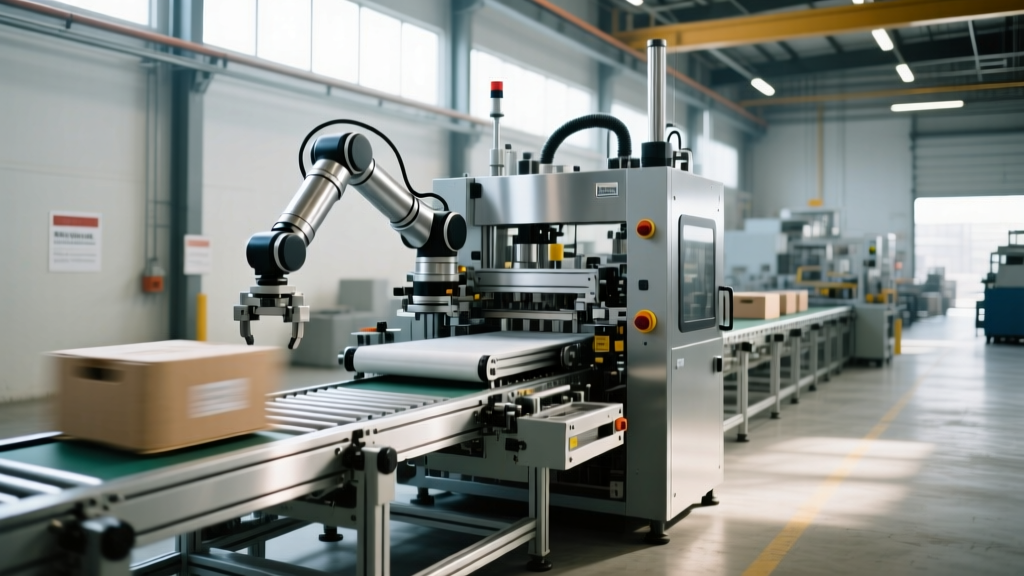
- Select the Machine: Choose a machine rated for at least 25 CPM continuous duty. For this speed, a robotic pick-and-place solution or a continuous-motion side-load cartoner is optimal, avoiding the capital overspend of a 60 CPM drop packer.
For facilities handling high-mix, low-volume production, prioritize robotic systems with quick-release End-of-Arm Tooling (EOAT). According to data from the Packaging Machinery Manufacturers Institute (PMMI), facilities utilizing robotic case packers for high-SKU environments report a 28% reduction in changeover downtime compared to mechanical wrap-around alternatives. Ensure all wet-environment specifications mandate 316L stainless steel construction with IP69K-rated electrical enclosures to withstand high-pressure caustic washdowns.