Cost Analysis: Quality Machine and Tool Spindle Bearing Upgrades
Analyze the true costs of spindle bearing configurations. Compare ceramic vs. steel bearings, rebuild pricing, and budget frameworks for 2026.
The True Cost of Spindle Downtime vs. Preventative Budgeting
The spindle assembly dictates the volumetric accuracy, surface finish, and material removal rate of any CNC machining center. When procuring a quality machine and tool spindle configuration, shop managers often fixate on the upfront catalog price of the bearings. However, the total cost of ownership (TCO) is heavily skewed by downtime, lubrication infrastructure, and premature failure modes like false brinelling or fretting corrosion.
In 2026, the average cost of unplanned CNC downtime ranges from $250 to $450 per hour, factoring in lost throughput, scrap material, and expedited shipping for replacement parts. A standard BT40 spindle rebuild takes 10 to 14 days if parts are in stock. That three-week lead time can silently erase $30,000 in shop capacity. Therefore, budget planning must shift from minimizing initial bearing costs to maximizing mean time between failures (MTBF).
⚠️ Budget Warning: The False Economy of Generic BearingsSubstituting OEM-specified P4 (ABEC 7) precision bearings with unbranded aftermarket alternatives to save $800 on a rebuild frequently results in thermal runaway at RPMs above 12,000. The resulting spindle seizure will cost upwards of $6,500 to machine a new shaft and housing.
Spindle Bearing Configuration Pricing Matrix
Understanding the baseline costs for different bearing architectures is critical for accurate capital expenditure forecasting. The table below outlines current market pricing for standard machining center configurations.
| Configuration Type | Typical Application | Bearing Set Cost (USD) | Full Rebuild Cost | Expected MTBF (Hours) |
|---|---|---|---|---|
| Back-to-Back Angular Contact (Steel) | General milling, heavy cutting (CAT40/BT40) | $600 - $1,200 | $5,500 - $8,500 | 8,000 - 12,000 |
| Ceramic Hybrid Angular Contact (Si3N4) | High-speed mold machining (HSK-A63, 20k+ RPM) | $1,800 - $3,500 | $8,000 - $14,000 | 15,000 - 22,000 |
| Cylindrical Roller + Thrust | Heavy-duty boring mills, high radial load | $900 - $1,600 | $7,000 - $11,000 | 12,000 - 18,000 |
| Hydrostatic / Liquid Bearing | Ultra-precision jig boring, hard turning | N/A (Integrated) | $25,000 - $45,000+ | 30,000+ |
Ceramic Hybrid vs. Steel: The ROI Breakdown
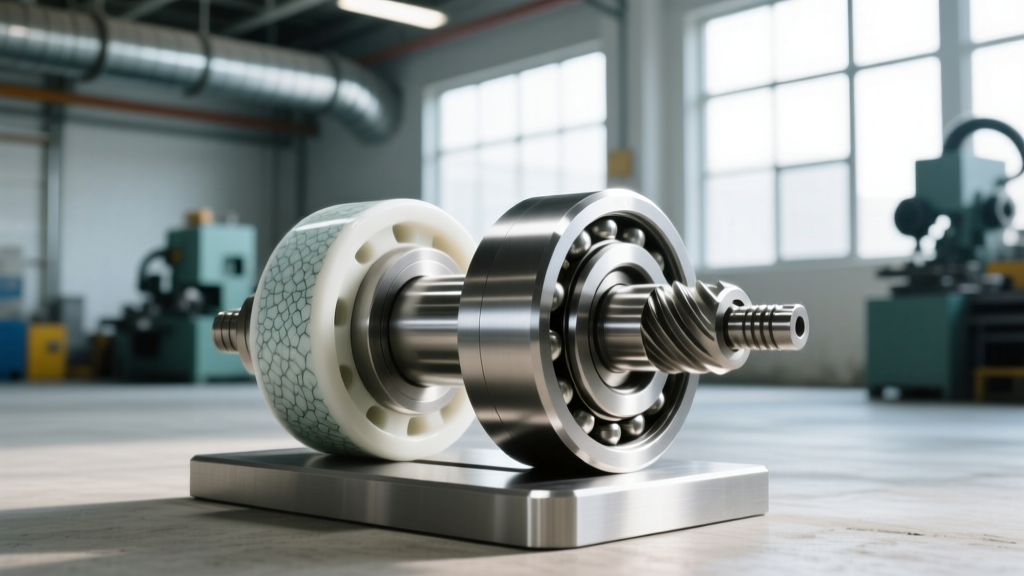
When investing in a quality machine and tool bearing configuration for high-speed applications, silicon nitride (Si3N4) ceramic hybrid bearings are the undisputed standard. According to engineering data from NSK Machine Tool Spindle Bearings, ceramic balls are 40% lighter and significantly stiffer than steel. This reduces centrifugal force on the outer race at high RPMs, allowing for tighter preload and reduced thermal expansion.
The Cost Premium: A matched set of four P4-precision ceramic hybrid bearings will cost approximately $2,400, compared to $850 for a high-end steel equivalent. However, the ROI is realized through extended tool life and reduced scrap. By maintaining tighter radial runout (under 2 microns) at 24,000 RPM, ceramic configurations can extend carbide end mill life by 15-20% in aerospace aluminum milling. If your shop spends $40,000 annually on cutting tools for a specific high-speed cell, the $1,550 bearing premium pays for itself in less than three months.
Lubrication Infrastructure Costs
Bearing selection directly dictates your lubrication budget. Grease-packed, sealed-for-life bearings (like the SKF Super Precision Bearings sealed series) eliminate the need for external pumps, saving $4,000 to $7,000 in initial machine build costs. However, they are thermally limited to roughly 1.2 million DN (bore in mm × max RPM). For operations exceeding this threshold, an oil-air lubrication system is mandatory. Budget an additional $3,500 for the oil-air pump unit, metering valves, and air-drying filtration, plus $150 per month in synthetic spindle oil and compressed air consumption.
The 60% Rule: Rebuild vs. Replace Decision Framework
When a spindle fails, the immediate budget decision is whether to rebuild the existing unit or purchase a new OEM replacement. Use the 60% Rule to guide your capital allocation:
- Obtain a Teardown Quote: Have a certified spindle repair facility perform a root-cause analysis and provide a firm rebuild quote. (Typical cost: $350-$500 for teardown).
- Calculate the Threshold: Multiply the cost of a brand-new OEM spindle by 0.60. For a $16,000 new HSK-63 spindle, the threshold is $9,600.
- Execute the Decision: If the rebuild quote (including new bearings, shaft grinding, and dynamic balancing) exceeds $9,600, or if the housing is scored beyond repair, replace the unit entirely. Rebuilding a severely compromised shaft introduces harmonic vibrations that will destroy the new bearings within 2,000 hours.
- Factor in Core Value: Many OEMs and high-end rebuilders offer a $1,000 to $2,500 core credit for your broken spindle assembly. Deduct this from the replacement cost before finalizing the budget.
Hidden Budget Killers in Spindle Procurement
Shop owners frequently approve a $7,500 spindle rebuild invoice, only to be hit with secondary costs that derail the maintenance budget. Account for these specific line items during your planning phase:
- Rotary Union Rebuild ($350 - $600): If your spindle features through-spindle coolant (TSC), the rotary union seals invariably degrade alongside the bearings. Failing to rebuild the union simultaneously will result in coolant leaking into the new rear bearings within weeks.
- Drawbar Pneumatic Cylinder Service ($400 - $850): Weak drawbar retention force causes tool pullout and micro-chatter, which manifests as false brinelling on the bearing races. Always budget for a complete drawbar belleville spring replacement and cylinder reseal.
- Spindle Encoder / Resolver Replacement ($600 - $1,200): Coolant intrusion or bearing seizure often destroys the rear-mounted encoder. This part is rarely included in a standard mechanical rebuild quote.
- Mandatory Run-In Cycles (8 - 12 Hours): A newly rebuilt spindle requires a programmed, multi-stage thermal run-in cycle to properly seat the grease and stabilize preload. This consumes 8 to 12 hours of machine availability. Budget for lost production time during the commissioning week.
Expert Insight on OEM vs. Aftermarket Sourcing:
While aftermarket bearing distributors can offer 20% discounts on catalog prices, the variance in cage materials and ball grade sorting can be disastrous for spindles operating above 15,000 RPM. For critical 5-axis trunnion tables and high-speed milling spindles, restrict your procurement to OEM-authorized channels for SKF, NSK, or FAG to guarantee matched-set preload tolerances.
2026 Capital Planning Checklist for Spindle Maintenance
To transition from reactive spending to strategic budget management, implement the following protocols for your machine tool fleet:
- Vibration Baseline Mapping: Allocate $2,500 annually for a third-party vibration analyst to map the baseline displacement (in µm/s) of every spindle. A 20% increase in high-frequency acceleration is the earliest financial indicator of bearing degradation, allowing you to schedule rebuilds during planned holiday shutdowns rather than mid-production.
- Strategic Spare Inventory: For shops running lights-out manufacturing or high-volume automotive contracts, budget $12,000 to $18,000 to keep one fully assembled, dynamically balanced OEM spindle on the shelf. The cost of carrying inventory is vastly outweighed by the prevention of a $40,000 line-stoppage event.
- Chiller Maintenance Allocation: Spindle cooling chillers must maintain fluid temperature within ±0.1°C. Budget $800 per year per chiller for descaling and refrigerant checks; thermal shock from a failing chiller will cause uneven preload distribution and catastrophic bearing failure.
By aligning your bearing configuration choices with rigorous lifecycle cost analysis, you transform the spindle from a recurring maintenance liability into a predictable, optimized production asset.