Spindle Selection for Aerospace Tooling and Machining
Expert guide to machine tool spindle types and bearing configurations for aerospace tooling and machining. Compare hybrid ceramic, hydrostatic, and costs.
The Aerospace Machining Dilemma: Speed vs. Torque
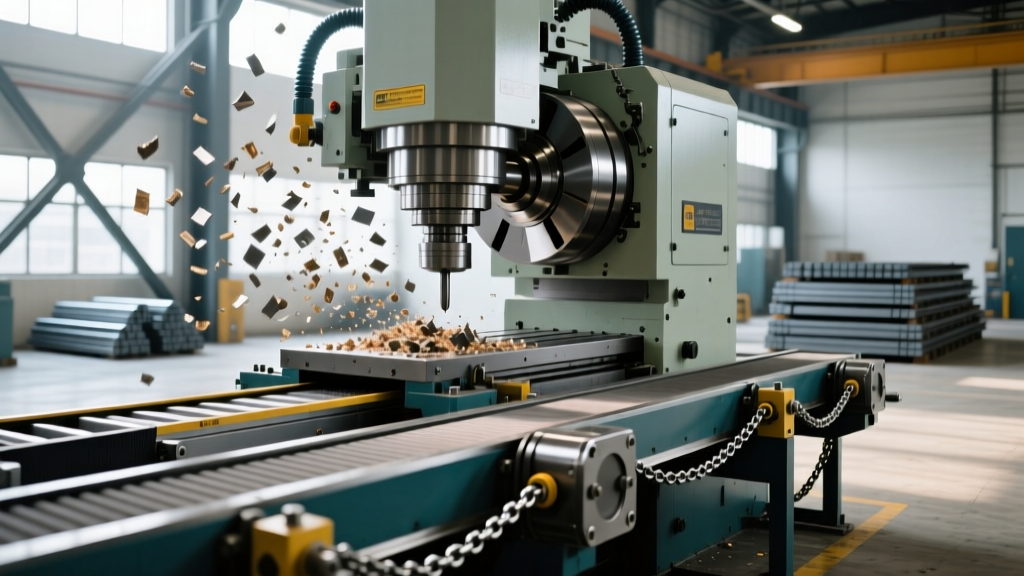
Configuring a 5-axis trunnion or gantry mill for aerospace tooling and machining requires resolving a fundamental physics conflict: the need for massive torque at low RPMs to rough titanium alloys, and the demand for extreme rotational speeds to finish carbon fiber reinforced polymers (CFRP) without delamination. The spindle is the critical bottleneck in this equation. Selecting the wrong bearing configuration or drive type results in catastrophic tool wear, thermal growth exceeding 5 µm, and scrapped monolithic structural components.
Material-Specific Spindle Requirements
- Ti-6Al-4V & Inconel 718: Requires high radial stiffness, massive damping, and peak torque below 3,000 RPM. Thermal stability is paramount due to long roughing cycles.
- CFRP & Honeycomb Composites: Requires 15,000 to 24,000+ RPM, ultra-low axial runout (< 2 µm), and high axial stiffness to prevent ply delamination and fraying.
- Aluminum 7075-T6 (Structural Ribs): Demands high-speed metal removal rates (MRR), requiring spindles capable of 24,000+ RPM with high dynamic balance (G0.4 or better).
Core Spindle Drive Mechanisms
The drive mechanism dictates the torque curve and maximum speed ceiling. For aerospace applications, two primary architectures dominate the market.
Integral Motor Spindles (Electrospindles)
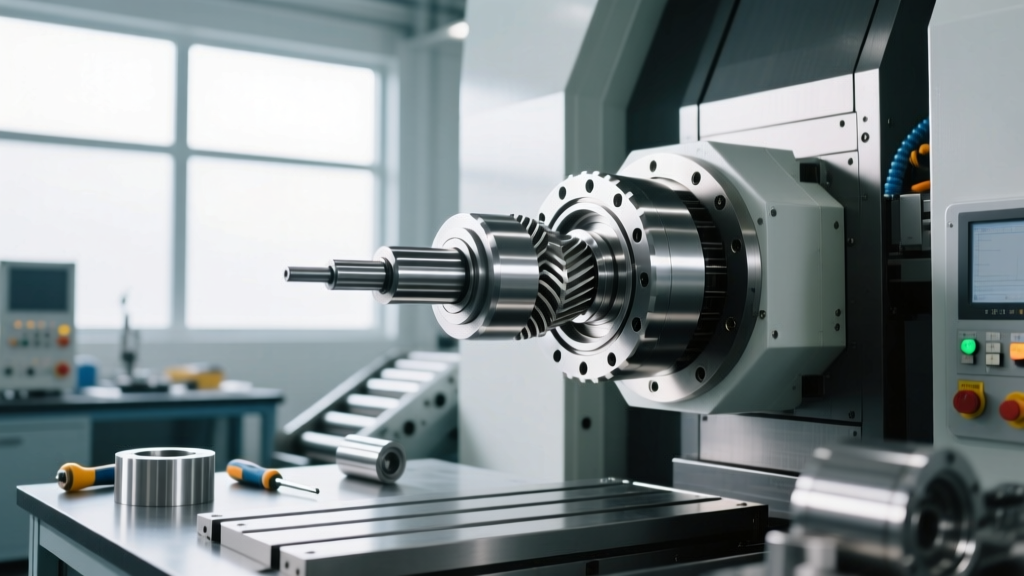
In an electrospindle, the rotor is mounted directly onto the spindle shaft, eliminating belts or gears. This reduces vibration and allows for speeds exceeding 30,000 RPM. Models like the GMN HCS series or IBAG HF series are standard for aerospace aluminum and composite finishing. However, the internal motor generates significant heat, requiring a dedicated closed-loop chiller system maintaining coolant at 20°C ± 0.1°C to prevent thermal expansion of the shaft.
Gear-Driven and Belt-Driven Spindles
For heavy-duty titanium roughing, integral motors often lack the low-end torque required without overheating. Gear-driven spindles (often featuring a two-speed gearbox) provide the necessary torque multiplication. A 40-taper gear-driven spindle can deliver over 300 Nm of continuous torque at 1,500 RPM, making it ideal for slotting and helical interpolation in solid titanium billets.
Bearing Configurations: The Heart of the Spindle
The bearing pack defines the spindle's stiffness, speed limit, and lifespan. According to engineering data from SKF's aerospace division, bearing selection must account for the specific cutting forces and thermal loads unique to aerospace alloys.
Hybrid Ceramic Angular Contact Bearings
The undisputed workhorse for high-speed aerospace milling is the hybrid ceramic bearing, featuring silicon nitride (Si3N4) balls and hardened steel races. Si3N4 is 40% lighter and significantly harder than steel, reducing centrifugal forces on the outer race at high RPMs.
- 15° Contact Angle: Optimized for high-speed aluminum and composite machining. Offers lower axial stiffness but minimizes friction heat.
- 25° Contact Angle: The standard for general aerospace milling. Provides superior axial rigidity to handle the thrust loads generated by deep-cavity milling of structural ribs.
Preload specification is critical. Light preload (approx. 300-500 N) is used for 24,000+ RPM composite routing, while medium-to-heavy preload (800-1200 N) is mandatory for 12,000 RPM titanium semi-finishing to prevent chatter.
Hydrostatic Bearings
For dedicated titanium and Inconel roughing machines, hydrostatic bearings replace rolling elements with a pressurized film of oil. This fluid film provides virtually infinite fatigue life and unmatched damping characteristics. The stiffness of a hydrostatic spindle remains constant regardless of RPM, absorbing the interrupted cutting forces of roughing complex aerospace forgings without transmitting vibration to the tool.
Active Magnetic Bearings (AMB)
As of 2026, Active Magnetic Bearings represent the frontier of advanced manufacturing research and high-end aerospace production. AMBs levitate the spindle shaft using electromagnetic fields. This eliminates mechanical friction, allows for real-time, sub-micron dynamic stiffness adjustment, and provides built-in vibration monitoring. While currently restricted to ultra-premium 5-axis aerospace cells due to costs exceeding $60,000 per unit, AMBs are becoming the standard for machining next-generation bladed disks (blisks) where zero runout is non-negotiable.
Spindle Bearing Comparison Matrix
| Bearing Type | Max RPM (HSK-A63) | Radial Stiffness | Damping Capacity | Primary Aero Application |
|---|---|---|---|---|
| Hybrid Ceramic (15°) | 24,000 - 30,000 | High | Low | CFRP Routing, Al-7075 Finishing |
| Hybrid Ceramic (25°) | 15,000 - 20,000 | Very High | Medium | Ti-6Al-4V Semi-Finishing |
| Hydrostatic | 8,000 - 12,000 | Extreme | Extreme | Inconel/Titanium Heavy Roughing |
| Active Magnetic | 30,000+ | Adjustable | Active Control | Blisk Milling, Ultra-Precision |
Cost Analysis and Total Cost of Ownership (TCO)
When procuring equipment for aerospace tooling and machining, the initial capital expenditure is only a fraction of the spindle's lifecycle cost. Aerospace shops must factor in rebuild intervals, which are heavily dictated by the aggressiveness of the cutting parameters and the effectiveness of the air-purge and lubrication systems.
| Spindle Configuration | New Unit Cost (2026 Est.) | Mean Time Between Rebuilds | Average Rebuild Cost |
|---|---|---|---|
| HSK-A63 Hybrid Ceramic (Oil-Air) | $18,000 - $24,000 | 6,000 - 8,000 Hours | $7,500 - $11,000 |
| HSK-A100 Gear-Driven (Titanium) | $32,000 - $40,000 | 10,000 - 12,000 Hours | $14,000 - $18,500 |
| Hydrostatic Roughing Spindle | $45,000 - $55,000 | 20,000+ Hours | $12,000 (Pump/Seal Service) |
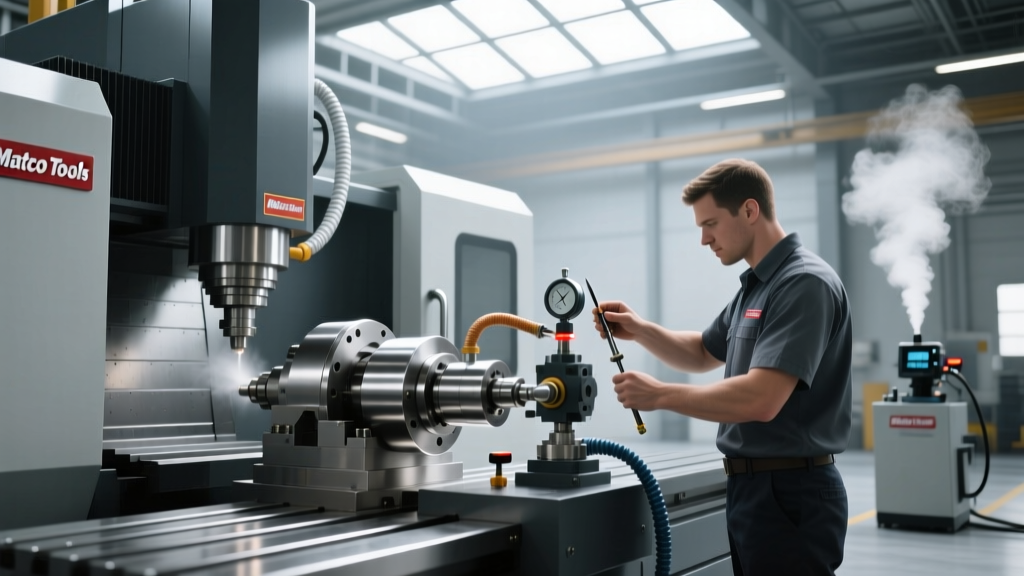
Thermal Management Warning: Running a 24,000 RPM hybrid ceramic spindle without a dedicated chiller unit will cause the steel inner race to expand faster than the Si3N4 ball. This increases the preload dynamically, leading to catastrophic bearing seizure within 45 minutes of continuous cutting. Always specify a dual-circuit chiller capable of handling both the spindle jacket and the motor cooling loop independently.
Procurement Checklist for Machine Builders and Shop Managers
To ensure your spindle configuration aligns with the realities of aerospace manufacturing, verify the following specifications before issuing a purchase order:
- Runout Tolerance: Demand a test certificate showing < 2 µm radial and axial runout at the tool nose at maximum operating speed, not just static bench runout.
- Lubrication System: For speeds above 12,000 RPM, grease-packed bearings are insufficient. Specify an oil-air lubrication system with a metered dosing valve to prevent over-lubrication, which causes churning heat.
- Drawbar Mechanism: For automated aerospace cells utilizing HSK interfaces, specify a hydraulic or pneumatic drawbar with a minimum clamping force of 18 kN for HSK-A63 to prevent tool pullout during high-feed-rate aluminum roughing.
- Sealing Technology: Aerospace composites generate highly abrasive carbon dust. Ensure the spindle features a multi-stage labyrinth seal with a positive-pressure air purge to prevent particulate ingress into the bearing pack.
- Vibration Sensor Integration: Require built-in eddy-current or piezoelectric vibration sensors wired directly to the CNC control for real-time chatter detection and adaptive feed-rate override.