Case Study: Retrofitting a Major Tool Machine for Industry 4.0
A technical case study on retrofitting a DMG MORI CMX 600V major tool machine for Industry 4.0, detailing MTConnect integration, costs, and OEE gains.
The Legacy Integration Bottleneck in Modern Job Shops
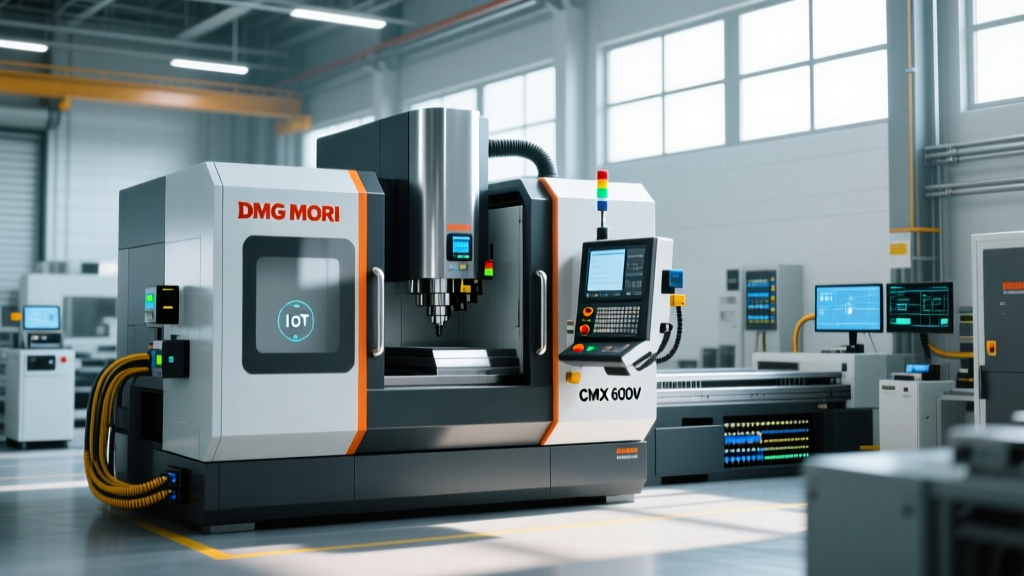
Extracting real-time telemetry from a major tool machine often stalls at the CNC control level. While modern machining centers boast high-speed spindles and advanced kinematics, their internal data architectures frequently remain siloed. For a mid-sized aerospace tier-2 supplier in Ohio, the challenge was not the cutting capability of their DMG MORI CMX 600V 5-axis machining centers, but the inability to integrate these assets into their enterprise resource planning (ERP) and manufacturing execution systems (MES). The facility operated six CMX 600V units equipped with FANUC 0i-F Plus controls. Despite the controls supporting network connectivity, the shop relied on manual operator logs to track Overall Equipment Effectiveness (OEE), resulting in a calculated OEE of just 42% due to unrecorded micro-stoppages and tool-change delays.
Upgrading a major tool machine for Industry 4.0 connectivity requires bypassing proprietary data locks and establishing a standardized, machine-agnostic communication pipeline. This case study details the exact hardware architecture, protocol selection, and financial breakdown required to retrofit a legacy-leaning CNC fleet for smart factory integration in 2026.
Warning: The FOCAS Polling TrapWhen extracting data via the FANUC Open CNC API Specification (FOCAS), developers often set polling intervals below 50 milliseconds to capture high-frequency spindle load data. On FANUC 0i-F series controls, polling the
cnc_rdspmeter function at intervals under 100ms can overwhelm the control's internal CPU, causing millisecond-level interpolation delays that manifest as surface finish chatter on aerospace aluminum parts. Always decouple high-frequency sensor data from the core CNC motion controller using external I/O modules.Architecture Design: Edge Gateway to Cloud Pipeline
To normalize the proprietary FANUC data, the engineering team deployed an edge computing architecture rather than attempting direct cloud-to-CNC polling, which introduces unacceptable latency and security vulnerabilities on the shop floor.
Hardware and Protocol Stack
- Edge Gateway: Advantech UNO-2473G (Intel Atom E3845, 8GB RAM, dual Ethernet). Mounted directly to the machine enclosure to minimize CAT6 cable runs and avoid electromagnetic interference (EMI) from the spindle VFD.
- Protocol Adapter: An open-source MTConnect agent running on a Docker container within the edge gateway. MTConnect was chosen over proprietary FANUC FOCAS direct-to-cloud bridges because it normalizes the data into a standardized XML schema, making it readable by any downstream MES.
- Message Broker: HiveMQ (MQTT protocol) running on a local on-premises server. MQTT's publish-subscribe model minimizes bandwidth consumption compared to HTTP REST polling.
- Payload Standard: Sparkplug B. Instead of sending raw JSON or XML over MQTT, the edge gateway converts MTConnect XML tags into Sparkplug B protobuf payloads, reducing network payload size by 85%.
Protocol Selection Matrix: MTConnect vs. OPC-UA
Selecting the right semantic layer is critical when networking a major tool machine. The team evaluated both the MTConnect standard and the OPC-UA architecture. Below is the decision matrix used for the CMX 600V fleet.
| Feature | MTConnect (v2.2) | OPC-UA |
|---|---|---|
| Primary Use Case | Machine monitoring, OEE tracking, state analysis | Process control, deep PLC integration, robotics |
| Data Model | Standardized XML (Device, Component, DataItem) | Flexible node-based address space |
| Implementation Cost | Low (Open source agents available) | High (Requires licensed server/client stacks) |
| FANUC Compatibility | Excellent via FOCAS-to-MTConnect adapters | Requires FANUC FIELD system or third-party OPC server |
Because the objective was strictly monitoring and OEE calculation—not altering the machine's internal PLC logic—MTConnect provided the highest return on investment with the lowest technical debt.
Financial Breakdown and ROI Timeline
Retrofitting a major tool machine requires capital expenditure that must be justified by measurable throughput gains. The Association for Manufacturing Technology frequently highlights that hidden integration costs derail IIoT projects. Below is the exact line-item cost for a single CMX 600V retrofit.
Per-Machine Capital Expenditure (CapEx)
- Advantech UNO-2473G Edge Gateway: $2,850
- FOCAS Library Licensing (Perpetual, per machine): $1,200
- Industrial Ethernet Switch & CAT6 Shielded Cabling: $340
- Custom MTConnect Adapter Configuration (Contracted): $2,400 (16 hours @ $150/hr)
- Total Hardware & Integration Cost: $6,790 per machine
Operational Savings and ROI
Post-integration, the MES automatically detected an average of 47 minutes of unrecorded 'idle' time per shift per machine, previously misclassified as 'setup' by operators. By optimizing tool-presetting workflows based on this data, the shop reduced setup times by 22%. With a fully burdened machine rate of $145/hour, recovering just 30 minutes of spindle time per day yields $72.50 in daily marginal revenue per machine.
Payback Period: $6,790 / $72.50 = 93 operating days. For a two-shift operation, the retrofit achieved full ROI in under two months.
Troubleshooting the First 90 Days: A Decision Tree
Deploying smart connectivity on a major tool machine inevitably surfaces edge cases in data transmission. The maintenance team developed the following diagnostic framework to resolve data dropouts without escalating to the OEM.
Symptom: MTConnect Agent Shows 'EXECUTION: IDLE' During Active Cutting
- Check 1: FOCAS Handle Exhaustion
- Cause: The edge gateway application opened multiple FOCAS connections without closing them, hitting the control's 10-handle limit.
- Fix: Implement a strict connection-pooling script in the Python adapter, ensuring
cnc_freelibhndl()is called on every exception.
- Check 2: Macro Variable Mapping Error
- Cause: The CNC program uses custom macro variables (e.g., #500) to track part counts, but the MTConnect XML map is polling the standard piece counter (#3901).
- Fix: Update the
agent.cfgfile to map thePartCountDataItem to the specific custom macro variable address.
Symptom: MQTT Broker Drops Connection During Spindle Acceleration
- Check 1: EMI on Ethernet Lines
- Cause: Unshielded CAT5e cables routed parallel to the 480V spindle power lines experience packet loss during high-current acceleration ramps.
- Fix: Replace with shielded CAT6a (S/FTP) and ensure the drain wire is grounded to the machine's main earth bus, not the enclosure door.
- Check 2: Edge Gateway Thermal Throttling
- Cause: The UNO-2473G is mounted near the hydraulic power unit, exceeding its 50°C ambient operating limit.
- Fix: Relocate the gateway to the top of the electrical cabinet and install a filtered fan intake.
Data Payload Optimization for High-Speed Machining
A critical failure mode in early Industry 4.0 deployments is network saturation. A 5-axis machine executing complex aerospace contours generates thousands of data points per minute. Sending raw XML via HTTP to the cloud will quickly consume bandwidth and crash lightweight edge routers.
By implementing the Sparkplug B specification over MQTT, the edge gateway only transmits the state change of a metric, rather than polling the absolute value continuously. For example, if the spindle speed remains at 12,000 RPM for 45 minutes, Sparkplug B sends exactly one payload at the start of the operation. Furthermore, the BIRTH and DEATH certificates inherent in Sparkplug B allow the central MES to instantly know if the major tool machine loses power or network connectivity, eliminating 'ghost' machines that skew OEE dashboards with false uptime metrics.
Strategic Takeaways for Smart Factory Integration
Upgrading a major tool machine for Industry 4.0 is not merely an IT exercise; it is a fundamental restructuring of shop-floor data dynamics. The success of the DMG MORI CMX 600V retrofit relied on three non-negotiable principles: decoupling high-frequency sensor polling from the motion controller, utilizing standardized semantic models like MTConnect to prevent vendor lock-in, and rigorously calculating the marginal value of recovered spindle time to justify CapEx. Facilities attempting similar retrofits must prioritize edge-computing stability over cloud-centric architectures, ensuring that the physical realities of EMI, thermal limits, and PLC scan times do not compromise the digital twin.