Norton Machine Tool Abrasives: 2026 Brand & Value Comparison
Compare Norton, 3M, and Tyrolit abrasive tooling for CNC grinders. Discover 2026 cost-per-part data, ceramic oxide specs, and CBN wheel value analysis.
The Reality of 'Norton Machine Tools' in Modern Procurement
When manufacturing engineers and procurement specialists search for 'Norton machine tools' in 2026, they are rarely looking for legacy manual grinding equipment. Instead, they are navigating the Saint-Gobain Norton abrasive tooling ecosystem—the critical consumable interface that dictates the productivity, surface finish, and cost-per-part of modern CNC grinding platforms like the Studer S41, Okuma GA15W, and Toyoda GL5. Selecting the right abrasive tooling is as critical as selecting the machine tool itself. A mismatched grinding wheel can reduce a $1.5 million CNC grinder to the output rate of a manual 1990s surface grinder.
This guide provides a deep-dive value analysis comparing Norton's advanced abrasive solutions against primary competitors 3M and Tyrolit. We will evaluate ceramic aluminum oxide performance, superabrasive (CBN/Diamond) integration, and real-world cost-per-part metrics to help machine shops optimize their grinding operations.
Procurement Clarification: Legacy Machines vs. Modern ToolingHistorically, the Norton Grinding Machine Company produced heavy cylindrical and surface grinders. Today, those legacy machine brands have been absorbed into other conglomerates. In the current industrial market, 'Norton' exclusively refers to Saint-Gobain's abrasive tooling, honing stones, and superabrasive wheels designed to be mounted on modern CNC machine tools.
The Ceramic Aluminum Oxide Showdown: Norton Quantum vs. Competitors
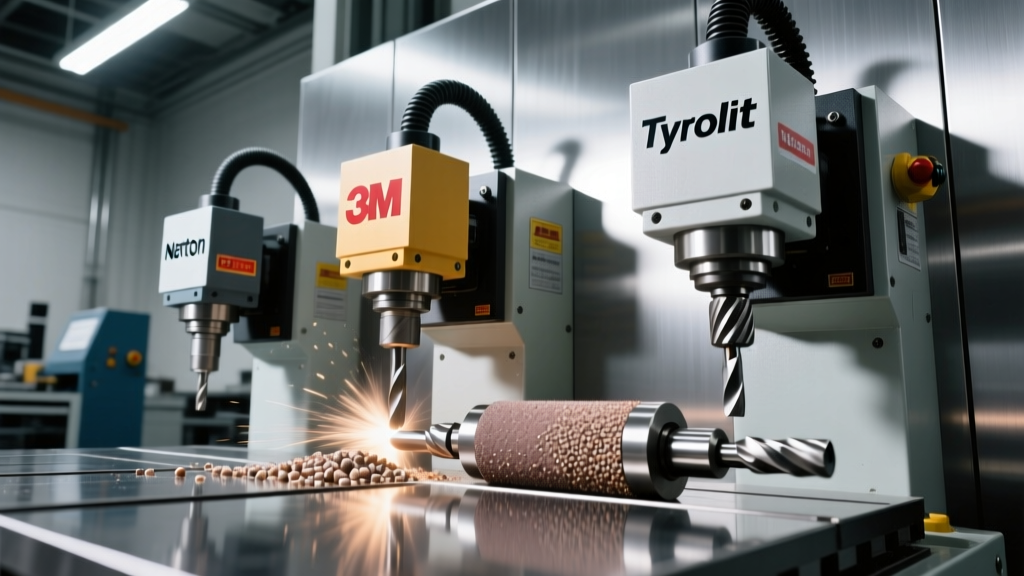
Ceramic aluminum oxide (Al2O3) grains revolutionized precision grinding by offering high friability—meaning the grain fractures at a micro-level to continuously expose sharp cutting edges, preventing glazing and reducing thermal damage to the workpiece. Norton's proprietary Quantum (NQ) seeded gel technology competes directly with 3M's Cubitron II and Tyrolit's CerabonX.
Norton Quantum wheels utilize a highly porous vitrified bond system that excels in heavy stock removal on hardened steels (45-65 HRC) without inducing grinding burn. In contrast, 3M Cubitron II relies on precision-shaped triangular grains that require specific directional mounting and optimal coolant penetration to prevent premature grain pullout. Tyrolit offers a middle ground with aggressive cutting action but typically requires more frequent dressing cycles to maintain form-holding on complex profiles.
2026 Specification & Cost Comparison Matrix
| Brand / Product Line | Grain Technology | Bond System | Avg. 2026 Price (14x1x5) | Dressing Interval | Optimal Application |
|---|---|---|---|---|---|
| Norton Quantum (NQ) | Seeded Gel Ceramic Al2O3 | Highly Porous Vitrified | $195 - $245 | Every 15-20 passes | Plunge grinding, camshafts, bearing races |
| 3M Cubitron II | Precision-Shaped Grain | Standard Vitrified / Resin | $220 - $280 | Every 10-15 passes | High-speed creep-feed, aerospace alloys |
| Tyrolit CerabonX | Sintered Ceramic Al2O3 | Modified Vitrified | $180 - $230 | Every 12-18 passes | General cylindrical grinding, tool steel |
Note: Pricing reflects Q1 2026 B2B distributor averages for standard vitrified wheels. Custom profiled wheels command a 30-50% premium.
Vitrified vs. Resinoid Bonds: Matching the Wheel to the Machine
A common procurement error is specifying the correct Norton grain but the wrong bond type for the machine tool's rigidity and coolant delivery system. Norton offers both vitrified (glass-based) and resinoid (synthetic resin) bonds for their NQ and standard aluminum oxide lines.
- Vitrified Bonds (Norton V-Bond): Rigid, porous, and excellent for holding tight geometric tolerances (±0.0002 inches). They require a machine tool with high static stiffness and high-pressure coolant (minimum 150 PSI at the nozzle) to flush swarf from the porous structure. Best for Studer and Okuma CNC cylindrical grinders.
- Resinoid Bonds (Norton B-Bond): Flexible and shock-absorbing. They are ideal for older manual grinders, portable snagging operations, or cut-off applications where machine vibration would shatter a vitrified wheel. They do not hold form well for precision profile grinding.
Superabrasives: Norton CBN and Diamond for Hard Machining
For high-volume production of hardened components (e.g., automotive gear shafts, fuel injection nozzles), standard ceramic wheels are economically unviable due to frequent dressing downtime. This is where Norton's Winterthur vitrified CBN (Cubic Boron Nitride) and diamond wheels dominate the value analysis.
A standard Norton vitrified CBN wheel costs between $900 and $1,600 depending on the CBN concentration and core material (aluminum vs. carbon fiber). While the initial capital outlay is 5x higher than ceramic wheels, the lifecycle economics fundamentally alter the shop's cost-per-part.
'Switching our Okuma GA15W from Norton Quantum ceramic wheels to Norton vitrified CBN for our 62 HRC pinion shafts eliminated dressing downtime entirely for 12,000-part runs. The wheel cost was amortized to $0.04 per part, compared to $0.18 per part with ceramic, factoring in machine idle time and dressing tool wear.' — Lead Manufacturing Engineer, Tier 1 Automotive Supplier
Real-World Cost-Per-Part Breakdown: Ceramic vs. CBN
Consider a production run of 10,000 hardened steel shafts on a CNC cylindrical grinder:
- Norton Quantum Ceramic Route: Requires 40 wheels at $220 each ($8,800). Add 15 minutes of dressing time per wheel at a $120/hr machine rate ($12,000). Total abrasive cost: $20,800 ($2.08/part).
- Norton Vitrified CBN Route: Requires 2 CBN wheels at $1,400 each ($2,800). Dressing is limited to a 2-minute touch-up every 2,000 parts ($200 machine time). Total abrasive cost: $3,000 ($0.30/part).
For runs exceeding 5,000 parts of hardened steel, Norton CBN tooling yields an 80% reduction in consumable and downtime costs. For more on optimizing grinding parameters, refer to technical guidelines from Modern Machine Shop and the Saint-Gobain Norton expertise hub.
Troubleshooting Common Norton Abrasive Failures
Even premium Norton tooling will fail if machine parameters are misaligned. Below is a diagnostic matrix for common failure modes when using Norton Quantum and CBN wheels.
| Symptom | Probable Cause | Corrective Action |
|---|---|---|
| Wheel Glazing (Shiny surface, high spindle load) | Coolant concentration too high (>8%), clogging porous vitrified bond. | Reduce coolant concentration to 5-6%. Increase nozzle velocity to penetrate boundary layer. |
| Premature Grain Pullout (CBN) | Wheel speed too low; insufficient centrifugal force to clear swarf, causing mechanical tearing of bond. | Increase wheel surface speed (SFM) by 15%. Ensure wheel is properly balanced to < 0.5 µm vibration. |
| Chatter Marks on Workpiece | Resonance in the machine tool spindle or improper wheel flange clamping. | Check flange pressure. Use Norton's Blotters (compressible washers). Re-dress wheel with a sharper diamond nib. |
| Thermal Burn (Blueing on steel) | Infeed rate exceeds grain friability threshold; wheel is too hard (grade H or higher). | Drop wheel grade by 2 steps (e.g., from J to G). Increase workpiece RPM to reduce arc of contact. |
Decision Framework: When to Specify Norton Tooling
Use this procurement framework to determine when Norton abrasives provide the highest ROI for your machine shop compared to alternative brands:
Step 1: Evaluate the Workpiece MaterialIf grinding aerospace superalloys (Inconel, Waspaloy), Norton's specialized SG (Seeded Gel) and ruby abrasive lines offer superior heat dissipation compared to standard white aluminum oxide. Specify Norton for high-temperature alloys.
Step 2: Analyze Production Volume
For job-shop environments with high-mix, low-volume parts (< 50 parts per setup), stick to Norton Quantum ceramic wheels. The flexibility to dress the wheel to multiple profiles outweighs the cost of dedicated CBN tooling.
Step 3: Assess Machine Tool Rigidity
Norton vitrified CBN and high-performance ceramic wheels demand high static and dynamic stiffness. If your CNC grinder exhibits more than 1.5 µm of spindle deflection under load, the aggressive cutting action of Norton's premium grains will cause chatter. Upgrade machine maintenance or fallback to Norton's softer resinoid bonds.
Step 4: Coolant Delivery Verification
Norton's porous bond technology relies heavily on high-velocity coolant penetration. If your machine tool is limited to low-pressure flood coolant (< 50 PSI), the wheel will load rapidly. In low-pressure scenarios, specify Norton wheels with wider grit spacing (e.g., 46 to 60 grit) to provide larger chip-clearance pockets.
Final Procurement Strategy
Specifying Norton machine tool abrasives is not a simple catalog order; it is an engineering decision that integrates grain chemistry, bond porosity, and machine tool dynamics. By leveraging Norton's Quantum line for flexible, high-precision ceramic grinding and transitioning to Winterthur CBN for dedicated hard-machining cells, manufacturing facilities can drastically reduce cost-per-part while maintaining sub-micron surface finishes. Always request a sample wheel and conduct a controlled time-study against your incumbent abrasive brand before locking in annual supply contracts.