Redefining What Is Machine Tool Efficiency: Flood vs MQL Mist Cooling
Compare flood vs MQL mist machine tool coolant systems. Discover 2026 cost metrics, failure modes, and decision frameworks for CNC optimization.
The Fluid Dynamics of Modern CNC Machining
When manufacturing engineers ask what is machine tool optimization in a modern 5-axis environment, the answer increasingly points to the cutting zone's thermal management. For decades, flood coolant has been the default mechanism for heat extraction and chip evacuation. However, the 2026 landscape of precision machining is defined by a bifurcated approach: high-volume flood systems for extreme thermal loads, and Minimum Quantity Lubrication (MQL) mist systems for high-speed, near-dry operations.
Selecting between flood and MQL is no longer a matter of shop preference; it is a rigid mathematical decision based on specific cutting mechanics, material thermal conductivity, and operational expenditure (OpEx). This analysis breaks down the engineering realities, hidden costs, and failure modes of both systems.
Health & Safety Baseline: Traditional flood coolant aerosolization poses significant respiratory risks. According to the National Institute for Occupational Safety and Health (NIOSH), exposure to metalworking fluid mists can cause occupational asthma and hypersensitivity pneumonitis. MQL systems utilizing vegetable-based esters drastically reduce airborne particulate toxicity, aligning with stricter 2026 OSHA indoor air quality mandates.Flood Coolant Systems: The Thermal Heavyweight
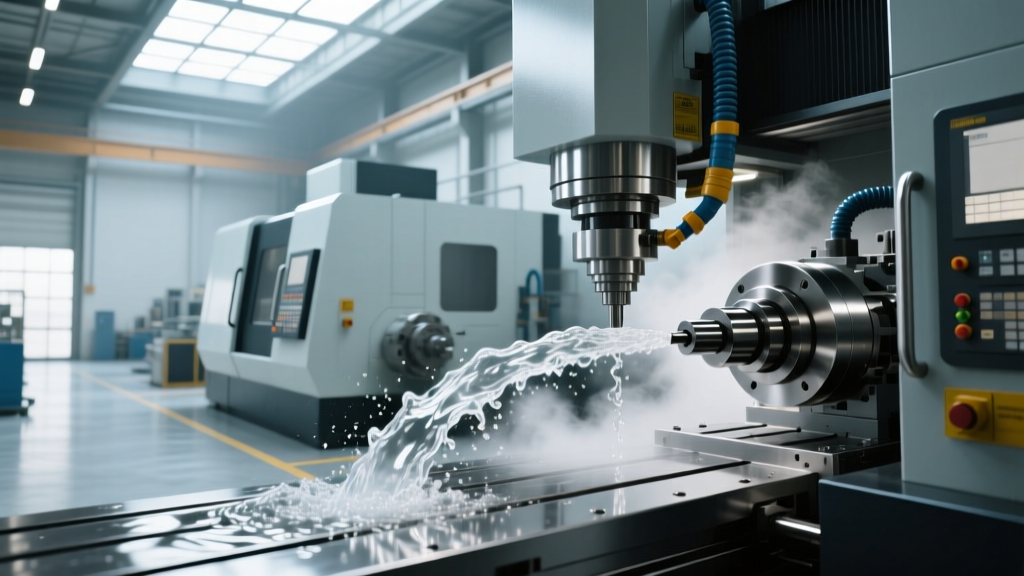
Flood cooling relies on high-volume fluid delivery—typically 5 to 15 gallons per minute (GPM) per spindle horsepower—to physically wash away chips and absorb cutting heat. Modern flood systems utilize semi-synthetic or synthetic water-soluble fluids maintained at a 5% to 8% concentration.
The Hidden OpEx of Flood Systems
While the initial capital expenditure (CapEx) for a standard 100-gallon sump and pump system is relatively low ($3,500–$6,000), the lifecycle costs are severe:
- Fluid Disposal: Hazardous waste hauling for spent coolant averages $2.50 to $4.00 per gallon in most North American municipalities.
- Tramp Oil & Skimming: Way lube leakage contaminates sumps. Shops must invest in centrifugal tramp oil separators (e.g., Keller Technologies or Abanaki units costing ~$4,200) to prevent anaerobic bacterial growth (Pseudomonas aeruginosa), which causes sump rancidity.
- Part Washing: Flood-cooled parts emerge coated in fluid, requiring secondary aqueous washing stages that add 12-18 minutes per batch cycle.
MQL Mist Systems: Capillary Action and Near-Dry Machining
Minimum Quantity Lubrication (MQL) replaces bulk fluid with a precisely metered aerosol of biodegradable ester oil, delivered at rates between 5 and 50 milliliters per hour. The fluid does not cool the cut via mass heat absorption; instead, it reduces the coefficient of friction at the tool-chip interface via capillary penetration.
Delivery Mechanisms: External vs. Through-Spindle
The efficacy of MQL relies entirely on nozzle placement and air pressure dynamics (typically 4 to 6 bar).
- External MQL: Nozzles are mounted on the machine turret or spindle housing. Best for 3-axis milling and sawing, but suffers from 'shadowing' where the tool holder blocks the mist from reaching the cutting edge.
- Internal (Through-Spindle) MQL: The aerosol is generated at a central mixing unit (e.g., UNIST Accu-Stat or SKF MicroLube) and routed through the spindle drawbar and tool coolant holes. This is mandatory for deep-hole drilling and high-speed 5-axis contouring, ensuring the lubricant reaches the exact shear zone regardless of tool orientation.
Comparative Matrix: Flood vs. MQL (2026 Metrics)
| Metric | Flood Coolant (Semi-Synthetic) | MQL Mist (Polyol Ester) |
|---|---|---|
| Fluid Consumption | 20 - 100 Liters / minute | 5 - 50 Milliliters / hour |
| Annual Fluid Cost (Per Machine) | $4,500 - $12,000 | $400 - $900 |
| Disposal Costs | High (Hazardous/Industrial) | Near Zero (Dry chips are recyclable) |
| Tool Life Impact | High (Thermal shock reduction) | Moderate-High (Friction reduction, no thermal shock) |
| Chip Recyclability Value | Low (Contaminated, requires briquetting) | High (Clean, premium scrap pricing) |
2026 Decision Framework: When to Deploy Which
Do not attempt a blanket conversion to MQL. The physics of the cut dictate the cooling strategy.
Deploy MQL When:
- Machining Aluminum (6061, 7075): High-speed milling (15,000+ RPM) generates small, hot chips. MQL prevents chip welding to the flute (built-up edge) without the thermal shock that micro-fractures carbide edges.
- Cast Iron & Composites: These materials are traditionally machined dry. MQL provides just enough lubrication to suppress hazardous graphite or carbon-fiber dust without creating a toxic sludge.
- High-Value Scrap Environments: Titanium and Inconel chips contaminated with flood coolant are often downgraded by recyclers. MQL keeps chips clean, preserving their $8-$15/lb scrap value.
Retain Flood Cooling When:
- Heavy Interrupted Cuts in Steel: The mechanical shock combined with high thermal loads requires the mass heat extraction only water-based fluids can provide.
- Deep Hole Drilling (BTA/Gun Drilling): High-pressure flood coolant (up to 1,500 PSI) is strictly required to evacuate long, stringy chips from deep bores. MQL air pressure is insufficient for chip ejection in holes exceeding 20x diameter.
- Grinding Operations: The sheer surface area and friction of abrasive wheels demand the thermal mass of flood coolant to prevent workpiece metallurgical burn.
Edge Cases and Catastrophic Failure Modes
Understanding why these systems fail is critical for maintaining OEE (Overall Equipment Effectiveness).
MQL Failure Modes
Ester Oxidation & Nozzle Clogging: If MQL fluid sits in delivery lines over a weekend without purging, vegetable-based esters can oxidize and turn into a varnish-like resin. This blocks the 1mm micro-nozzles. Fix: Implement automated weekend line-purge cycles using compressed air, or switch to synthetic, oxidation-stable esters like Fuchs Renocut MQL.
Loss of Capillary Penetration: If the air-to-oil ratio is skewed too heavily toward air (lean mist), the fluid atomizes into particles larger than 5 microns. These large droplets bounce off the high-velocity cutting zone rather than penetrating the tool-chip interface. Fix: Calibrate the aerosol generator to maintain a droplet size of 1-3 microns.
Flood Failure Modes
Concentration Crash: Operators frequently top off evaporated sumps with pure water instead of pre-mixed coolant. This drops the concentration below 4%, destroying the biocide buffer and causing rapid bacterial blooms. Fix: Install inline IoT digital refractometers (e.g., from Sensia or Prominent) that automatically trigger dosing pumps when concentration drops below 6.5%.
Hydraulic Shock on Carbide: Directing a high-pressure, low-temperature flood stream directly onto the cutting edge of a continuous heavy cut causes rapid thermal cycling. This leads to combing and micro-chipping on the carbide insert rake face. Fix: Apply coolant either strictly before the cut begins or continuously without interruption; never introduce cold fluid to an already superheated insert.
Conclusion: The Hybrid Future
The binary choice between flood and mist is evolving into hybrid delivery systems. Modern 2026 CNC architectures feature dual-plumbed spindles capable of switching from 1,000 PSI flood for roughing to precise internal MQL for finishing passes within the same G-code program. Mastering the fluid dynamics of both systems is no longer optional; it is the defining characteristic of high-margin, technologically advanced machine shops.