Three M Tool & Machine Value Analysis: 2026 Budget Guide
Evaluate Three M Tool & Machine against premium OEMs and budget imports. A 2026 cost analysis framework for optimizing machine shop tooling budgets.
The Procurement Dilemma: Upfront Price vs. Cost Per Part
Allocating a machine shop’s annual tooling budget in 2026 requires moving beyond catalog pricing. With raw material costs fluctuating and spindle time valued at $85 to $150 per hour depending on the shop’s overhead, the true metric for procurement is Cost Per Part (CPP), not the initial invoice total. When evaluating mid-market suppliers like Three M Tool & Machine against top-tier premium OEMs (such as Sandvik Coromant or Kennametal) and ultra-low-cost direct imports, shop managers must calculate the financial impact of tool life, changeover penalties, and machine downtime.
Warning: The False Economy of Budget ToolingPurchasing unbranded, direct-import end mills at $18 each instead of $65 seems like a 72% savings. However, if the budget tool fails catastrophically mid-cycle on a $400 titanium aerospace blank, the scrapped part and 45 minutes of lost spindle time instantly erase the savings from the previous 50 successful parts.
Deconstructing the Three M Tool & Machine Value Proposition
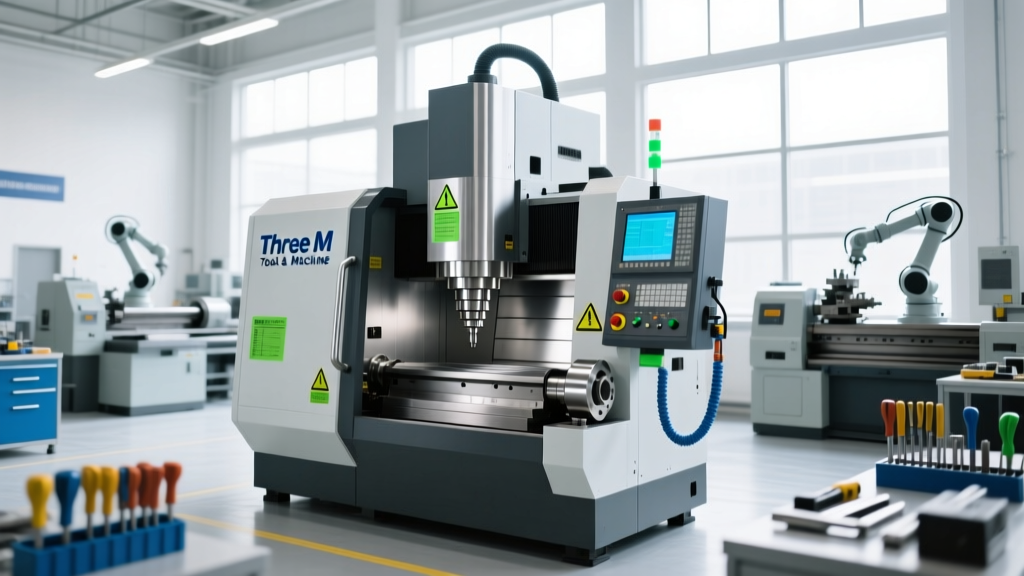
Three M Tool & Machine occupies a strategic middle ground in the tooling ecosystem. They typically source or manufacture tooling that utilizes reliable micro-grain carbide substrates but bypasses the massive R&D and global marketing premiums associated with tier-one brands. To understand where they fit into a 2026 budget plan, we must analyze their performance in high-stress applications, specifically roughing pre-hardened 4140 steel (32-36 HRC).
Cost Per Part (CPP) Comparison Matrix
The following matrix breaks down the actual economics of running a standard 45-degree face milling operation on 4140 steel across three distinct supplier tiers. Calculations assume a machine rate of $110/hour and a 500-piece production run.
| Metric | Premium OEM | Three M Tool & Machine | Budget Import |
|---|---|---|---|
| Initial Insert Cost | $18.50 | $9.20 | $3.50 |
| Average Tool Life (Minutes) | 45 min | 28 min | 9 min |
| Inserts Consumed (500 parts) | 33 | 53 | 166 |
| Total Tooling Cost | $610.50 | $487.60 | $581.00 |
| Changeover Downtime Cost | $121.00 | $194.33 | $608.66 |
| True Run Cost (Tool + Downtime) | $731.50 | $681.93 | $1,189.66 |
While the premium OEM yields the longest tool life, the Three M Tool & Machine option delivers the lowest True Run Cost. The budget import, despite having the lowest upfront insert cost, becomes the most expensive option due to the compounding penalty of machine downtime required for frequent indexing and replacement.
Hidden Variables: Spindle Health and CAM Integration
Tooling budgets often fail to account for secondary costs that manifest months after the initial purchase. Two critical factors heavily influence the long-term value of sourcing from a mid-tier supplier like Three M Tool & Machine.
Harmonic Chatter and Spindle Bearing Degradation
Ultra-cheap imported toolholders and end mills frequently suffer from poor concentricity and inconsistent balancing (often lacking ISO 1940-1 G2.5 balancing standards). When run at 12,000 RPM, this imbalance introduces harmonic chatter. Over a 12-month period, the micro-vibrations degrade the machine’s spindle bearings, leading to a premature rebuild that costs between $8,500 and $14,000. Three M Tool & Machine toolholders generally maintain strict runout tolerances (under 0.0002 inches at the gauge line), protecting your $60,000 CNC spindle investment.
Digital Tool Data and Setup Times
In modern machine shops, setup time is non-revenue time. Premium brands and established mid-tier suppliers like Three M Tool & Machine increasingly comply with the ISO 13399 standard for cutting tool data representation. This compliance allows shop programmers to import exact 3D tool assemblies, including holder extensions and cutting diameters, directly into CAM software like Mastercam or Fusion 360. Budget suppliers rarely provide this digital infrastructure, forcing programmers to manually measure and input tool offsets, adding 15 to 25 minutes of setup time per new tool.
“When we audit machine shops for cost-reduction, we look at the tool crib first. Shifting 40% of roughing operations from premium brands to qualified mid-tier suppliers like Three M Tool & Machine routinely frees up enough capital to upgrade to high-pressure coolant systems without increasing the overall annual budget.” — Manufacturing Extension Partnership field engineering guidelines, via NIST MEP.
Coolant Pressure Economics: Where to Spend and Where to Save
A critical component of 2026 budget planning is matching the tooling to the machine’s coolant capabilities. If your CNC mills are equipped with standard 250 PSI flood coolant, purchasing premium through-spindle coolant (TSC) optimized inserts is a waste of capital; the pressure is insufficient to clear the chips effectively, negating the tool’s engineered advantages.
- Standard Flood (250 PSI): Utilize Three M Tool & Machine’s standard peripheral-coated end mills and AlTiN coated inserts. Focus budget on rigid toolholders (like hydraulic or shrink-fit) to maximize tool life through rigidity rather than relying on coolant pressure.
- High-Pressure TSC (1,000+ PSI): This is where premium OEMs shine. The engineered chip-breaker geometries and specialized coolant channel designs of tier-one brands justify their 40% price premium when running difficult-to-machine alloys like Inconel 718 or Ti-6Al-4V.
The 2026 Strategic Budget Allocation Framework
Based on current industry economic data tracked by the Association For Manufacturing Technology, mid-sized job shops should abandon the practice of single-sourcing their tooling. Instead, implement a tiered procurement strategy optimized for specific machining operations.
The 60/25/15 Procurement RuleDivide your annual consumable tooling budget using this ratio to maximize ROI without sacrificing part quality.
- 60% Core Roughing & Hogging (Mid-Tier / Three M Tool & Machine): Roughing operations prioritize metal removal rates (MRR) over surface finish. Use mid-tier suppliers for face mills, roughing end mills, and drill bodies. The slight reduction in tool life is easily offset by the lower replacement cost and acceptable surface finishes.
- 25% Finishing & Tight Tolerance (Premium OEM): Reserve your most expensive, high-performance solid carbide end mills and precision boring bars for finishing passes. When holding a ±0.0005-inch tolerance on a aerospace bore, the predictable wear patterns and superior edge preparation of premium brands prevent scrapped parts.
- 15% Consumables & Workholding (Value / Bulk): Items like deburring tools, standard HSS taps for non-critical threads, and soft jaws should be sourced purely on price and bulk availability, as their failure does not result in catastrophic part loss.
Final Procurement Directives
Evaluating Three M Tool & Machine requires looking past the initial quote and modeling the tool’s behavior on the shop floor. For general machining, aluminum milling, and standard steel roughing, their tooling provides the optimal intersection of substrate quality and cost efficiency. However, shops must pair this mid-tier tooling with high-quality, balanced toolholders and rigorous CAM programming to extract maximum value. Stop buying premium tooling for roughing operations, and immediately cease purchasing unbranded imports for finishing passes. Realigning your 2026 budget around the Cost Per Part metric will yield immediate improvements in both spindle utilization and net profit margins.