Industry 4.0 Tactics for Machining Tool Steel: Case Studies
Discover how Industry 4.0 connectivity and smart machine tools optimize cycle times and reduce insert wear when machining tool steel like H13 and D2.
The Metallurgical Bottleneck in Hardened Die Machining
Machining tool steel presents a unique triad of challenges: high hardness (often 55-62 HRC), severe abrasiveness due to primary carbides, and a strong tendency to work-harden under cutting forces. Traditional CNC programming for materials like D2 cold-work or H13 hot-work steel relies on conservative, static feed rates designed to prevent catastrophic tool failure. While safe, this approach leaves significant cycle time and insert life on the table.
As smart machine tools and Industry 4.0 connectivity mature in 2026, forward-thinking die and mold shops are abandoning static G-code in favor of closed-loop adaptive control. By leveraging high-frequency spindle load monitoring, acoustic emission (AE) sensors, and edge computing, shops can dynamically adjust feeds and speeds in real-time. This case study analysis explores how modern connectivity protocols are transforming the economics of machining tool steel.
Case Study: Adaptive Spindle Control on H13 Hot-Work Steel
A mid-sized extrusion die manufacturer in the Midwest recently retrofitted their 5-axis Makino D500 machining centers with integrated spindle power monitors and an edge-computing gateway. The primary objective was to optimize the roughing of H13 die blocks (pre-hardened to 48-52 HRC) using 3/4-inch, 5-flute AlTiN-coated solid carbide end mills.
Sensor Deployment and Edge Processing
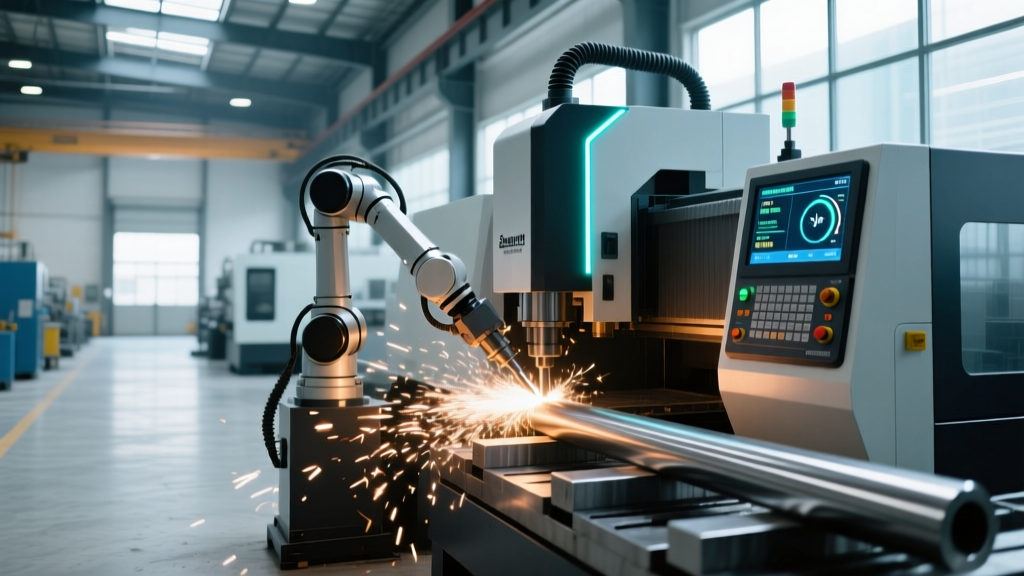
Instead of relying on the machine's internal macro-variables alone, the shop installed a Kistler piezoelectric force sensor ring beneath the spindle nose, coupled with a high-resolution spindle power monitor sampling at 1 kHz. This data is ingested by a Siemens Industrial Edge device running a localized AI model trained on H13 chip-formation acoustics and torque thresholds.
Technical Insight: Cloud latency is unacceptable for real-time chatter suppression. By processing the 1 kHz sensor data locally on the edge gateway, the system can send an override command to the Siemens Sinumerik ONE control in under 8 milliseconds, effectively choking the feed rate before a micro-chatter event escalates into a broken $140 end mill.Results: Baseline vs. Adaptive Control
The transition from static CAM-generated toolpaths to adaptive edge control yielded measurable improvements across all key performance indicators (KPIs) over a 90-day production run.
| Metric | Baseline (Static CAM) | Industry 4.0 (Adaptive Edge) | Delta |
|---|---|---|---|
| Average Cycle Time (Roughing) | 4 hours 15 mins | 3 hours 22 mins | -20.7% |
| Tool Life (Flutes per Insert) | 1.2 Die Blocks | 1.8 Die Blocks | +50% |
| Spindle Power Utilization | 45% (Conservative) | 82% (Optimized) | +37% |
| Scrap Rate (Tool Breakage) | 4.2% | 0.5% | -88% |
Acoustic Emission (AE) Monitoring for D2 Cold-Work Cavities
D2 tool steel is notorious for its high carbon (1.5%) and chromium (12%) content, which forms hard chromium carbides that act like grinding wheels against cutting edges. When milling deep, narrow cavities in D2 stamping dies, radial engagement varies wildly, leading to harmonic vibration and premature flank wear.
Implementing High-Frequency AE Sensors
To combat this, a specialized aerospace tooling shop integrated Marposs AE sensors directly into their DMG MORI HSC 20 linear machines. Unlike standard spindle load monitors that measure macro-level torque, AE sensors detect the high-frequency stress waves (100 kHz to 400 kHz) generated by the actual shearing of the metal matrix and the fracturing of chromium carbides.
- Chatter Detection: The AE system identifies the exact onset of regenerative chatter 40 milliseconds before it becomes audible or visible on the spindle load meter.
- Tool Wear Progression: By tracking the baseline shift in AE amplitude over a 120-minute cut, the system accurately predicts remaining useful life (RUL) of the TiSiN-coated ball nose end mill, triggering an automated M00 tool change command at exactly 85% wear, avoiding the catastrophic failure zone.
According to research highlighted by the SME Digital Manufacturing hub, integrating AE monitoring in hard-milling applications can reduce unplanned downtime by up to 35%, a critical factor when machining $20,000+ aerospace die blocks where a broken tool could ruin the workpiece.
Digital Twin Integration via MTConnect 2.4
Connectivity is only as valuable as the data standard that governs it. In 2026, the MTConnect Institute's v2.4 standard has become the backbone for normalizing machine data across mixed-fleet job shops. This is particularly vital when creating digital twins for machining tool steel, where machine rigidity and spindle taper condition dictate actual cutting performance.
Virtual Commissioning for Long-Reach Tooling
When machining deep slots in A2 air-hardening steel, shops frequently use extended-length toolholders (e.g., 6:1 L:D ratio hydraulic chucks). Deflection is a major concern. By streaming real-time MTConnect data (spindle torque, axis servo lag, and thermal drift) into a Siemens virtual CNC environment, engineers can simulate the exact cutting forces on the digital twin.
'By calibrating our digital twin with live MTConnect spindle load data, we stopped guessing deflection values in our CAM software. We now dynamically adjust our step-over from 8% to 12% on the fly when the digital twin confirms the spindle is operating below its thermal growth threshold.' — Lead Manufacturing Engineer, Precision Die Cast.
This level of synchronization ensures that the physical machine never exceeds its dynamic stiffness limits, preserving surface finish requirements (often 16 Ra or better for die cavities) without requiring secondary EDM or polishing operations.
Implementation Framework: Upgrading for Tool Steel Applications
Transitioning to smart machining for tool steel requires capital expenditure. A full sensor and edge-gateway retrofit typically ranges from $14,000 to $22,000 per machine. To ensure ROI, shops should follow a phased implementation framework, as recommended by the NIST Smart Connected Manufacturing program.
Phase 1: Data Visibility (Months 1-3)
Install MTConnect adapters on existing CNC controls (Fanuc, Mazak, Siemens). Focus strictly on data collection: spindle load profiles, tool change times, and axis feed overrides. Identify which specific tool steel grades and toolpath strategies are causing the highest torque spikes and tool breakage events.
Phase 2: Edge Analytics and Adaptive Overrides (Months 4-8)
Deploy edge computing hardware to process spindle load data. Implement adaptive feed control macros that automatically reduce the feed rate by 15% when spindle load exceeds 85% of the rated continuous torque, and increase it by 10% when load drops below 60% (such as during cornering or air-cutting transitions).
Phase 3: Predictive Maintenance and Digital Twins (Months 9-12)
Integrate acoustic emission and vibration sensors. Train machine learning models on the acoustic signature of fresh vs. worn carbide inserts cutting D2 and M2 steels. Link this data to your tool crib inventory system to automatically order replacement end mills when the predictive RUL drops below 4 hours.
The Bottom Line for Die and Mold Shops
Machining tool steel is no longer just a test of metallurgy and rigid machine castings; it is a data problem. The shops that will dominate the 2026 landscape are those that treat cutting forces, acoustic emissions, and thermal drift as real-time data streams rather than unpredictable variables. By investing in Industry 4.0 connectivity, shops can safely push their machines to 85% spindle utilization, turning the most abrasive, work-hardening steels into predictable, high-margin production runs.