Modern Machine and Tool Lubrication: MQL vs Flood vs Air-Oil
Compare flood, MQL, and air-oil lubrication systems for your modern machine and tool setup. Discover costs, schedules, and the best alternative for your shop.
Configuring a modern machine and tool environment for high-speed aerospace milling or hard-metal turning requires more than just rigid spindles and carbide inserts. Thermal growth and friction at the cutting edge or along linear guideways directly dictate part tolerances and tool life. While traditional flood coolant remains the default for many job shops, alternative systems like Minimum Quantity Lubrication (MQL) and Air-Oil micro-lubrication are rapidly capturing market share due to strict environmental regulations and the demand for higher surface finish quality.
Selecting the right delivery system involves analyzing capital expenditure, fluid consumption rates, and long-term disposal costs. Below is a technical comparison of the three dominant lubrication architectures, followed by precise maintenance schedules to maximize uptime.
System Architecture Comparison Matrix
| System Type | Fluid Delivery Method | Typical Flow Rate | Retrofit Capital Cost | Annual Disposal Cost |
|---|---|---|---|---|
| Flood Coolant (High-Pressure TSC) | Pressurized liquid stream (up to 1000 PSI) | 10 - 50 Gallons/min | $15,000 - $40,000 | $5,000 - $20,000+ |
| Minimum Quantity Lubrication (MQL) | Compressed air aerosol (externally or through-spindle) | 10 - 50 ml/hour | $3,500 - $8,500 | $0 (Evaporative/Chip recycling) |
| Air-Oil Micro-Lubrication | Metered oil droplets carried by air stream | 0.01 - 0.1 cc per shot | $2,000 - $6,000 | Negligible |
Flood Coolant: High-Pressure Through-Spindle (TSC) Dynamics
Flood coolant is indispensable for heavy roughing, deep-hole drilling, and machining heat-resistant superalloys (HRSA) like Inconel 718 or Ti-6Al-4V. The primary advantage of modern flood systems is not just lubrication, but aggressive thermal evacuation and chip flushing.
The 1000 PSI TSC Standard
Standard low-pressure flood systems (150-300 PSI) often fail to penetrate the vapor barrier generated at high cutting speeds. Upgrading to a high-pressure Through-Spindle Coolant (TSC) system operating at 1,000 PSI forces fluid directly into the shear zone. This breaks the chip in ductile materials and prevents built-up edge (BUE). However, high-pressure pumps require specialized mechanical seals and rigid hose routing to prevent catastrophic blowouts.
Refractometer Calibration Rule
Never rely on visual clarity to determine flood coolant concentration. Use a refractometer to maintain a Brix scale of 6% to 8% for standard semi-synthetic fluids. Multiply the refractometer reading by the fluid's specific correction factor (usually between 1.0 and 1.5) to get the true concentration. Running below 5% invites bacterial growth and flash rusting; running above 10% causes skin irritation and excessive foaming.
Minimum Quantity Lubrication (MQL): The Sustainable Challenger
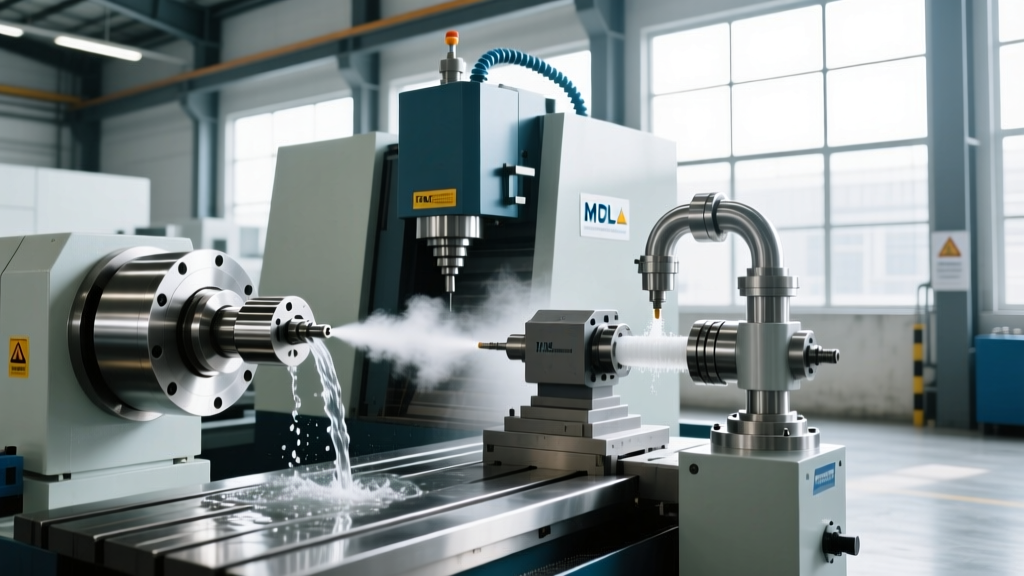
MQL replaces gallons of liquid with a precisely metered aerosol mist of biodegradable ester-based or fatty alcohol fluids. The fluid is atomized at the nozzle or mixed inside the spindle and delivered via compressed air at 4 to 6 bar.
Where MQL Outperforms Flood
MQL excels in near-dry machining of aluminum alloys (e.g., 6061-T6, 7075) and cast iron. Because the fluid is applied in microscopic droplets (10 to 50 ml/hr), it penetrates the cutting zone without creating the hydrodynamic shock that can chip fragile carbide micro-edges during interrupted cuts. Furthermore, the chips produced are virtually dry, allowing for immediate recycling without expensive centrifuge separation.
Warning: MQL Mist ExtractionWhile MQL eliminates liquid disposal, it generates airborne oil mist. OSHA and NIOSH Metalworking Fluids Guidelines strictly regulate inhalable particulate limits. Any MQL implementation on a modern machine and tool setup must be paired with a high-efficiency HEPA mist collector rated for sub-micron aerosol capture to maintain shop air quality below 0.5 mg/m³.
Air-Oil Micro-Lubrication: Precision Spindle and Guideway Focus
Unlike MQL, which targets the cutting edge, Air-Oil systems are designed exclusively for machine tool kinematics: spindle bearings, ball screws, and linear guideways. Systems like SKF Oil-Air Lubrication Units use progressive metering valves to inject microscopic oil volumes (e.g., 0.05 cc) into an air stream, which then carries the droplets to the friction points.
The Danger of Over-Lubrication
A common failure mode in high-speed spindles (20,000+ RPM) is churning friction. If too much grease or oil is packed into the bearing cavity, the rolling elements must displace the lubricant, generating immense parasitic heat that causes thermal expansion and seizes the spindle. Air-oil systems prevent this by delivering only the exact molecular boundary layer required for lubrication, while the continuous airflow actively cools the bearing housing and creates positive pressure to repel external contaminants.
Decision Framework: Selecting the Right Architecture
Use this operational matrix to determine the optimal lubrication strategy for your specific machining cells:
- Choose Flood TSC if: You are performing heavy roughing, deep-hole drilling (BTA or gun drills), or machining HRSA materials where thermal evacuation is the primary bottleneck.
- Choose MQL if: You are high-speed milling aluminum, sawing, or performing near-dry turning of cast iron, and want to eliminate the $15,000+ annual cost of coolant hauling and tramp oil skimming.
- Choose Air-Oil if: You are rebuilding or specifying high-frequency grinding spindles, high-speed machining center linear guides, or precision rotary tables where liquid coolant would wash away delicate bearing greases.
Optimized Maintenance Schedules for Modern Systems
Advanced lubrication systems require rigorous adherence to maintenance intervals to prevent catastrophic component failure. Implement the following schedule on your shop floor:
Daily Operations (Shift Start)
- Flood: Check sump level and test concentration with a refractometer. Verify tramp oil skimmer operation.
- MQL: Inspect fluid reservoir levels. Purge air lines to ensure no moisture condensation is mixing with the ester fluid.
- Air-Oil: Verify the visual cycle indicator pins on the progressive metering valves are actuating. Check air pressure regulator (must hold steady at 4-6 bar).
Weekly Diagnostics
- Flood: Test coolant pH (target 8.5 to 9.2). A drop below 8.0 indicates bacterial colonization. Apply biocide or adjust concentration immediately.
- MQL: Clean or replace the aerosol generator nozzle inserts. Clogged capillary tubes will result in dry cutting and immediate tool fracture.
- Air-Oil: Inspect the air filter element on the lubrication unit. Replace if the pressure drop exceeds 0.5 bar.
Monthly & Annual Overhauls
Every 30 days, flood systems require tank agitation and vacuuming of settled fines to prevent the recirculation of abrasive swarf. Annually, completely dump, pressure-wash, and recharge the flood sump, replacing all inline filter bags (typically 25 to 50 micron ratings depending on the operation). For MQL and Air-Oil systems, annually audit the PLC timing parameters to ensure the metering intervals have not drifted and match the OEM kinematic specifications.
By aligning your lubrication architecture with your specific material removal rates and adhering to strict fluid management schedules, you safeguard both your tooling investments and your operational margins. For broader environmental compliance strategies regarding industrial fluids, refer to the EPA Pollution Prevention guidelines to ensure your shop remains ahead of evolving disposal regulations.