Manufacturer Machine Tool Distributor: Lubrication Alternatives
Compare machine tool lubrication systems and schedules. Learn how a manufacturer machine tool distributor can upgrade your CNC from manual to air-oil.
The Hidden Cost of Way Wear and Lubrication Failure
Unplanned CNC downtime stemming from way wear, ball screw galling, and spindle bearing seizure accounts for a massive percentage of lost production hours in modern machine shops. The root cause is rarely the structural metal itself; it is almost always the failure or inadequacy of the lubrication delivery system. Upgrading from legacy manual greasing or failing single-line resistance setups requires partnering with a qualified manufacturer machine tool distributor to specify the correct volumetric, progressive, or air-oil alternative for your specific 2026 CNC fleet.
Choosing the right system is not merely about pumping fluid; it is about precision metering, PLC integration, and matching the tribological requirements of the machine's sliding and rolling elements. Below, we break down the primary lubrication system alternatives, exact scheduling parameters, and how to leverage a specialized distributor for a seamless retrofit.
WARNING: The Viscosity Mismatch TrapNever mix ISO VG grades in a shared reservoir. Pumping ISO VG 220 way oil through a high-speed spindle air-oil system designed for ISO VG 10 will cause immediate bearing overheating and catastrophic spindle failure within hours. Always verify the OEM tribology chart before authorizing a distributor to install a centralized multi-zone pump.
Core Alternatives: 4 Machine Tool Lubrication Systems Compared
When consulting a manufacturer machine tool distributor, you will generally evaluate four primary delivery architectures. Each serves a distinct mechanical purpose and carries different capital and maintenance costs.
| System Architecture | Best Application | Avg. Retrofit Cost (2026) | Primary Failure Mode | Pressure Range |
|---|---|---|---|---|
| Single-Line Resistance | Standard CNC Mills/Lathes (Way Lube) | $800 - $1,500 | Line break bypasses meter unit | 15 - 30 PSI |
| Progressive Divider | Heavy-Duty Machining Centers, Presses | $2,500 - $4,500 | Blocked line stalls entire valve | 150 - 350 PSI |
| Volumetric / Dual-Line | Large Gantry Mills, Multi-Axis Boring | $3,500 - $6,000 | Metering pin scoring | 50 - 150 PSI |
| Air-Oil / MQL | High-Speed Spindles, Minimum Quantity | $5,000 - $9,000 | Air pressure drop starves bearing | 40 - 80 PSI (Air) |
Deep Dive: System Mechanics and Distributor Sourcing
1. Single-Line Resistance (The 'One-Shot' Standard)
Single-line resistance systems, popularized by legacy Bijur Delimon setups, rely on a centralized pump pushing fluid through a network of proportioning meter units (MUs). A standard MU3 orifice delivers roughly 0.014 cubic centimeters per stroke. The system operates at low pressure (typically 20 PSI). When the pump cycles, a pressure switch (such as a Gems Sensors PS-10) signals the PLC that pressure was achieved.
The Alternative Upgrade: The fatal flaw of resistance systems is that a severed nylon line will vent pressure to the atmosphere, yet the pump will still build enough localized pressure to satisfy the switch, leaving the Z-axis dry while the PLC registers a 'success'. A specialized manufacturer machine tool distributor will upgrade this to a monitored single-line parallel system or add flow-sensor confirmation at critical junction blocks to eliminate this blind spot.
2. Progressive Divider Systems (The Heavy-Duty Choice)
For heavy cutting loads where way oil or lithium-complex grease must be positively displaced, progressive systems are the undisputed standard. Utilizing valves like the Lincoln Industrial SL-V series, the fluid enters a master valve and sequentially forces internal pistons to move. If a single delivery line becomes pinched or blocked, the internal piston cannot complete its stroke, halting the entire valve block.
This mechanical interlock is a massive advantage for reliability. By installing an IFM IG55 proximity switch on the master valve's cycle indicator pin, the CNC controller can count exact physical strokes. According to data from SKF Lubrication Solutions, progressive systems reduce unplanned bearing failures by up to 45% compared to unmonitored manual greasing because they guarantee volumetric delivery or trigger an immediate machine halt.
3. Air-Oil and MQL (The High-Speed Alternative)
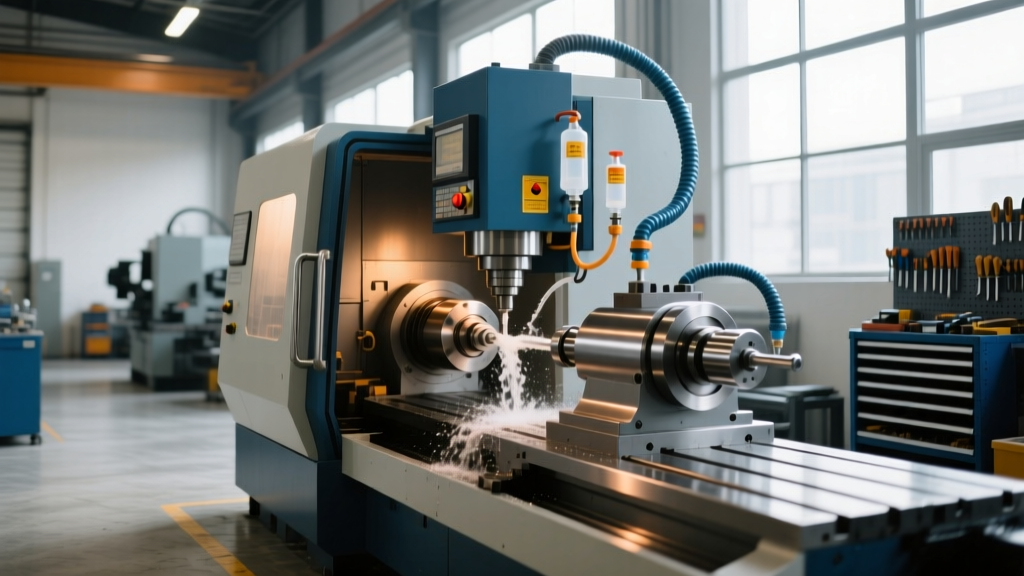
Spindle bearings rotating above 15,000 RPM cannot tolerate the viscous drag of traditional oil baths or standard way oil. Air-oil systems mix precise micro-droplets of ISO VG 10 or VG 22 spindle oil with compressed air, delivering a continuous, atomized mist directly to the bearing raceways. Sourcing these requires a manufacturer machine tool distributor who understands pneumatic logic, as the system requires clean, dry air (ISO 8573-1 Class 1.2.1) to prevent moisture from emulsifying the bearing grease.
Decision Framework: Which System Do You Need?- If you are retrofitting a standard 3-axis VMC for general milling → Choose Single-Line Parallel with flow-sensor verification.
- If you operate heavy-duty horizontal boring mills with extreme axial loads → Choose Progressive Divider with cycle-counting proximity switches.
- If you run high-speed graphite or aluminum machining centers → Choose Air-Oil / MQL to eliminate fluid drag and thermal spindle growth.
Optimizing Lubrication Schedules for 2026 CNC Fleets
Installing the hardware is only half the battle. The lubrication schedule—programmed directly into the machine's PLC or triggered via M-codes—dictates the lifespan of the components. Standard OEM schedules are often overly conservative, wasting expensive synthetic way oils and creating environmental runoff.
Way and Ball Screw Schedules (ISO VG 68)
For standard cast-iron to Turcite-B way interfaces using a fluid like Mobil Vactra Oil No. 2 (ISO VG 68), the optimal schedule depends on machine state:
- Active Cutting Cycle: 15 seconds of pump ON time, followed by 45 minutes of OFF time. This maintains the hydrodynamic wedge without flushing the way covers.
- Standby / Idle State: 2 seconds of pump ON time every 4 hours. This prevents the microscopic asperities on the ways from cold-welding due to static friction.
- Post-Maintenance Prime: 120 seconds continuous run to purge air from the metering units before clearing the PLC alarm.
Spindle Bearing Schedules (ISO VG 10 / Air-Oil)
Air-oil systems do not run on a simple timer; they run on a pulse-interval basis tied to spindle RPM. A modern distributor will integrate the lube system via the Fanuc Focas protocol or Siemens OPC-UA, triggering a 3-second air-oil pulse every 3 minutes when the spindle exceeds 8,000 RPM, and scaling back to every 15 minutes during low-speed tapping operations.
Vetting Your Manufacturer Machine Tool Distributor
Not all suppliers are equipped to handle complex tribological retrofits. When interviewing a manufacturer machine tool distributor for a facility-wide upgrade, require them to answer the following technical qualifiers:
- Volume Calculation: Can they provide a spreadsheet detailing the exact cubic centimeter (cc) output per lube point based on the specific metering unit orifices selected?
- PLC Integration: Do they supply the ladder logic updates for the pressure switch I/O addresses, or do they expect your internal maintenance team to reverse-engineer the pump's PCB?
- IIoT Readiness: Can the proposed pump controller output MQTT or Modbus TCP data to your shop's SCADA system for predictive maintenance tracking?
A true engineering partner will provide the fluid volume calculations, the electrical schematics, and the PLC logic mapping as part of the initial proposal.
Frequently Asked Technical Questions
Can I use synthetic hydraulic oil instead of dedicated way oil?
No. Hydraulic oils (like ISO VG 46 AW) lack the tackiness additives (such as polyisobutylene) found in dedicated way oils. Without these tackifiers, the oil will sling off the ball screws and way covers under high acceleration, leading to boundary lubrication conditions and rapid wear.
Why does my progressive system alarm out immediately after a reservoir refill?
This is caused by air entrapment in the pump suction tube. Progressive valves cannot compress air; the air pocket acts as a spring, preventing the internal pistons from reaching the physical end of their stroke. You must bleed the master valve block using the dedicated relief port before resetting the PLC fault.
How often should the nylon distribution lines be replaced?
Standard polyamide (nylon) lines degrade due to UV exposure, way-cover pinch points, and chemical attack from synthetic coolants. Establish a mandatory replacement schedule every 36 months, or upgrade to flexible PTFE (Teflon) tubing with stainless steel braiding for permanent, crush-proof reliability.