CNC Retrofit Safety: Upgrading to a Precise Machine Tool
Learn how to safely upgrade a manual mill into a precise machine tool. Covers CNC retrofit compliance, ANSI B11.8 standards, and safety I/O wiring.
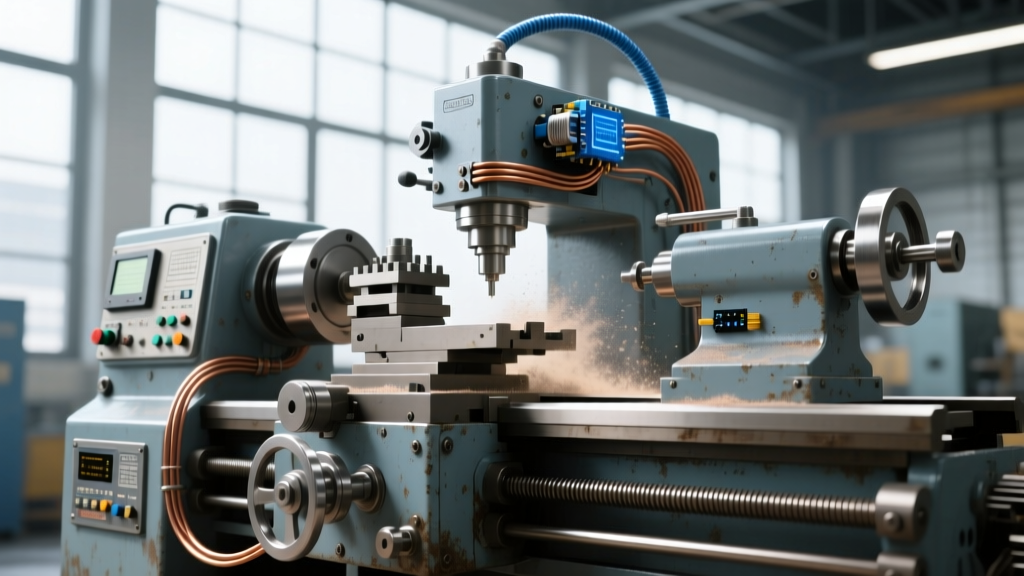
Converting a manual knee mill or engine lathe into a computer-controlled system transforms it into a highly capable and precise machine tool. However, replacing human handwheels with high-torque servo or stepper motors introduces severe kinetic and entanglement hazards. A machine that previously relied on the operator's physical proximity and reaction time now operates with automated, unpredictable force. As of 2026, regulatory bodies and insurance underwriters heavily scrutinize retrofitted equipment, meaning a DIY approach to safety wiring is no longer acceptable in professional environments.
⚠️ The Compliance Gap: Manual vs. CNC Operation
Under OSHA guidelines, a manual machine's safety relies heavily on administrative controls and operator training. Once automated, the machine falls under strict engineering control mandates. The control system must independently verify safe states before allowing motion, requiring hardwired safety relays rather than software-dependent logic.
Governing Safety Standards for CNC Retrofits
When designing the electrical and mechanical safety architecture for a retrofitted precise machine tool, three primary standards dictate the engineering requirements:
- ANSI B11.8 (Milling/Drilling) & ANSI B11.6 (Lathes): These standards define the mechanical guarding requirements, including chip containment, polycarbonate shield thickness, and interlock placement. The Association for Manufacturing Technology (AMT) maintains these B11 series standards, which explicitly require that opening a guard during an automatic cycle triggers an immediate Category 0 or Category 1 stop.
- NFPA 79 (Electrical Standard for Industrial Machinery): This governs the electrical cabinet build. It mandates the use of 24VDC for control circuits, specific wire color coding (e.g., yellow for external interlocks, red for AC power), and the physical separation of high-voltage motor drives from low-voltage safety logic.
- ISO 13849-1 (Safety-Related Parts of Control Systems): This standard introduces the concept of Performance Levels (PL). A standard CNC retrofit E-stop circuit must achieve at least PLd, Category 3, meaning a single fault in the safety circuit will not lead to the loss of the safety function, and the fault will be detected before the next demand on the safety function.
Evaluating CNC Controllers for Safety I/O Architecture
Not all CNC control boards handle safety logic equally. Hobbyist boards often route E-stop signals through the primary microcontroller or USB interface, which violates ISO 13849-1 because a software crash or USB disconnect could mask a safety fault. Professional retrofits require controllers with dedicated, optically isolated safety I/O or external safety relay integration.
| Controller System | Safety Architecture | ISO 13849-1 Compliance Path | 2026 Est. Base Price |
|---|---|---|---|
| Centroid Acorn/G400 | Dedicated hardware I/O board with isolated inputs. | Requires external dual-channel safety relay to cut servo contactors. | $1,200 - $1,800 |
| MachMotion (Mach4) | Ethernet SmoothStepper with breakout board relays. | Software E-stop available, but hardwired external contactors mandatory for compliance. | $1,500 - $2,200 |
| FlashCut CNC | Integrated USB/Ethernet signal generator with safety I/O. | Supports direct integration with Pilz or Allen-Bradley safety modules. | $1,800 - $2,500 |
Critical Safety Hardware Integration
To achieve a compliant safety envelope, the following hardware must be integrated into the machine's electrical cabinet and physical guards.
1. Dual-Channel E-Stop Circuits
Pressing an E-stop button must physically remove power from the axis servo drives and the spindle VFD (Variable Frequency Drive). This is achieved using a dual-channel safety relay, such as the Pilz PNOZ s4 or Allen-Bradley Guardmaster 440R. The E-stop buttons (e.g., Eaton FAK-R/KC02) must feature two normally-closed (NC) contacts. These contacts wire into the safety relay's dual input channels. If one wire breaks or shorts, the relay detects the asymmetry and locks out the system, preventing a restart until the fault is cleared.
2. Guard Interlocks with Solenoid Locking
For a precise machine tool like a CNC lathe where the chuck retains massive rotational inertia, a simple tongue-and-groove interlock is insufficient. If an operator opens the door the millisecond the cycle ends, the chuck could still be spinning at 2,000 RPM. You must use a solenoid-locked interlock switch, such as the Schmersal AZM201. This device physically locks the guard door closed. The CNC controller sends a 'spindle at zero speed' signal to the safety relay, which then de-energizes the solenoid, allowing the door to open.
3. Polycarbonate Shielding Specifications
Manual machine splash guards are rarely sufficient for CNC coolant pressures and automated chip ejection. According to OSHA guidelines and ANSI B11 standards, viewing windows must be constructed from polycarbonate (e.g., Lexan Margard) with a minimum thickness of 0.250 inches (6mm) for standard knee mills, and up to 0.500 inches (12mm) for high-speed lathes. Note that standard polycarbonate degrades and crazes when exposed to synthetic or semi-synthetic CNC coolants; always specify coolant-resistant coated grades.
💡 Pro-Tip: VFD Dynamic Braking
Do not rely solely on cutting power to the spindle motor to stop it quickly. Configure your VFD (e.g., Yaskawa GA800 or Hitachi WJ200) to use dynamic braking resistors. When the safety relay cuts the run-permissive signal, the VFD should actively brake the spindle to 0 RPM in under 2 seconds before the door interlock solenoid releases.
Safety Component Cost Breakdown (3-Axis Knee Mill)
Budgeting for a retrofit often overlooks the compliance hardware. Below is a realistic 2026 parts list for bringing a Bridgeport-style knee mill up to professional safety standards.
| Component | Model / Spec | Qty | Unit Cost | Total |
|---|---|---|---|---|
| Safety Relay | Pilz PNOZ s4 (Dual Channel) | 2 | $385.00 | $770.00 |
| E-Stop Stations | Eaton FAK-R/KC02 (2 NC contacts) | 3 | $110.00 | $330.00 |
| Door Interlock | Schmersal AZM201 Solenoid Lock | 1 | $450.00 | $450.00 |
| Main Contactor | Schneider Electric TeSys D (40A) | 1 | $145.00 | $145.00 |
| Polycarbonate Shield | 0.250" Lexan Margard (Custom cut) | 1 | $280.00 | $280.00 |
| Total Safety Hardware Budget | $1,975.00 | |||
Common Compliance Failures in DIY Retrofits
When auditing retrofitted equipment, safety inspectors frequently cite the following critical violations:
- Software-Dependent E-Stops: Wiring the E-stop button directly to a 5V logic pin on a breakout board, relying on the CNC software (like Mach3 or LinuxCNC) to halt motion. If the PC freezes, the E-stop becomes useless. The E-stop must physically sever the 120V/240V AC supply to the drives via a hardwired contactor.
- Bypassed Interlocks: Operators taping down guard interlock tongues to avoid opening and closing heavy doors during setup. Using RFID-coded safety switches (like the Sick STR1) prevents this defeat mechanism, as they cannot be bypassed with a spare piece of metal or tape.
- Improper Wire Routing: Running 24VDC safety interlock wires in the same conduit as 230V AC spindle power. Electromagnetic interference (EMI) from the VFD can induce false voltages in the safety circuit, potentially masking an open guard door. NFPA 79 requires physical separation or grounded metallic shielding between power and control wiring.
FAQ: Certification and Liability
Does a retrofitted machine require a new CE or UL mark?
If you retrofit a machine for internal use within your own manufacturing facility in the US, you do not typically need a new UL listing, but you must comply with OSHA's Machine Guarding eTool requirements and NFPA 79. However, if you are retrofitting machines to resell them as a business, the machine is considered 'newly manufactured' and requires full CE marking (in Europe) or a Nationally Recognized Testing Laboratory (NRTL) certification (in the US).
Can I use standard limit switches as safety interlocks?
No. Standard microswitches (like the common Omron D2VW) are not rated for safety applications. They lack the forced-break (positive-opening) mechanism required by safety standards. If a standard switch welds shut internally due to arcing, the machine will start with the door open. You must use switches specifically rated for safety, featuring the EN 50047 or ISO 14119 designation with positive-opening NC contacts.
How do I document the safety circuit for compliance?
Maintain an electrical schematic drawn in standard IEC format, detailing the dual-channel safety relay wiring, the contactor coil circuits, and the E-stop loop. Additionally, perform and document a risk assessment (using methodologies like ANSI/RIA 15.06 or ISO 12100) that identifies hazards (e.g., automatic tool changer pinch points) and maps them to the specific engineering controls installed.