Machine Tool Restoration: Brand Value and ROI Analysis
Evaluate the ROI of machine tool restoration across top legacy brands. Compare Monarch, Bridgeport, and Cincinnati rebuild costs versus market value.
The decision to pursue machine tool restoration hinges on a strict financial and mechanical calculus: does the mass, rigidity, and geometric stability of legacy American iron justify the capital and labor required to bring it to modern tolerances? Not all castings are equal. While a 1960s Monarch lathe possesses inherent metallurgical value that appreciates upon restoration, a 1980s mid-tier CNC mill often represents a depreciating liability once the original control system fails. For shop owners and equipment brokers in the 2026 secondary market, understanding brand-specific restoration ROI is the difference between acquiring a generational asset and funding a money pit.
According to capital equipment lifecycle research published by the Association for Manufacturing Technology (AMT), the average lifespan of heavy-duty manual and early CNC machine tools exceeds 50 years when properly maintained, vastly outperforming the 10-to-15-year lifecycle of modern lightweight, high-speed production machines. However, realizing that lifespan requires targeted investment. This guide dissects the restoration viability of the most common legacy brands found in the North American secondary market.
The Brand Hierarchy: Tiered ROI Analysis
Machine tool restoration is not a one-size-fits-all endeavor. We categorize legacy equipment into three distinct tiers based on their post-restoration market value, availability of replacement components, and structural integrity.
Tier 1: High-ROI Legacy Iron (Monarch, Kearney & Trecker, Cincinnati Milacron)
These machines were over-engineered with massive, stress-relieved castings, hand-scraped ways, and premium spindle assemblies. They hold their value exceptionally well and often appreciate once restored to OEM or better specifications.
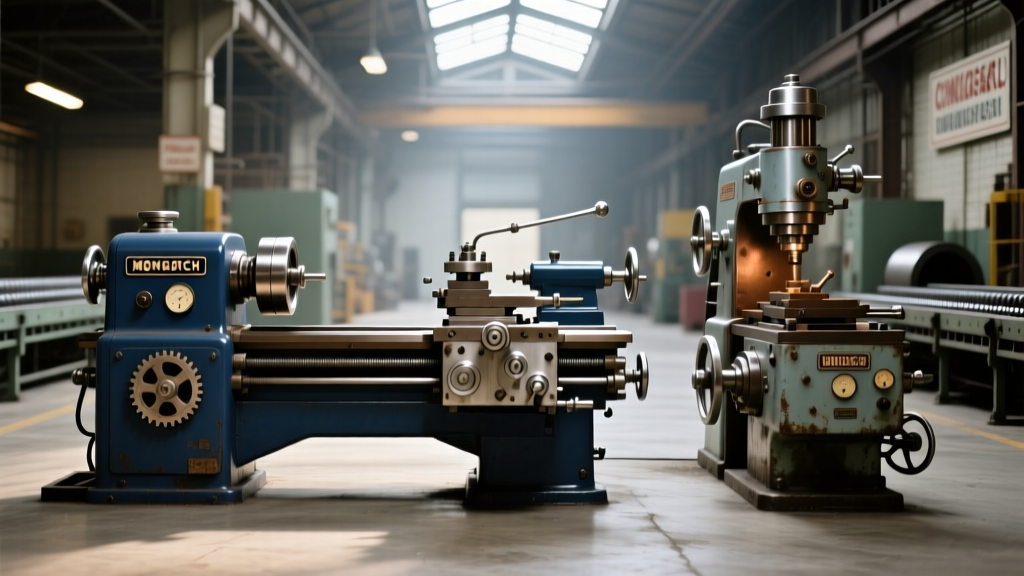
- Monarch 10EE & 16CY Lathes: The gold standard of manual turning. A complete restoration—including scraping the bed and cross-slide to 20 points per square inch (PPI), replacing spindle bearings with precision angular contacts (e.g., SKF or Timken), and upgrading the obsolete Ward Leonard DC drive to a modern AC VFD or Eurotherm DC drive—typically costs between $12,000 and $18,000. A fully restored Monarch 10EE commands $24,000 to $32,000 in the current market, yielding a strong positive ROI.
- Kearney & Trecker (Milwaukee-Matic) & Cincinnati Milacron: Heavy horizontal and vertical mills from these brands feature exceptional damping characteristics. The primary restoration hurdle is the CNC control. Ripping out a dead Fanuc 6M or proprietary Acramatic control and retrofitting a modern system like a Centroid All-in-One-DC (hardware cost: ~$4,500) or a LinuxCNC-based Mesa Electronics setup breathes new life into the iron. Total retrofit and mechanical refurbishment costs average $25,000 to $40,000, but the resulting machine rivals new $150,000+ equipment in heavy hogging capabilities.
Tier 2: Break-Even Commodity Iron (Bridgeport, South Bend Heavy 10)
These machines are ubiquitous. Parts are cheap, but the market is flooded, suppressing post-restoration resale value.
- Bridgeport Series I (2J Head): Paying a professional machine rebuilder $6,000 to scrape the knee dovetails, re-grind the quill, and replace the spindle bearings on a standard 9-inch Series I destroys any financial ROI. A professionally restored Bridgeport sells for $7,500 to $9,000, barely covering the acquisition and rebuild costs. Restoration of Tier 2 machines only makes financial sense if the labor is performed in-house by your own maintenance team, or if you are acquiring a rare variant (e.g., Series II, CNC Boss 8) with significantly higher ceiling value.
Tier 3: Depreciating Liabilities (Early 1990s Import CNCs, Obscure Brands)
Brands like early Fadal (VMC 15/40), Tree, or undocumented Asian imports from the 1990s suffer from severe structural wear and obsolete, unsupported electronics. The castings lack the mass of American iron, meaning way wear cannot be easily corrected without replacing entire components. Avoid restoring Tier 3 machines for profit; they are strictly core-charge candidates.
Restoration Cost Breakdown: Where the Capital Goes
To accurately forecast ROI, shop owners must understand the granular costs of professional machine tool restoration. The Society of Manufacturing Engineers (SME) emphasizes that geometric accuracy—achieved through precision scraping and alignment—is the primary driver of restored machine value.
| Restoration Phase | Typical Scope & Materials | Estimated Cost Range (USD) |
|---|---|---|
| Way Scraping & Alignment | Hand scraping to 18-22 PPI, Turcite-B way liner application, Moglice injection | $4,500 - $8,500 |
| Spindle Rebuild | Precision bearing replacement, dynamic balancing, drawbar rebuild | $2,200 - $5,000 |
| Ball Screw / Leadscrew | Replacement of worn Acme screws with precision rolled ball screws | $1,800 - $3,500 |
| CNC Retrofit (if applicable) | Centroid Acorn/All-in-One, servos, VFDs, wiring, enclosure integration | $6,000 - $12,000 |
| Cosmetics & Lubrication | Industrial epoxy paint (e.g., Rust-Oleum V2100), Bijur lube system rebuild | $1,500 - $3,000 |
The 5-Point Inspection Framework Before Acquisition
Before purchasing a restoration candidate, conduct this non-negotiable mechanical audit. If the machine fails points 1 or 2, walk away; the casting or spindle housing is permanently compromised.
- Spindle Housing Concentricity: Mount a 0.0001" dial indicator on a magnetic base and sweep the inside bore of the spindle housing. If the bore is out of round by more than 0.0005", the housing requires line-boring, which adds $3,000+ to the rebuild cost.
- Bed Twist and Wear: Place a 36-inch precision ground straight edge along the V-ways. Use feeler gauges to check for drop in the center (where the carriage sits most often). Wear exceeding 0.003" over 12 inches requires full bed re-grinding, not just scraping.
- Spindle Runout: Insert an 11-inch precision test bar into the spindle taper. Measure TIR (Total Indicator Runout) at the end of the bar. Acceptable as-is tolerance for a restoration candidate is < 0.0005". Anything worse indicates a crashed or bent spindle shaft.
- Gearbox and Back-gear Engagement: Manually engage the back-gear. It should slide smoothly without excessive backlash. Listen for grinding; chipped bull gears are notoriously difficult to source for legacy models.
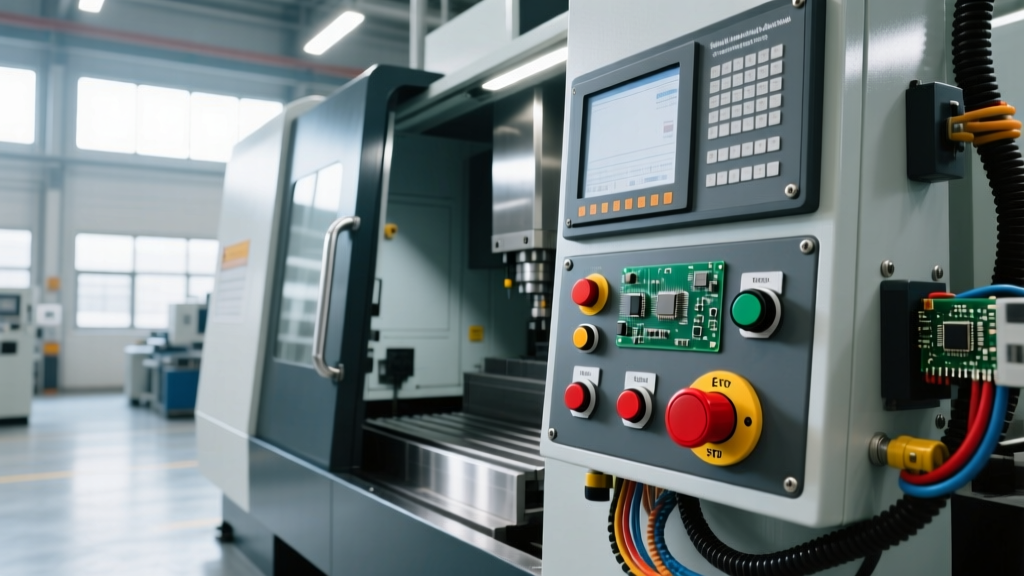
- Control Cabinet Condition: For CNC candidates, open the cabinet. Look for leaking capacitors, corroded ribbon cables, or evidence of rodent infestation. A clean, dry cabinet saves thousands in electrical troubleshooting.
Final Verdict: Capital Allocation Strategy
Machine tool restoration is a highly viable strategy for equipping a shop with heavy-duty capabilities at a fraction of new-machine costs, provided the correct brands are targeted. Allocate your capital toward Monarch lathes and heavy Cincinnati or Kearney & Trecker mills. Budget a minimum of $15,000 for manual machines and $35,000 for CNC retrofits. Avoid the trap of over-restoring commodity machines like the standard Bridgeport Series I unless the labor is kept strictly in-house. By adhering to strict mechanical inspection frameworks and focusing on Tier 1 legacy iron, shops can secure decades of high-precision machining capability while maintaining strong asset equity.