Maintaining Machine Tool Controls: Safety Interlocks and E-Stops
Master the 90-day maintenance schedule for CNC safety interlocks and E-stops. Includes testing protocols, failure modes, and ISO 13849-1 compliance.
The Financial and Legal Reality of Interlock Neglect
A failed safety interlock on a 5-axis CNC mill or a multi-tasking turning center does not merely halt production; it exposes the manufacturing facility to catastrophic liability and severe operator injury. As machine tool controls evolve to integrate seamlessly with automated pallet loaders and robotic tending cells, the complexity of safety circuits has increased exponentially. When a machine tool company designs a modern machining center, the safety architecture is validated to specific Performance Levels (PL) under ISO 13849-1:2023. However, without a rigorous, documented maintenance schedule, environmental factors like tramp oil, conductive swarf, and mechanical vibration will degrade these circuits below their certified safety thresholds.
CRITICAL DATA POINT: According to OSHA's machine guarding standards, failure to maintain functional E-stop and interlock circuits is consistently ranked among the top cited violations in metalworking facilities. The average fine for a willful safety interlock bypass or failure exceeds $156,000 per violation in 2026, exclusive of civil litigation and the $15,000-$25,000 per hour cost of unplanned 5-axis CNC downtime.Anatomy of 2026 Machine Tool Safety Circuits
Modern safety architectures have largely moved away from hardwired, single-channel relay logic. Today's machine tool controls rely on dual-channel 24VDC architectures monitored by programmable safety controllers like the Pilz PNOZmulti 2 or Siemens SINUMIK 840D sl integrated safety (Safety Integrated). These systems continuously monitor for cross-circuit faults, wire breakages, and contact welding. Maintenance technicians must understand that testing an E-stop is no longer just about verifying the machine halts; it requires validating that the diagnostic feedback loop correctly registers the fault code on the HMI without triggering a secondary safety shutdown.
Core Components Requiring Scheduled Service
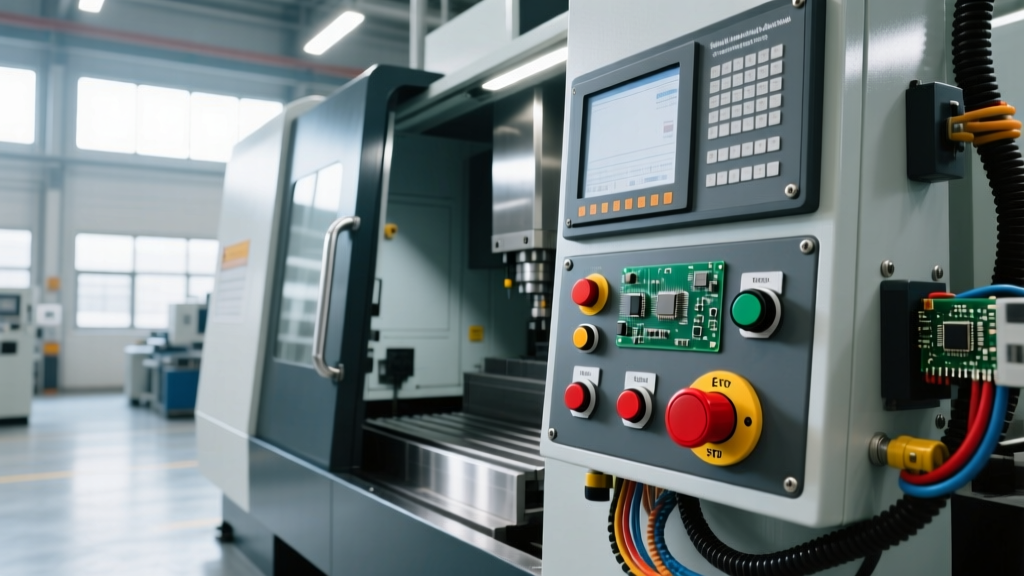
- Emergency Stop Actuators: E.g., Eaton FAK-R/K/KC01 or Siemens 3SU1 mushroom-head pushbuttons with dual NC (Normally Closed) contact blocks.
- Door Interlock Switches: RFID-coded non-contact switches (e.g., Sick STR1) or guard locking solenoids (e.g., Euchner NZ.V) with integrated escape releases.
- Safety Relays and Controllers: The logic solvers that evaluate the dual-channel inputs and drop the main contactor power.
The 90-Day Interlock & E-Stop Maintenance Matrix
Relying on daily operator checks is insufficient for internal component degradation. The following 90-day preventive maintenance (PM) matrix must be executed by a qualified controls technician using calibrated multimeters and OEM diagnostic software.
| Component | Maintenance Task | Acceptable Tolerance / Metric | Tool Required |
|---|---|---|---|
| E-Stop Contact Blocks | Measure contact resistance across NC terminals while depressed. | < 0.5 Ohms per channel | Milliohm meter |
| RFID Door Interlocks (Sick STR1) | Verify read range and check for mechanical sag on door hinges. | 5mm to 12mm actuation distance | Feeler gauge, calipers |
| Solenoid Guard Locks (Euchner) | Lubricate locking bolt, test manual mechanical escape release. | Smooth actuation, < 20N release force | Dry PTFE spray, force gauge |
| Safety Relay (Pilz PNOZ) | Force single-channel fault to verify cross-fault detection. | HMI fault registration < 50ms | OEM diagnostic software |
| Main Safety Contactors | Inspect main power contacts for pitting, arcing, or welding. | Zero pitting, no carbon tracking | Visual inspection, thermal camera |
Step-by-Step E-Stop Circuit Validation Protocol
Validating an E-stop circuit requires proving that both redundant channels operate independently and that the safety controller correctly identifies a discrepancy if one channel fails. Follow this exact sequence during your annual ISO compliance audit:
- Baseline Voltage Check: With the machine in a safe, idle state, measure the 24VDC supply at the E-stop input terminals on the safety controller. Ensure voltage does not drop below 22.5VDC under load.
- Channel 1 Isolation Test: Physically disconnect the wire for Channel 1 at the E-stop mushroom button. Trigger the E-stop. The machine must halt, and the safety controller must flag a 'Channel Asymmetry' or 'Cross-Circuit' fault on the HMI. Reconnect Channel 1.
- Channel 2 Isolation Test: Repeat the process for Channel 2. If the machine halts but fails to flag the specific asymmetry fault code, the diagnostic feedback loop is compromised, and the safety controller must be replaced or reprogrammed.
- Simultaneous Actuation: Press the E-stop normally. Measure the voltage drop across the main safety contactor coils. It must drop to 0VDC within the response time calculated in your system's SISTEMA validation file (typically under 50ms for Category 3 / PL d architectures).
Common Failure Modes and Edge Cases
Interlocks rarely fail without warning. Recognizing the precursors to failure allows maintenance teams to replace components during scheduled weekend downtime rather than mid-shift. NIOSH guidelines on machine guarding emphasize that environmental degradation is the primary culprit in metal removal environments.
1. Coolant Ingress in IP67 Rated Switches
Many shops assume IP67 ratings guarantee survival against CNC cutting fluids. However, IP67 only protects against temporary immersion in water. Synthetic and semi-synthetic coolants act as surfactants, bypassing standard O-rings and degrading internal PCB traces. Solution: Upgrade door interlocks exposed to direct coolant splash to IP69K-rated models with stainless steel housings, or install physical acrylic deflector shields over the switch bodies.
2. Mechanical Binding in Solenoid Locks
Guard locking switches like the Euchner NZ.V rely on a physical bolt sliding into a striker. If the heavy polycarbonate door sags over time due to hinge wear, the bolt binds against the striker housing. This causes the solenoid coil to overheat and eventually burn out while trying to retract the bolt. Solution: Check door hinge deflection quarterly. If sag exceeds 2mm, replace the heavy-duty hinges and realign the striker to ensure a frictionless bolt entry.
3. Contactor Contact Welding
When an E-stop is triggered while the spindle is under heavy cutting load, the massive inductive kickback can cause the main safety contactor contacts to arc and weld together. If this occurs, the E-stop button breaks the control circuit, but the main power remains live. Solution: Verify that OEM-installed RC snubber circuits or arc suppression modules are intact across the contactor coils. Replace main contactors every 3-5 years depending on the machine's duty cycle, regardless of visual appearance.
RFID vs. Magnetic Interlocks: A Maintenance Perspective
Choosing the right replacement interlock when an OEM part is backordered requires understanding the maintenance implications of the underlying technology.
Magnetic (Reed) Interlocks
Pros: Lower upfront cost ($150-$250), simple wiring, tolerant to minor misalignment.
Cons: Vulnerable to defeat (a simple magnet from a scrap bin can bypass the switch), contacts degrade faster in high-vibration environments.
Best For: Low-risk, low-vibration enclosures where tampering is highly unlikely.
RFID Coded Interlocks
Pros: Virtually impossible to defeat without the exact paired actuator ($400-$700), solid-state output (no mechanical contacts to weld), high vibration resistance.
Cons: Strict alignment tolerances, requires specific pairing procedures during replacement.
Best For: High-risk 5-axis machining centers, robotic load/unload zones, and areas with heavy tramp oil exposure.
Documenting Compliance for ISO 13849-1
Maintenance without documentation is legally indefensible. Every 90-day inspection and annual validation must be logged in the machine's physical maintenance binder and the shop's CMMS (Computerized Maintenance Management System). Records must include the exact serial numbers of any replaced safety components, the measured response times, and the signature of the technician. If a machine's safety circuit is modified—such as adding a secondary air-clearance door—the entire safety architecture must be re-evaluated using validation software like SISTEMA to ensure the new configuration still meets the required Performance Level (PL r). Never bypass, zip-tie, or tape an interlock to meet a production deadline; the resulting degradation of your safety culture and legal standing far outweighs the cost of a replacement $450 RFID switch.