Machine Tools Industry News Today: Auction Equipment Repair
Master auction equipment repair with our troubleshooting guide. Learn to diagnose liquidated CNC mills, fix Fanuc controls, and restore way lube systems.
The Liquidation Reality: Navigating the 2026 Surplus Market
If you track machine tools industry news today, the narrative is clear: economic shifts and automation upgrades in 2026 are driving a massive wave of mid-tier job shop liquidations. For well-capitalized machine shops and independent repair technicians, industrial auctions present a lucrative opportunity to acquire high-end CNC machining centers—such as Mazak VCN-530Cs or Haas VF-2s—at 30% to 45% below market value. However, liquidated equipment carries hidden liabilities. Machines sitting idle in unclimate-controlled warehouses for six months or more suffer from varnished lubrication systems, degraded spindle bearings, and dead control batteries.
This guide bypasses generic buying advice and delivers a rigorous, step-by-step troubleshooting and repair protocol for resurrecting auction-sourced machine tools. According to market analyses from The Association For Technology in Manufacturing (AMT), the secondary market for CNC equipment has expanded significantly, making post-auction diagnostic skills a critical competitive advantage.
The 48-Hour Post-Auction Diagnostic Protocol
When a liquidated machine hits your loading dock, the clock starts. Do not immediately apply main shop power. Follow this isolation and diagnostic sequence to prevent catastrophic electrical failures.
⚠️ CRITICAL WARNING: Electrical IsolationLiquidated machines often have compromised cable insulation due to rodent damage or coolant ingress during storage. Before applying 480V 3-phase power, perform a Megger test on the main spindle motor and axis servo motors. Apply 500V DC; winding resistance must read >100 MΩ. Any reading below 2 MΩ indicates insulation breakdown. Powering up a compromised motor will instantly destroy the spindle drive amplifier.
Step 1: Control Parameter & Battery Resuscitation
The most common issue with auction-bought CNCs is the loss of absolute encoder memory. If a Fanuc-controlled machine was unplugged without the control battery being maintained, you will immediately encounter Alarm 300 (Absolute Encoder Battery Loss) upon boot.
- The Fix: Power the control ON (using a temporary 120V step-up transformer if necessary) before swapping the SRAM battery (typically Fanuc part #A98L-0031-0012). If you change the battery while the control is dead, you will lose all parameters and macro variables.
- Calibration: If the alarm persists, you must perform a zero-return calibration. Navigate to the parameter write enable (PWE) screen, set PWE=1, and manually jog each axis to the physical machine zero marks stamped on the way covers. Input the grid shift parameters to re-establish the absolute zero position.
Step 2: Way Lubrication & Ballscrew Binding
Way oil left in reservoirs for over 90 days oxidizes into a sticky varnish, clogging the metering units (MUs) on Bijur or Showa automatic lubrication systems. If you cycle the lube pump and the pressure switch immediately faults, do not force it.
- Disconnect the main supply line at the pump outlet.
- Flush the reservoir and pump with a kerosene-based solvent or a dedicated machine cleaner like Mobil Vacuoline 1405 to dissolve the varnish.
- Reconnect and cycle. If specific axis resistors (the small brass nozzles on the ways) fail to weep oil, the internal check valves are seized. Replace the entire metering unit bank (Cost: $150–$350) rather than attempting to rebuild them.
Troubleshooting Matrix: Common Liquidation Machine Failures
The following matrix details the most frequent failure modes specific to machines that have been decommissioned and stored, alongside actionable repair strategies. For deeper insights into CNC maintenance standards, refer to guidelines published by Modern Machine Shop.
| Symptom Upon Power-Up | Liquidation-Specific Root Cause | Diagnostic Action | Repair Strategy & Est. Cost |
|---|---|---|---|
| Axis Following Error (Alarm 411) | Ballscrew bearing seizure due to lack of lubrication and ambient moisture rust. | Disconnect servo motor coupling. Attempt to turn ballscrew by hand. Check for binding. | Replace thrust bearings and repack with high-temp grease. ($800–$1,500) |
| Tool Changer Arm Stuck Mid-Swing | Cam box oil evaporated or leaked; proximity switches shifted during transport. | Check cam box sight glass. Verify PLC I/O ladder for tool arm sensor states. | Fill cam box with ISO 68 oil. Manually rotate motor hex-key to home arm. ($50 parts + labor) |
| Spindle Vibration > 0.0005" TIR | False brinelling of spindle bearings from machine vibration during truck transit. | Run a vibration analyzer at 1,000, 3,000, and 6,000 RPM. Look for bearing defect frequencies. | Complete spindle cartridge rebuild or replacement. ($4,500–$9,000) |
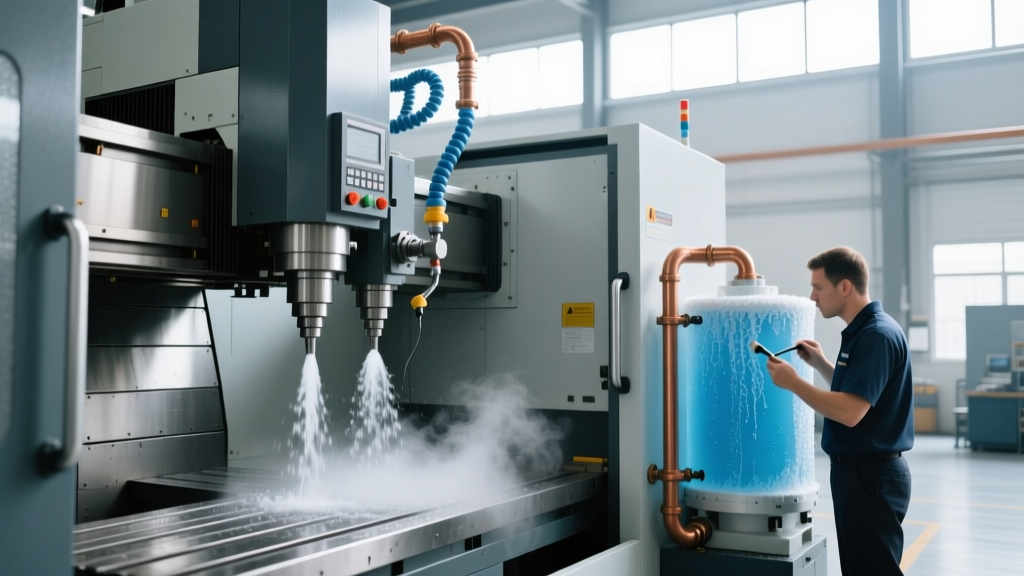
| Coolant Pump Trips Breaker | Coolant separated and solidified into a rubbery mass, locking the impeller. | Remove pump strainer. Attempt to spin impeller manually with pliers. | Drop sump, scrape tank, pressure wash. Replace pump seal kit. ($300–$600) |
Spindle Runout & Taper Fretting: The Hidden Auction Tax
A machine might cycle perfectly on the floor, but fail the moment you attempt to hold tight tolerances. Liquidated machines are frequently sold with tooling still locked in the spindle. Over months of storage, temperature fluctuations cause micro-movements between the tool holder and the spindle taper, resulting in severe fretting corrosion.
Inspecting the Taper and Drawbar
Do not rely on a visual inspection. You must quantify the spindle's mechanical integrity using precision instruments.
- Taper Inspection: Insert a certified CAT40 or BT40 Tool Holder Taper Inspection Gauge (such as those from Parlec or Techniks). Apply Prussian blue to the gauge. Insert and clamp. Upon removal, the blue transfer must show >85% contact area. If you see pitting or uneven wear rings, the spindle taper requires in-situ grinding by a specialist like Machine Tool Builders.
- Drawbar Retention Force: A weak drawbar will allow the tool holder to pull out during heavy roughing, destroying the spindle taper. Use a digital pull-force gauge. For a standard CAT40 spindle, the retention force must exceed 2,000 lbf. If it reads below 1,500 lbf, the Belleville washers inside the drawbar are fatigued or crushed. Rebuilding the drawbar stack is a standard $400 repair that saves a $10,000 spindle.
Expert Insight: When negotiating the final price of a liquidated CNC at auction, always factor in a mandatory $2,500 'resurrection contingency' per machine. This covers the inevitable costs of dead SRAM batteries, degraded way wipers, and fresh calibration. If the auction house claims the machine 'runs and makes parts,' demand a video of it executing a rigid tap cycle under load—idle air-cutting proves nothing about the Z-axis servo health.
Sourcing Obsolete Replacement Components
Liquidation auctions often offload older, highly capable workhorses from the late 1990s and early 2000s, such as Bridgeport VMCs with Heidenhain controls or older Mori Seiki lathes. Sourcing replacement parts for these machines requires bypassing the OEM, which may have discontinued the specific PCB or drive module.
The Secondary Component Network
Instead of waiting 12 weeks for an OEM retrofit kit, leverage specialized industrial repair houses. Companies like Fanuc America offer certified exchange programs for older Alpha series drives, but for out-of-production components, independent repair facilities are your best route.
- Control Boards & Drives: Facilities specializing in industrial electronics can repair trace burns on Yaskawa and Mitsubishi spindle drives for roughly 30% of the cost of a remanufactured unit. Turnaround time is typically 5 to 7 days.
- Hydraulic & Pneumatic Manifolds: Older machines utilize custom hydraulic blocks for the tool clamping cylinder. If a seal blows and the manifold is cracked, do not replace the whole assembly. Machine a new aluminum block locally using the original as a template, and integrate modern SMC pneumatic valves for faster, more reliable tool changes.
- Megger test all 480V motors and transformers (>100 MΩ).
- Hot-swap control batteries to preserve absolute encoders and parameters.
- Flush and replace varnished way lube; verify metering unit weeping.
- Test spindle taper contact area (>85%) and drawbar pull force (>2,000 lbf).
- Verify ball screw backlash with a dial indicator (Target: <0.0002" deviation).
Successfully navigating the secondary equipment market requires more than just capital; it demands a rigorous, systematic approach to mechanical and electrical troubleshooting. By applying these targeted repair strategies, you can transform a neglected liquidation asset into a high-precision production engine, maximizing your ROI in a competitive manufacturing landscape.