Machine Tool Leasing vs Buying Used: Inspection Checklist & Cost Analysis
Compare machine tool leasing against buying used CNC equipment. Includes a detailed inspection checklist, hidden cost analysis, and budget frameworks.
The CapEx vs. OpEx Dilemma in Modern Machine Shops
Acquiring CNC equipment requires navigating a complex financial landscape. Shop owners must choose between the immediate capital expenditure (CapEx) of purchasing used machinery and the operational expenditure (OpEx) model of machine tool leasing. While buying a depreciated asset like a 2018 Mazak VCN-530C or Haas VF-2SS might appear cheaper on paper, the hidden costs of mechanical degradation, obsolete control systems, and unplanned downtime frequently erode the initial savings. Conversely, machine tool leasing preserves working capital and guarantees uptime through OEM warranties, albeit at a higher total nominal cost.
Core Financial Framework
Buy Used: Optimal when you possess in-house maintenance expertise, have surplus cash reserves, and can thoroughly vet the machine's mechanical history.
Machine Tool Leasing: Optimal when cash flow preservation is critical, production uptime is non-negotiable, and you require the latest high-speed machining capabilities without taking on depreciation risk.
Machine Tool Leasing vs. Buying Used: The Decision Matrix
Before deploying an inspection team to evaluate a used machine, evaluate your shop's operational profile against this decision matrix. If your shop scores heavily on the right column, machine tool leasing is likely the superior financial instrument.
| Evaluation Criteria | Buy Used Equipment | Machine Tool Leasing |
|---|---|---|
| Cash Flow Impact | High immediate CapEx drain; depletes working capital. | Predictable monthly OpEx; preserves credit lines. |
| Maintenance Risk | 100% borne by buyer; high risk of spindle/drive failure. | Covered by OEM warranty; predictable budgeting. |
| Technology Obsolescence | High risk; older controls lack modern look-ahead processing. | Zero risk; upgrade to new models at lease end. |
| Tax Treatment | Section 179 deduction or MACRS depreciation. | Lease payments often fully deductible as operating expense. |
The Definitive Used CNC Inspection Checklist
If your budget analysis dictates that purchasing a used machine is the correct path, you must mitigate risk through rigorous physical inspection. Do not rely on broker assurances or video demonstrations. Deploy this checklist on-site.
1. Mechanical & Geometric Accuracy (The Spindle & Ways)
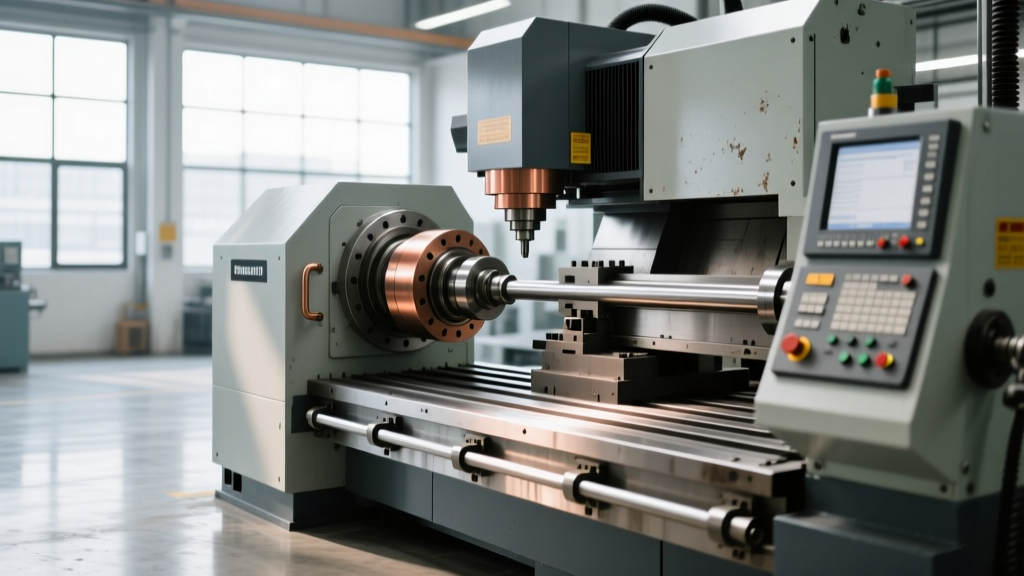
The mechanical heart of any CNC mill or lathe dictates its ability to hold tolerances. Wear in these areas is expensive to rectify.
- Spindle Runout Test: Mount a 0.0001-inch resolution dial indicator on a magnetic base. Measure the internal taper and the tool holder flange face. Acceptable runout for a standard VMC is under 3 microns (0.00012 inches). Anything above 5 microns indicates worn spindle bearings, which cost $8,000 to $15,000 to rebuild.
- Ballbar Circularity Test: Utilize a wireless system like the Renishaw QC20-W ballbar to test circular interpolation. This diagnostic tool identifies backlash, stick-slip, and servo mismatch in under 10 minutes. Look for circularity errors below 10µm.
- Way Cover & Gib Inspection: Retract the axes fully to inspect the telescopic way covers. Torn bellows or dented steel covers allow abrasive swarf into the linear guideways or box ways, causing catastrophic wear. Check the axis gibs for excessive play by applying lateral force to the table with a dial indicator engaged.
2. CNC Controller & Electrical Cabinet Health
Electrical failures cause more unplanned downtime than mechanical ones. Open the main electrical cabinet and inspect the following:
- Servo Drive Capacitors: Inspect the DC bus capacitors on the servo amplifiers (especially on older Fanuc or Yaskawa drives). Bulging, leaking, or crusty residue on the capacitors indicates imminent failure. Replacing a full set of servo drives on a 3-axis mill can exceed $12,000.
- Control Battery & Parameters: Verify when the absolute pulse coder batteries were last changed. Demand a full CNC parameter backup and macro program copy on a USB drive before finalizing the purchase. Rebuilding lost parameters on a 10-year-old machine can take weeks of OEM support time.
- Relay and Contactor Wear: Look for pitting or carbon scoring on the main spindle contactors and coolant pump relays. These are high-cycle components that fail without warning.
'Never buy a used 5-axis machine without a full volumetric laser interferometer test. The geometric stacking errors in the trunnion table or swivel head will ruin your aerospace tolerances, and retrofitting kinematic compensation software is often cost-prohibitive on out-of-warranty machines.'
— Senior Applications Engineer, 5-Axis Integration Specialist
3. Coolant, Lubrication, and Chip Management
- Way Lube Distribution: Cycle the automatic way lubrication pump. Verify that oil is physically weeping from all distribution nodes on the X, Y, and Z axes. Dry ways lead to rapid stick-slip degradation.
- Coolant Tank & Pump: Inspect the coolant sump for heavy sludge buildup, which indicates poor maintenance and can clog the high-pressure through-spindle coolant (TSC) pump. A replacement 1000 PSI TSC pump costs upwards of $6,500.
Total Cost of Ownership (TCO): Hidden Costs Breakdown
To accurately compare buying used against machine tool leasing, we must model the 5-year Total Cost of Ownership. Below is a real-world financial model comparing the acquisition of a used 2018 Haas VF-2SS versus leasing a brand-new 2026 equivalent model.
| Cost Category (5-Year Horizon) | Buy Used (2018 VF-2SS) | Machine Tool Leasing (New VF-2SS) |
|---|---|---|
| Initial Acquisition / Down Payment | $95,000 (Outright Purchase) | $12,000 (First & Last + Security) |
| Monthly Payments (60 Months) | $0 | $144,000 ($2,400/mo) |
| Rigging & Installation | $3,500 | $3,500 |
| Unplanned Repairs (Spindle/Drives) | $14,000 (Est. 1 major failure) | $0 (Covered by Warranty) |
| Preventative Maintenance & Fluids | $6,000 | $4,500 |
| Energy Consumption (Newer is efficient) | $11,000 | $8,500 |
| Total 5-Year Cash Outlay | $129,500 | $172,500 |
| Working Capital Retained | $0 | $83,000+ |
While the used machine saves roughly $43,000 in nominal cash outlay over five years, the machine tool leasing route retains over $83,000 in working capital on day one. For a job shop operating on tight margins, that retained capital can be deployed into raw materials, marketing, or hiring skilled programmers, often yielding a higher ROI than the equipment savings.
Tax Implications: Section 179 and Lease Deductions
The tax treatment of your acquisition heavily influences the true cost. According to the IRS guidelines on Section 179, businesses can deduct the full purchase price of qualifying new and used equipment from their gross income. However, the deduction is capped annually and phases out after a certain spending threshold.
Conversely, machine tool leasing—specifically operating leases or Fair Market Value (FMV) leases—allows shops to deduct the entire monthly lease payment as an ordinary business expense. This bypasses the Section 179 spending caps entirely. The Equipment Leasing and Finance Association (ELFA) frequently publishes data showing that mid-sized manufacturers leverage FMV leases to keep their balance sheets unencumbered, maintaining better debt-to-equity ratios for future real estate or facility expansion loans.
Structuring the Lease: FMV vs. $1 Buyout
If you choose machine tool leasing, you must select the correct end-of-term structure:
- Fair Market Value (FMV) Lease: Offers the lowest monthly payments. At the end of the 36 to 60-month term, you can return the machine, upgrade to a newer model, or purchase it at its appraised fair market value (typically 10% to 15% of original MSRP). Best for shops that want to constantly upgrade to the latest high-speed spindles and controls.
- $1 Buyout (Capital) Lease: Monthly payments are 15% to 20% higher than FMV, but you own the machine outright for $1 at the end of the term. Best for heavy-duty, slow-depreciating assets like large CNC lathes or horizontal boring mills where the mechanical lifespan far exceeds the lease term.
Final Verdict: Aligning Equipment Acquisition with Cash Flow
Buying used CNC equipment is a viable strategy only if you have the technical acumen to execute the inspection checklist flawlessly and the financial reserves to absorb a $15,000 surprise spindle rebuild. If your shop relies on just-in-time delivery, operates with lean cash reserves, or requires the latest 5-axis kinematics to win aerospace contracts, machine tool leasing transitions equipment acquisition from a high-risk capital gamble into a predictable, tax-advantaged operational expense.