CNC Retrofit Safety: Guarding Machining Cutting Tools on Manual Mills
Explore ANSI and OSHA compliance for manual CNC retrofits. Learn how to safely guard machining cutting tools, wire interlocks, and upgrade enclosures.
The Hidden Hazards of Manual-to-CNC Conversions
Converting a manual Bridgeport Series I knee mill or a South Bend Heavy 10 lathe to CNC operation using modern controller kits from Centroid, FlashCut, or Mach4 is a highly effective way to increase production capability in 2026. However, bolting servo motors and precision ball screws onto legacy iron fundamentally alters the machine's risk profile. Manual machines rely on the operator's physical proximity, sensory feedback, and immediate reflexes via handwheels. CNC automation removes the human from the immediate control loop.
This operational shift means machining cutting tools now operate at sustained maximum feeds, deeper axial engagements, and higher RPMs without a human hand on the quill lever. If a carbide end mill shatters or a workpiece breaks free from a vise, the kinetic energy exceeds the design limits of original 1970s cast-iron guards. Upgrading your machine's motion control without simultaneously upgrading its safety architecture violates core tenets of OSHA 1910.212 General Requirements for All Machines and exposes the shop to severe liability.
Compliance Warning: Under OSHA enforcement guidelines, modifying a machine's control system to allow automated, unattended operation classifies the retrofit as a "new machine" integration. The entire system must be brought up to current ANSI B11.8 (Milling, Grinding, Drilling) and ISO 12100 risk assessment standards, regardless of the base casting's manufacture date.Containment Strategies for High-Speed Machining Cutting Tools
Manual machine operators typically use lightweight acrylic or PETG splash guards to keep coolant off their aprons. When transitioning to CNC, these materials become dangerous liabilities. Automated toolpaths frequently push machining cutting tools to their mechanical limits, increasing the probability of tool fracture. A shattered 3/4-inch solid carbide roughing end mill traveling at 8,000 RPM possesses enough kinetic energy to penetrate standard acrylic, causing catastrophic lacerations or blindness.
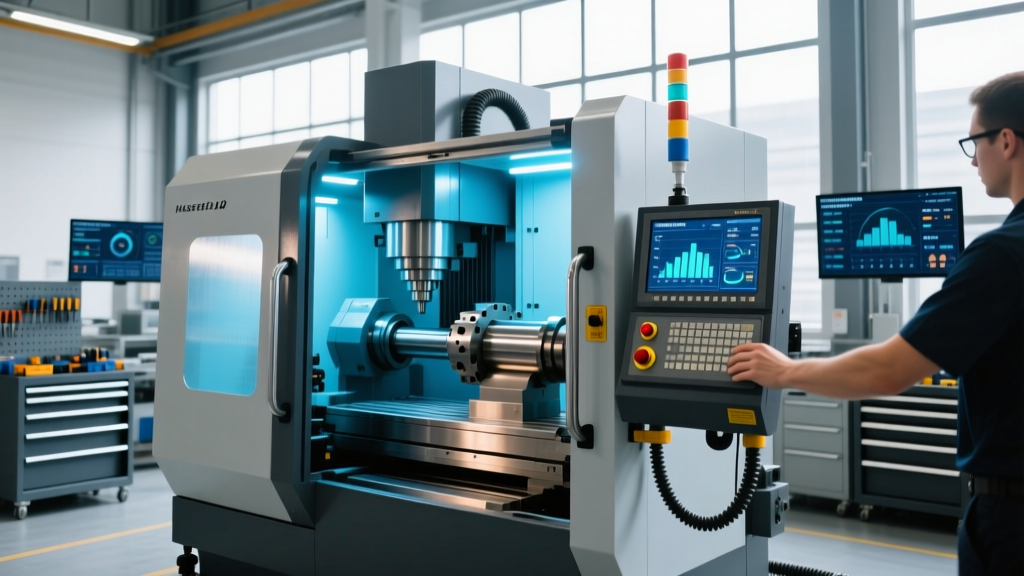
Proper containment requires engineered polycarbonate with specific thickness and mounting criteria. The shield must be mechanically fastened to the machine's primary casting—not just bolted to sheet metal way covers—to absorb impact shock.
| Shielding Material | Impact Resistance | Coolant/Chemical Resistance | CNC Retrofit Suitability |
|---|---|---|---|
| Acrylic (PMMA) | Poor (Shatters into sharp shards) | Excellent | Banned for high-speed CNC containment |
| PETG | Moderate (Cracks under high impact) | Good | Acceptable only for low-RPM lathe splash guards |
| Polycarbonate (Lexan) | Excellent (Deforms, does not shatter) | Poor (Degrades with synthetic coolants) | Requires 0.250" minimum thickness; must be replaced every 3-5 years |
| Polycarbonate (Margard coated) | Excellent | Excellent (Chemical resistant coating) | Industry Standard for CNC mill and lathe enclosures |
For a standard knee mill retrofit, fabricating and mounting a 0.250-inch Mar-guard coated polycarbonate enclosure with aluminum extrusion framing typically costs between $800 and $1,400 in 2026. This is a non-negotiable expense for shops employing personnel or running job-shop contracts requiring ISO 9001 compliance.
Interlock Systems and Defeat Prevention
Enclosures are useless if operators can open them while the spindle is engaged. ANSI B11.8 mandates that access doors to the machining envelope be equipped with interlocks that remove power to the spindle drive and halt axis motion when opened.
The Danger of Magnetic Reed Switches
Many budget CNC retrofit tutorials recommend using cheap magnetic reed switches for door interlocks. This is a severe compliance violation. Reed switches are easily defeated by an operator taping a spare magnet to the sensor, bypassing the safety circuit while the door is open. OSHA inspectors actively look for defeated interlocks, and incidents involving bypassed safety switches routinely result in willful violation citations exceeding $150,000 per instance.
Expert Specification: Use RFID-coded, non-contact safety switches such as the Schmersal AZM201 or the Euchner MGB2. These units require a unique, cryptographically paired RFID actuator. They cannot be defeated by standard magnets, screwdrivers, or tape. Budget approximately $250 to $400 per door for compliant RFID interlock hardware.Electrical Enclosure and E-Stop Wiring Standards
Retrofitting a manual machine involves mounting a new electrical cabinet to house the VFD (Variable Frequency Drive), servo drives, and CNC controller. This cabinet must comply with NFPA 79: Electrical Standard for Industrial Machinery.
Category 3 / Performance Level d (PLd) E-Stop Circuits
A common mistake in DIY and small-shop retrofits is wiring the Emergency Stop button directly into the CNC controller's software input or in series with the main 120V control power. If the software crashes or a relay welds shut, the E-stop fails to remove hazardous energy.
Compliant E-stop circuits require a dual-channel architecture monitored by a dedicated safety relay, such as the Pilz PNOZ X3 or Omron G9SA.
- Channel 1 & 2: The E-stop button must contain two separate, mechanically linked normally-closed (NC) contacts wired to the safety relay.
- Spindle Contactor: The safety relay outputs must physically drop power to the main spindle contactor and servo drive enable circuits.
- Feedback Loop: The safety relay must monitor the contactor's auxiliary contacts to ensure the main power circuit actually opened. If a contactor welds shut, the safety relay locks out and prevents the machine from restarting.
Implementing a monitored, dual-channel E-stop system adds roughly $350 to $600 to the electrical bill of materials but is the primary defense against catastrophic runaways.
Step-by-Step Safety Validation Checklist
Before running the first automated G-code program on a retrofitted manual machine, the integrator or shop owner must complete and document the following validation protocol to satisfy OSHA machine guarding requirements and internal liability insurance audits:
- Static Containment Check: Verify all polycarbonate shields are fastened with steel hardware (not zip-ties or self-tapping screws into plastic) and that hinges are rated for the door's weight plus dynamic vibration.
- Interlock Defeat Test: Attempt to defeat the door interlock using a neodymium magnet and a steel spacer. The machine must remain in a safe state.
- E-Stop Functional Drop Test: Run the spindle at maximum RPM (e.g., 8,000 RPM) and hit the E-stop. Measure the coast-down time. Verify that the VFD dynamic braking engages and that axis servo drives immediately drop torque.
- Ground Continuity Verification: Use a milliohm meter to verify that the machine casting, the vise, the new electrical enclosure, and the polycarbonate frame all share a continuous ground path back to the main facility earth ground, preventing static buildup and shock hazards from coolant pumps.
- Way Cover Integrity: Ensure telescoping way covers are installed on the X and Y axes. CNC rapids (often 100-200 IPM on retrofitted knee mills) will instantly destroy exposed dovetail ways via chip ingress, leading to axis binding and potential workpiece ejection.
The ROI of Compliance
A fully compliant safety upgrade for a standard manual-to-CNC knee mill retrofit costs between $1,400 and $2,800 in parts and fabrication. While this represents a 20% to 30% premium over the base motion-control kit, it transforms a hazardous prototype into a production-grade asset. In 2026, with manufacturing insurance premiums heavily weighted against shops with incomplete machine guarding documentation, treating safety as an engineered subsystem—rather than an afterthought—is the only viable strategy for sustainable CNC integration.